A new interactive website from NASA's Global Climate Change site gives the public the opportunity to "fly" with the fleet of Earth satellite missions and observe the planet from a global perspective, in a "three-dimensional" environment.
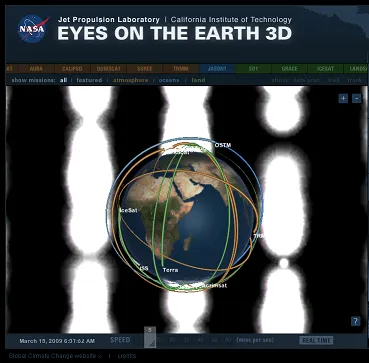
The web application shows the location of the current 15 Earth observation missions in real time. These missions constantly monitor Earth's vital signs, such as sea level, concentration of carbon dioxide in the atmosphere, global temperatures, among others.
Visitors to the site can observe the orbit of the satellites around the planet, either all together, by type (atmosphere, oceans, land) or select one of them.
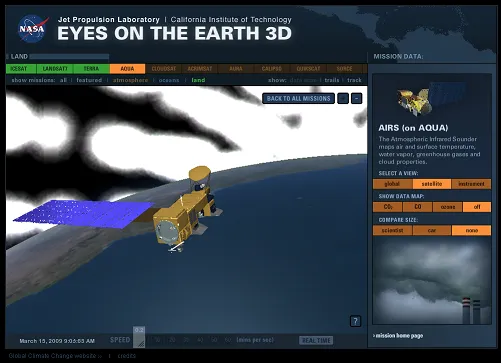
In this case, I chose the Aqua satellite. When selecting a mission, it is possible to view it in Global, Satellite, or Instrument mode.
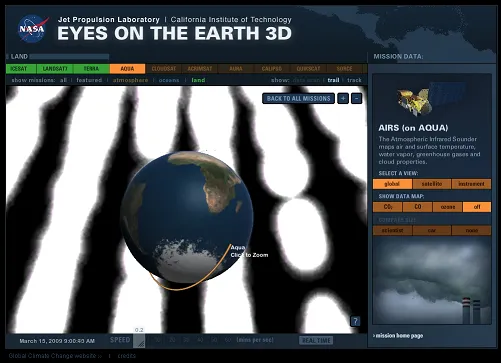
In this case, AIRS (Atmospheric Infrared Sounder) on Aqua is shown, a mission launched in 2002, which investigates the planet's water cycle. AIRS is one of the six instruments on board the satellite.
We can also see maps of the distribution of carbon dioxide (CO2), carbon monoxide (CO) or Ozone (ozone). For example, the carbon monoxide maps show the distribution (at a specific time, indicated in each case). The red and yellow regions indicate higher concentrations of CO, while the blue ones indicate areas of lower concentration. Below the planet view, on each map, a bar is shown indicating the concentrations.
And it is also possible to see the instruments that make it up and compare the satellite with a scientist or a car.
In the lower region, the speed (minutes per second) can be adjusted. At the top, the (+) and (-) signs allow you to increase or decrease the image. It is also possible to rotate the view with the mouse.
Below and to the right of the application you will find a link to the page of the mission shown.
"This novel web application gives the public an unprecedented perspective of our changing planet, as only NASA can do," said Michael Greene of JPL.
To access Eyes on the Earth 3D, visit:
http://climate.jpl.nasa.gov/Eyes/eyes.html
Sources and related links
About the images
The images are screenshots from the NASA site.