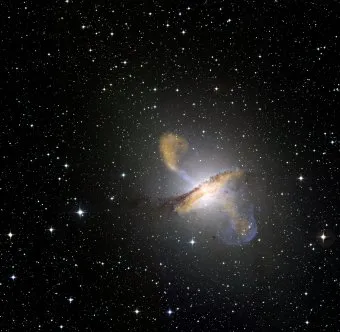
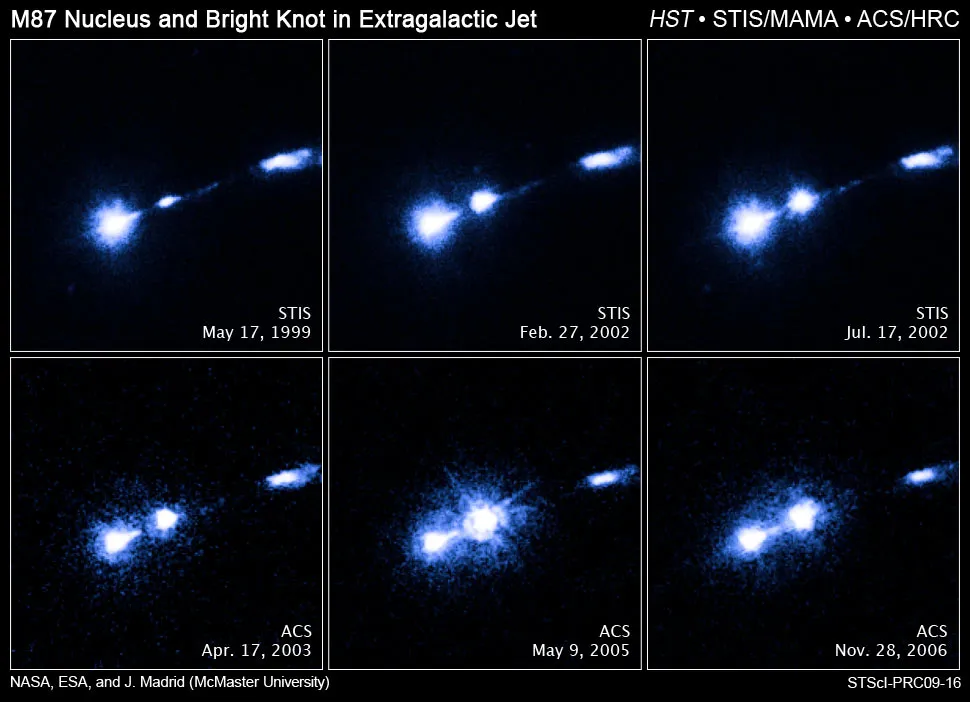
The Hubble Space Telescope witnessed an eruption of a matter jet from a monstrous black hole. The outburst comes from a bubble of gas, called HST-1, in a matter jet produced by a supermassive black hole that resides in the core of the giant elliptical galaxy M87.
HST-1 is so bright that it is shining brighter than the galaxy's core, whose black hole is one of the most massive discovered so far.
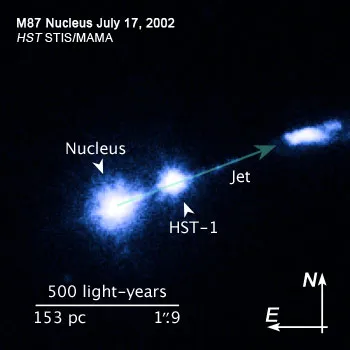
Astronomers observed a regular brightening of HST-1 for years, then it faded and later shone again. They say it is difficult to predict when it will happen again.
Hubble has monitored the surprising activity for seven years, generating the most detailed view in ultraviolet light of the event. Other telescopes have observed HST-1 at other wavelengths, including radio and X-rays. The Chandra X-ray Observatory was the first to report the brightening in the year 2000. HST-1 was discovered and named by Hubble astronomers in 1999. This knot of gas is 214 light-years from the galaxy's core.
The eruption could generate greater understanding of the variability of matter jets from black holes in distant galaxies that are difficult to study because they are so far away. M87 is located 54 million light-years away in the Virgo Cluster, a region of the nearby universe with the highest density of galaxies.
"I did not expect the jet in M87 or any other generated by the accretion of a black hole to increase in brightness the way this jet does," said astronomer Juan Madrid of McMaster University, Ontario, who led the study. "It grew in brightness 90 times more than normal. But the question is, does this occur for every individual jet or active nucleus, or are we seeing a rare behavior of M87?"
Despite the many observations by Hubble and other telescopes, astronomers are not sure what is causing the increased brightness. One of the simplest explanations is that the jet is colliding with a dust lane or a gas cloud and shines due to the shock. Another possibility is that the magnetic field lines of the jet are being tightened, releasing a large amount of energy. This phenomenon is similar to how solar flares develop and is a mechanism for creating auroras on Earth.
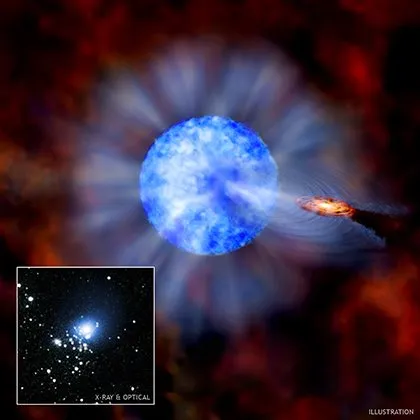
The disk around a rapidly rotating black hole has magnetic field lines that trap ionized gas falling into the black hole. These particles, along with radiation, flow rapidly away from the black hole along the magnetic field lines. The rotational energy of the accretion disk adds momentum to the matter jet.
Madrid assembled archive Hubble images of the jet to capture changes in the behavior of HST-1 over time.
The scientist found data in the telescope's spectrograph (STIS) that showed a remarkable increase in brightness between 1999 and 2001. In images from 2002 to 2005, HST-1 continued to increase regularly in brightness. In 2003 the gas knot was brighter than the luminous core of M87. In May 2005, HST-1 became 90 times brighter than in 1999. After May 2005, it began to fade, but intensified again in November 2006. This second outburst was weaker than the first.
"By observing the outburst for several years, I was able to follow the brightness and see the evolution of the eruption over time," noted Madrid. The scientist hopes that future observations of HST-1 will reveal the cause of its mysterious activity. "We hope the observations provide theories that give us good explanations about the mechanism that is causing the eruption. Astronomers will want to know if it is an intrinsic instability of the jet as it leaves the galaxy or if it is something else," he added.
Sources and related links
- HubbleSite: Hubble Witnesses Spectacular Flaring in Gas Jet from M87's Black Hole
- Hubble Space Telescope Observations of an Extraordinary Flare in the M87 Jet
Juan P. Madrid
The Astronomical Journal 137 3864-3868
DOI: 10.1088/0004-6256/137/4/3864
About the images
Credit: NASA, ESA, and J. Madrid (McMaster University)