Although we can theoretically imagine a black hole and there is evidence pointing to its existence, no one has seen a black hole. This could change in a few months.
Astronomers are working to link a network of microwave telescopes around the world to create a virtual instrument with the most precise vision to date. And they will point it at what is presumed to be a supermassive black hole at the center of our galaxy, called Sagittarius A* (Sag A*). Although partially built, the microwave eye has already produced an image of the galactic monster. In September, a team led by Shep Doeleman of the Massachusetts Institute of Technology, at the Haystack Observatory, published results that are almost good enough to show the reputed black hole (Nature, vol 455, p 78). We reported on this here in the note "A close look at the galaxy's black hole". Soon, Doeleman and his team hope to see the silhouette of the object accused of phagocytizing any matter that approaches it, including light. Furthermore, the team hopes to see matter falling into "the beast" to study the twisted space-time around it and thus learn about the formation and growth of these objects. These observations would also be one of the most severe tests of the general theory of relativity, which predicts the existence of these objects. What we know for sure is that something big is hiding at the center of our galaxy, since its powerful gravity affects the motion of nearby stars and gas. That something is about 4.5 million times the mass of our Sun, in an area the size of the inner solar system. There are few options for packing so much matter into such a small space. If they were 4 million suns, they would be easy to detect. A swarm of neutron stars or small black holes would be highly unstable. So the best chances seem to lie with a massive black hole. The Milky Way is not the only galaxy that hosts such a tenant. It is thought that most large galaxies have a supermassive black hole. In so-called active galaxies, enormous amounts of gas are falling into a black hole, forming a disk of hot matter around it that usually eclipses the billions of surrounding stars. Our own galactic monster is less fed, surviving on a thin mass of gas from nearby stars. As this gas falls toward the hole, it heats up and glows, although more weakly than the disk in an active galaxy. All kinds of electromagnetic radiation are emitted, from radio to X-rays. Of course, the black hole itself does not shine, so it is expected to be seen by the shadow that would form around it, drawing its silhouette, as the bright gas falls into the hole. Seeing this shadow is not easy. It will not have sharp edges because light and other radiation from the gas in front of the hole will still be seen. Furthermore, it will look very small. According to relativity, a black hole of 4.5 million solar masses should be 27 million kilometers in diameter, and although its gravity bends nearby light rays, making it appear twice as large, it will still be very small. From our distant point of view, that would cover an angle of only about 50 micro-arcseconds, the size of a soccer ball on the Moon. No ordinary telescope could see such a dark spot. Instead, Doeleman is using a well-proven technique called very long baseline interferometry (VLBI). By combining observations from antennas widely separated around the planet, radio astronomers can reconstruct what would be seen by a huge antenna, almost as large as Earth. Since small antennas collect less light, a VLBI image is less bright than one from an antenna that is actually the size of the world, but it can reveal the same details. Previous VLBI observations of the galactic center have been too blurry to see the giant's shadow. The problem is that we are trying to observe the most crowded part of the galaxy, where large amounts of gas scatter radio waves. "It's like a dense fog blurring the image of a streetlight," says astrophysicist Avi Loeb of Harvard University.
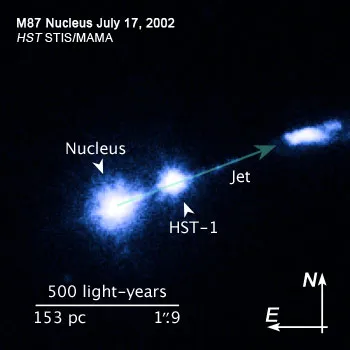
But still, the gas swirling around the black hole is opaque at most wavelengths, putting a veil over the shadow. And more fundamentally, the resolution depends on the wavelength of radiation observed, with longer wavelengths giving a vaguer image than shorter waves. Luckily, all these problems can be avoided if your telescope works at wavelengths of 1 millimeter. That short-wavelength radiation passes through the interstellar fog and the inner veil of gas. Furthermore, the resolution for a telescope with antennas separated by thousands of kilometers is sufficient, in theory, to see the shadow. In fact, the greater the antenna separation, the better. Doeleman's team adapted VLBI to work at a wavelength of 1.3 millimeters. In April 2007 they took their equipment to the telescopes in Arizona (SMT Telescope), California (CARMA) and Hawai'i (James Clerk Maxwell). The result was frustrating. They collected emissions from the central region of Sag A*, but they didn't have enough information to obtain an unambiguous image. "We have two models that fit the data," says Doeleman. In one, Sag A* looks like a donut with a hole in the middle, which could be the supermassive black hole. Unfortunately, their observations also matched a simple bubble of bright emissions, with no shadow of any black hole. Despite this, those observations are a strong signal that Sag A* really is a black hole. According to Avery Broderick of the University of Toronto, the results indicate that it almost certainly has an event horizon, a characteristic of black holes. An event horizon is a boundary inside which nothing escapes the black hole's gravity. Matter that crosses that boundary will definitely be swallowed by the giant object. Some theoretical alternatives to black holes, like so-called boson stars, would have physical surfaces instead of horizons. These surfaces would be heated by the falling gas. Together with Loeb and Ramesh Narayan of Harvard, Broderick analyzed Doeleman's results and says that if Sag A* has a surface it would be hot enough to shine with a regular emission of infrared light. Since that glow was never detected, they conclude that an event horizon lies there. But there could be loopholes in this argument, so it would be better to observe the hole directly, or its shadow. In April, Doeleman returned to Hawai'i. To improve sensitivity, he decided to try to use the signals from three telescopes together on Mauna Kea, instead of just one. After a few months of processing, the latest set of observations should, finally, reveal the shadow of the giant. The first blurry image would only be the beginning. Doeleman wants to move to a shorter wavelength, 0.87 millimeters. Meanwhile, more and more telescopes will be linked to get a more revealing view. The center of the microwave eye will be in the desert of Chile, where ALMA is being built. All its 66 antennas should be operational by 2012. In concert with other observatories around the planet, it should provide a much sharper image of Sag A*, as well as reveal a larger black hole in galaxy M87. Observations made at various wavelengths have revealed bursts of radiation from the gas around Sag A*. Using VLBI, Doeleman wants to see these eruptions in real time. Together, the observations could reveal something very precious to researchers about black holes: their rotation. Relativity indicates that a rotating black hole would create a swirl in spacetime, a phenomenon known as "frame dragging." Objects near the hole would be caught in this swirl and their motion would show how fast Sag A* spins. That, in turn, would give us clues about the past life of the hole, since its rotation depends on the amount of matter consumed to become as heavy as it currently is. Emanuele Berti of the University of Mississippi and Marta Volonteri of Michigan have calculated the effects of different "diets." Sag A* could have grown with a regular diet of galactic gas. Sharing the total rotation of the galaxy, the gas would have formed a disk spinning faster and faster as it approached the black hole, like water going down a drain. When the gas is finally swallowed, its rotation would be added to that of the hole. If Sag A* formed most of its weight that way, its rotation would be close to the maximum possible value that relativity allows. Or perhaps Sag A* grew by swallowing gas from nearby sources in random orbits. The random orientation of rotation of those sources could have canceled each other out, and thus the rotation of "the beast" would be low. Another possibility is that Sag A* grew in a hierarchical fashion, like the smaller galaxies that merged to form the Milky Way. Each galaxy would have brought its own black hole and then they would have merged to create the massive object. In Berti and Volonteri's simulation, that usually creates a hole with moderate rotation. Of course, all this assumes that Albert Einstein's general theory of relativity is correct. A century after its formulation, it remains the best theory of gravity and agrees precisely with observations of planetary orbits and gravitational lenses. But the theory has never been tested in the ultra-strong gravity near a black hole, where its predictions are most extreme. By mapping the shape of spacetime near the black hole one could distinguish between relativity and other competing theories developed to explain the anomalous motions of stars and galaxies, more commonly attributed to dark energy and dark matter. What if Doeleman's latest observations, made last month, show something strange? "Then we'll have a problem," says Broderick. It could be that relativity is radically wrong when it comes to extreme gravity environments. And the monster at the center of the galaxy would be more shadowy than thought. Other black holes In galaxy M87 there is a truly large black hole, more than 3 billion times the mass of the sun. Radio astronomers hope to be able to zoom in on this giant not only to see the black shadow of the event horizon, but to find the origin of a huge jet of matter coming out of it. At about 60 million light-years, M87 is 2000 times farther than Sag A*, so, although it is several hundred times the diameter of our own galactic black hole, it appears one-third its size. That implies, for the moment, that we cannot see it clearly with VLBI technique. That will change with ALMA. "This will bring M87 within range of VLBI artillery," says Shep Doeleman. The next two candidate black holes are in the Sombrero galaxy and Centaurus A, at 30 million and 12 million light-years, respectively. Their shadows would appear much smaller than that of the hole in M87 and could be beyond the power of current radio astronomy. However, a space mission called Black Hole Imager has been proposed, which would use X-rays instead of radio waves. Two or more X-ray telescopes flying in formation could, in theory, provide sufficient resolution. The project, if it moves forward, would only materialize after 2030, if an aggressive technological program is developed. Sources and related links
- Translation of the article: Coming soon: First pictures of a black hole by Stephen Battersby
- Event-horizon-scale structure in the supermassive black hole candidate at the Galactic Centre Sheperd S. Doeleman et al. Nature 455, 78-80 (September 4, 2008) DOI:10.1038/nature07245
- Broderick, A.E. & Loeb, A. 2009, Scientific American (To be published) Shedding Light on Darkness: Imaging Black Hole Silhouettes
- Broderick, A.E. & Loeb, A., 2008, ApJ (Submitted) Imaging the Black Hole Silhouette of M87: Implications for Jet Formation and Spin
- Broderick, A.E., Fish, V.L., Doeleman, S.S. & Loeb, A., 2008, ApJ (Submitted) Estimating the Parameters of Sgr A*’s Accretion Flow Via Millimeter VLBI
- Fish, V.L., Broderick, A.E., Doeleman, S.S. & Loeb, A., 2008, ApJL (Submitted) Using Millimeter VLBI to Constrain RIAF Models of Sagittarius A*
- Doeleman, S.S., Fish, V.L., Broderick, A.E., Loeb, A. & Rogers, A.E.E., 2008, ApJ (Submitted) Methods for detecting flaring structure in Sagittarius A* with high-frequency VLBI
- Reid, Mark J., Broderick, A.E., Loeb, A., Honma, M. & Brunthaler, A., 2008, ApJ, 682, 1041 Limits on the Position Wander of Sgr A*
- Broderick, A.E. & Loeb, A., 2006, MNRAS, 367, 905 Imaging Optically-Thin Hot Spots Near the Black Hole Horizon of Sgr A* at Radio and Near-Infrared Wavelengths
- Broderick, A.E. & Loeb, A., 2006, ApJL, 636, 109 Frequency –dependent Shift in the Image Centroid of the Black Hole at the Galactic Center as a Test of General Relativity
- Broderick, A.E. & Loeb, A., 2005, MNRAS, 363, 353 Imaging bright-spots in the accretion flow near the black hole horizon of Sgr A*
- Toronto:Imaging black holes
- The galaxy's black hole, closer
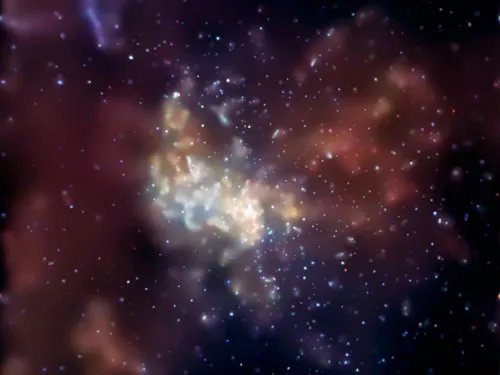
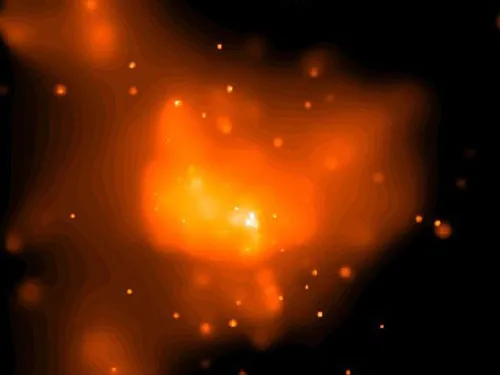
About the images The supermassive black hole Saggitarius A*, seen by the Chandra X-ray Observatory. Credit:NASA/MIT/F. Baganoff et al. chandra.harvard.edu/photo/2005/sgra/