The launch of both missions was postponed by the European Space Agency (ESA) upon finding an anomaly during tests, so Arianespace decided to carry out additional checks that will take a few days.
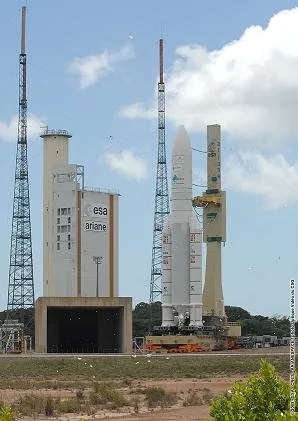
A new launch date will be announced shortly by ESA. The two satellites are in perfect condition in Kourou.
Both missions will be launched by an Ariane 5 rocket. The original program implied a planned launch date of May 6.
During the last few days, the spacecraft had been fueled, Herschel first, between April 10 and 11 and Planck between the 15th and 16th also of this month.
Planck's objective will be to map the anisotropies of the cosmic microwave background radiation with improved sensitivity and angular resolution. Its goals include determining the Hubble constant, testing cosmological inflation models, and measuring the amplitude of structures in the cosmic microwave background radiation.
Herschel, for its part, will study the formation of galaxies in the early universe. It will investigate the creation of stars and their interaction with the interstellar medium. It will observe the chemical composition of the atmospheres and surfaces of comets, planets, and satellites, and will examine the molecular chemistry of the universe.
The news was initially disseminated by a Tweet from Astronautics.
Sources and related links
About the images
Ariane 5 is moved to the launch zone at the spaceport in French Guiana. Credit: ESA/CNES/ARIANESPACE/Activite Photo Optique Video CSG
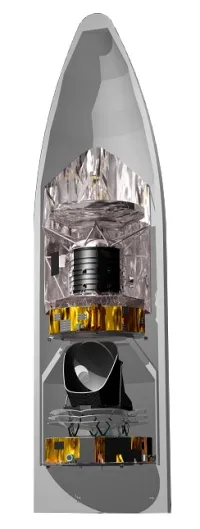
Planck (below) and Herschel (above) in the dual launch configuration on the Ariane 5 ECA rocket. Copyright: 2004: ESA, Alcatel Space, Arianespace