STAGES is a survey to investigate the evolution of galaxies through the A901/902 supercluster. The provided images include an 80-image mosaic containing 60 thousand galaxies and can be 'navigated' interactively.
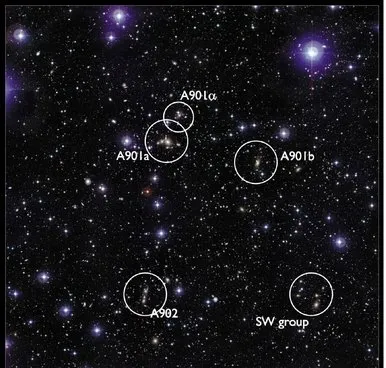
The study's name comes from 'Space Telescope A901/902 Galaxy Evolution Survey'. The team obtained observations of a complex system of superclusters called Abell 901/902. This supergrouping consists of three Abell clusters and related groups and filaments that make up a large piece of large-scale structure ideal for studying the relationships between environment and galaxy evolution.
It is a multi-wavelength survey, from X-rays to radio, including a Hubble Space Telescope mosaic covering the entire 0.5x0.5 degree extent of the structure.
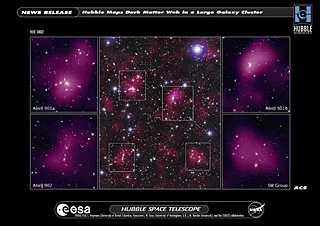
By examining all aspects of the environment, the team aims to determine the relative importance of dark matter halos, local galaxy density, and hot X-ray gas, in transforming galaxies.
Connecting galaxies with their environment
Galaxy clusters are the 'big cities' of the universe: places where hundreds or thousands of galaxies are gradually drawn in by the inexorable force of gravity. Orbiting each other like a swarm of bees, the galaxies in these regions look similar. There is a relationship in the morphological density of galaxies whereby galaxies that live in crowded regions are, in general, elliptical groupings of stars, while those that live in more isolated regions tend to be spirals, like the Milky Way.
Shape is not the only property that varies with environment. Astronomers found that the color of galaxies (blue or red), the amount of star formation (vigorous or nonexistent) and whether or not they possess an active galactic nucleus, also depend on the environment in which they live. Observational data suggests that galaxies in the densest regions tend to be older, rounded, and with little or no star formation.
How did this scenario occur? One option is that those galaxies in denser regions formed first and thus are older and more boring. On the other hand, one or several aspects of the environment could have actively transformed the galaxies. It is the old question: Are you born or made? That is, the dichotomy between inheritance and environment.
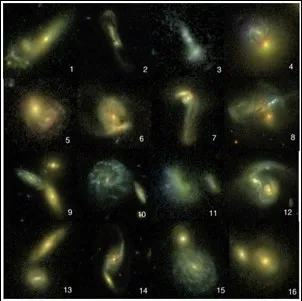
The external forces that can alter galaxies appear to be: the number of neighbors, the amount of hot gas and the amount of dark matter in the surroundings. Another variable is how big the galaxy is, since smaller galaxies seem to be the most likely to be affected by external forces, while the most massive ones appear more resistant to their local environment.
Galactic evolution in dense environments
To understand the importance of environment in galaxy evolution, the STAGES team says they have to be able to:
Study galaxies living in a wide range of environments (from isolated galaxies to the dense cores of clusters)
Investigate all aspects of the environment
Observe all properties of galaxies (such as their shape, color and star formation) and examine galaxies of all types, from the most massive to dwarfs.
That is where the STAGES survey of the Abell 901/902 supercluster comes into play:
The team selected a particularly interesting target and examined it in great detail using some of the most powerful telescopes on Earth and in space.
The work has observed the Abell 901/902 supercluster at many wavelengths. The figure below shows how different galaxies can appear when using telescopes sensitive to different types of radiation.
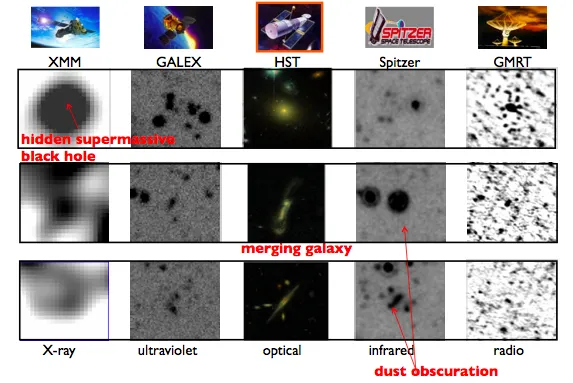
For example, star formation hidden behind a veil of dust may be invisible to Hubble but does not go unnoticed by the Spitzer Space Telescope. In the same way, with Hubble it is possible to detect a spectacular galaxy merger, which otherwise would appear as a fuzzy galaxy. To observe galaxies at different wavelengths, the STAGES survey used a variety of observatories such as the aforementioned Hubble and Spitzer, as well as XMM-Newton, COMBO-17, 2df, GALEX, GMRT and computational models.
The STAGES mosaic from the Hubble Space Telescope is made up of 80 images taken with the Advanced Camera for Surveys and covers an area approximately the size of the full moon in the sky. By digitally combining them, the final image consists of more than 5 billion pixels and contains images of 60 thousand galaxies.
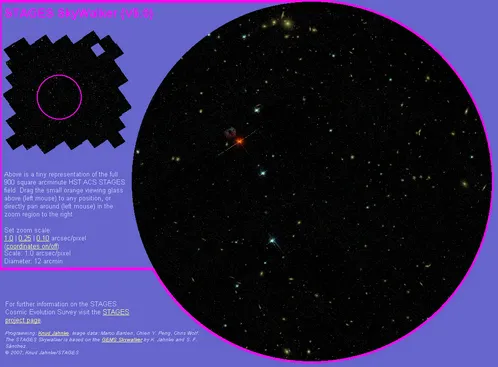
To be able to enjoy the beauty of these images interactively, the Skywalker tool was developed.
The tool shows a small image representing the entire STAGES Hubble field (900 square arc-minutes) and a main circular image. In the small image there is a circle that we can move with the mouse and thus 'navigate' the field shown in the main circle. It is also possible to move around that main circle with the mouse and change the zoom scale. Additionally, pressing the 'Coordinates on/off' option will show or hide the coordinates (right ascension and declination). The first image illustrating this note is a screenshot of Skywalker.
To access it, go to:
http://www.mpia.de/homes/jahnke/skywalker/swstages/swstagesV5.0.html
Also, on the site you can see other images of interacting galaxies and clusters.
The study allowed for a detailed map of dark matter in this supercluster. The details are told in "The Violent Life of Galaxies".
Sources and related links
- STAGES page
- STAGES: Environmental Drivers of Galaxy Evolution
Gray, M.
Cosmic Frontiers ASP Conference Series, Vol. 379,
proceedings of the conference held 31 July-4 August 2006 at Durham University, Durham, UK. Edited by Nigel Metcalfe and Tom Shanks., p.265
NASA ADS - STAGES: the Space Telescope A901/2 Galaxy Evolution Survey
M. E. Gray et al.
arXiv:0811.3890v1
About the
images
Credit:M. Barden, C. Peng, C. Wolf and the STAGES team.