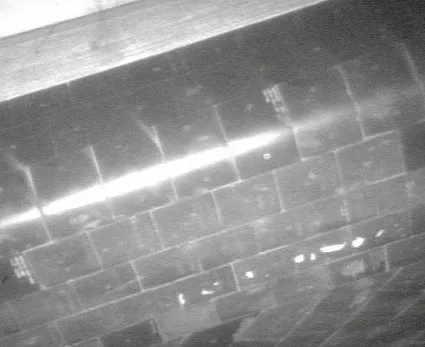
A batch of raw images from old NASA missions shows fast lights and strange objects in the sky. This footage, recently published on YouTube, is renewing UFO conspiracy theories that the U.S. government is hiding its knowledge about interactions with extraterrestrial life. Here, two astronauts talk about NASA's alleged cover-up and what these clips really show.
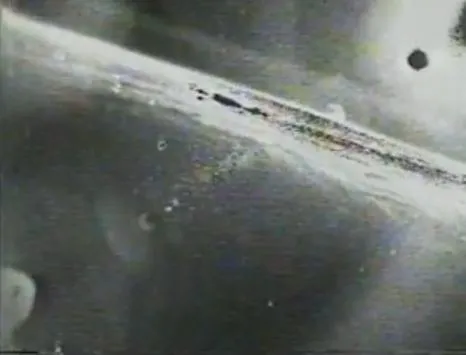
The scenario is like this: It's 1996; you are an astronaut and you are seeing an Unidentified Flying Object (UFO). You are gliding through space in low Earth orbit, watching this alien craft dance around your video camera. You are not alone: there are other astronauts aboard the space shuttle and mission control is watching the same thing from Houston. Yet, not a single voice or mention of E.T. or UFO can be heard in this recording. Apparently, it's another routine encounter with alien life and another day in the life of a massive, long global cover-up by the space agency.
This is what is being told on the web, following a series of video clips on YouTube presented as evidence that aliens are among us. The footage covers a number of missions and a range of mysterious objects. Even one video shows an object that seems to transform from one shape to another while the cameraman films. If that weren't mysterious enough, at one point, a light crosses the scene. And this, accompanied by a title like: 'Will the U.S. Government finally admit there are aliens?'
Whether the U.S. government has anything to confess or not about alien findings, the truth is that the astronaut behind those particular shots has nothing to hide. Mario Runco was a mission specialist aboard the STS-77 mission, launched in May 1996. One of the crew's objectives was to deploy an experimental satellite, called the Passive Aerodynamically Stabilized Magnetically Damped Satellite Test Unit (PAM-STU). The PAM-STU was about the size of a trash can and was designed to test a new approach to satellite maneuverability, using the planet's magnetic field to make altitude adjustments, instead of using thrusters. The crew filmed the satellite for days, but in the clip uploaded to YouTube by Martyn Stubb, the PAM appears as a grain, a low-light enhanced in black and white. Its two Stimsonite reflectors—the same materials used on roads and on bicycle reflectors—capture the ambient light, and at one point they seem to merge into a single bright spot as the satellite turns face-on. 'The lights moving in the background are either isolated ground lights or stars, I think probably the latter,' says Runco.
In another clip, a view through a shuttle window shows lights crossing space, then reversing direction and escaping in a flash. The clip's title is 'UFO quickly take off on NASA video.' The reality, however, is less dramatic. Thomas Jones, former mission specialist and co-author of 'Planetology: Unlocking the Secrets of the Solar System', was on that mission, STS-80—also conducted in 1996—and provides a description of the footage. 'A few ice crystals or thruster residue in the near field are floating and are hit by a thruster plume and expelled from the scene.'
Supporters of the 'UFO conspiracy' tend to dismiss the official responses from NASA members, the Pentagon, or any other government agency, but according to Runco even if there were an active cover-up, no amount of coercion could prevent an astronaut—himself included—from confirming the sighting of an alien craft. 'If I thought it was an intelligent craft, I would be the first to say so,' said Runco. 'I would want the credit: Mario Runco was the first person in history to reliably document the existence of an extraterrestrial civilization. Why would I want to keep it secret?'
Neither Runco nor Jones have any illusions of dispelling the myths related to UFOs and NASA, particularly when people can collect material and adapt it. 'There's no way to stop people from using public domain footage for silly purposes,' says Jones.
Buzz Aldrin made statements, according to him taken out of context by television, related to UFO sightings. Also Edgar Mitchell, former astronaut, stated that he believed in a cover-up since Roswell, although he said he never saw an alien. Oh, Mitchell grew up in Roswell... Oh, and, although he seems to be against the worldwide cover-up conspiracy, he cannot reveal the details that privileged people like him have about it.
The odds of the existence of extraterrestrial life are very high, by virtue of the enormity of the universe and the number of stars that can host planets. Even the most skeptical Drake equations result in high chances that many advanced extraterrestrial civilizations exist. However, something very different from that is interpreting the lights or objects we don't understand, that seem strange or mysterious in the sky, as intergalactic contact.
Clearly, we see what we want to see.
Personally, I think, like Carl Sagan, that extraordinary claims require extraordinary evidence.
Update 2011:
The article above is based on the one published by Erik Sofge in Popular Mechanics: Footage in the Sky: The Truth Behind NASA's 'UFO' Videos, as noted below.
That note includes ideas I have about it, but at the same time it doesn't say everything I think. That's why I'm updating the post to include other concepts, following a series of comments and inquiries I've received by email:
For example, they tell me things like:
1-The article's title says it is 'The truth' about UFOs. How dare you appropriate the truth?
Yes, the title says 'The truth' and not 'THE Truth.' Obviously it is MY truth, a lowercase truth, subjective, personal. Does the reader seek THE Truth in a blog? In a book? Who has THE truth? It's obvious there is not ONE truth. It's NOT necessary to clarify it. If you read the article thinking it is THE truth, you should review your ideas.
2-You are part of a conspiracy network that tries to hide THE Truth.
I am not part of any network of any kind. I participate as a collaborator in some organizations, nothing secret, like Greenpeace and similar ones.
3-You are "anti-UFO", but you say that "The odds of the existence of extraterrestrial life are extremely high." That's a contradiction.
I don't see the contradiction. Yes, among the organizations I participate in is SETI. I collaborate financially and by running the SETI@Home application on my PC, as well as promoting from here its existence and the importance of conducting a systematic and scientific search for possible intelligent extraterrestrial life. And no, I don't believe that the sightings that occur are extraterrestrial spacecraft. I see no contradiction.
I wish they were, I wish we would discover life besides that which inhabits Earth. Even so, the consequences could be very varied. How would we react on Earth to such a discovery? But aside from that, it would be wonderful to discover other forms of life.
Between that desire, materialized in a collaboration of scientific search, and believing that anything is a non-human spacecraft, there is an enormous difference.
Let's think for a second about two things:
a-Most sightings are made by people who almost never raise their heads, who almost never look at the sky. Who, therefore, are unaware of the apparent transit of planets (like Venus, Mars and Jupiter) or of artificial satellites or the shapes of clouds.
Furthermore, images are taken at the moment the observer thinks they see "something weird." It's logical that, without preparation and most people not possessing super-specialized equipment, what is obtained is blurry, unclear, ambiguous.
Between both things, the resulting combo is not very indicative to then go on to believe that beings from other worlds are visiting us.
b-The closest star is about 4 light-years away. It's clear that in the Solar System there are no other forms of life, at least intelligent and developed ones. So we leave the Sun and look for other stars. The closest stellar system doesn't seem suitable either. [Addendum October 2012: A planet was found in that system, although it can hardly harbor life as we know it. It is possible, however, that there are more planets there.] But let's assume the data is not sufficient in this case. Any civilization that could inhabit Proxima Centauri would take 4 years to reach Earth if traveling at the speed of light.
Traveling at that speed doesn't seem possible, but it's not impossible, theoretically, to travel at a speed close to that limit.
Humans currently create spacecraft that reach speeds of what? To escape Earth's gravity requires a speed of 11 km/s. Using the gravity of objects in the Solar system, very high speeds have been achieved, however NASA's shuttles only reach 28,000 km/h!
4 light-years are 37,817,019,821,952 kilometers!!
In a shuttle it would take us 1,350,607,850 hours to travel, that is 154,178 years.
But, wait a second, is that the only option? No, we have sent spacecraft to the solar system that, propelled by the planets, achieved higher speeds. And it's possible that with future technology current records could be broken several times. If we hypothesize, with nuclear propulsion it would be possible to reach the closest stellar system in...85 years!
Now then, are we regularly visited by spacecraft from there? It doesn't seem like a good place, but if we think about the stellar system that perhaps is habitable, we would be talking about much greater distances (and the travel time would be proportionally greater too). So let's stick for the moment with this strange possibility. Do spacecraft travel from Proxima Centauri to Earth? Do they take 85 years to arrive? Or do they take much less? If the latter occurs, they evidently have technology incredibly superior to that of humans.
And then perhaps they come and go with different spacecraft (are they all the same or do they have different shapes?). Do they never land? Or do they land where NO ONE sees them?
Isn't there anything in all this that sounds off to you? Do you really think this is possible?
If you think yes, tell me, is it possible or are you sure? Do you realize the difference between the two things? It's possible that there is intelligent life out there, but are we sure that there is?
4-What happens is that you are a skeptic who doesn't believe in anything. A bitter person.
Skeptic, yes, just like you. Bitter, perhaps. Although the latter is better than being a "happy fool."
Why do I say "skeptic, just like you"?
Philosophically I consider myself agnostic, although religiously, atheist. Sometimes, when I know that someone who is a believer asks me what I think about it, I respond:
"I'm a little more atheist than you," I say with an ironic smirk.
Do you know why? Catholics are "atheists." They deny the existence of Zeus, Muhammad, Buddha, and all the other gods you can think of, except their own.
Jews are atheists. Atheists of the same gods as Catholics, that is, all of them, but a little more because they also don't believe in Jesus Christ, right?
And so on with the rest of the religions. Believers are atheists to almost all gods, except one.
I am a little more atheist still.
However, it's a way of responding only to highlight what others think. In reality I don't know if there is or isn't a god as some kind of being or beginning of everything. In contrast, I don't believe in the religious ideas about it (which add even physical and moral aspects) in the same way that I don't believe in Santa Claus.
Now then: I am a skeptic about UFOs, and I am a little more skeptical than many of those who do believe in UFOs, who are also skeptics of: fairies, goblins, angels, demons, werewolves, vampires, gnomes-elves, wizards, witches, ghosts, spirits, the abominable snowman, and a myriad of other similar claims.
Or not? Or does the person who believes in UFOs also believe in all those things? And in pink flying elephants too? Surely there are many things that the UFO believer does not believe. Do they have evidence to support that non-belief? NO, it's the other way around. Whoever says that pink flying elephants exist should be able to prove it. Or not?
Well then, prove that ETs are visiting us and you'll see me change my mind.
5-You are closed-minded. You don't admit that others think differently.
Well, the previous line goes in the opposite direction. Are you sure the closed-minded one is me?
6-But You ask for impossible proofs//But you ask for proofs when there are already a lot.
As I finished the article above: extraordinary claims require extraordinary evidence. The same applies to the flying pink elephant. Or will you believe such a claim if I show you a blurry photograph? And if it's not blurry, will you quickly believe, knowing that it's possible to edit an image and assemble objects with others in a photo and/or video?
Because Dumbo flies, but I realize it's a drawing, or do you think there really is an elephant that flies with its ears?
I demand extraordinary evidence in the same way you would for any other type of claim.
The sightings that exist so far, in many cases, rely on very questionable, very ambiguous static or moving images. And, as if that weren't enough, there are quite a few who have falsified photos and videos. In other cases, however, there are photos that are indeed genuine, but are they ET craft or satellites or airplanes or atmospheric phenomena?
It's very easy to be mistaken, especially when one "wishes" that such a thing were something else. Let's not believe any claim. Let's be demanding. It would be a wonderful, extraordinary discovery. If you believe there is a worldwide conspiracy to cover up the UFO phenomenon, think again. Who is manipulating whom? Is it a case of hiding the forest with one's hand, or is there nothing to hide?
7-But with so many testimonies, so many sightings, do you believe everyone is lying?
No, on the one hand there are many people who believe they have seen something strange and, in reality, it's a mistake. It's not about an object that is strange per se, but one that is strange to that person who doesn't usually look up and watch the sky.
There are people who do have that habit, who are in a better position to discern between an astronomical object, a human-made artifact, and something that doesn't fit into either of those categories. And they saw something they cannot explain. Perhaps it is, indeed, "something strange." The word "perhaps" implies a possibility, not a certainty. And I believe it's a minority of cases.
Of course, just one that is genuine is enough. But how can we know if a supposed sighting is genuine based only on testimony?
There are very credible people, who have not had a habit of lying, of deceiving, and who do know something about the movements of stars and planets, of satellites, and what they have seen they have not recorded in photos or videos. There is a story there that could be considered plausible given the trust that could be placed in the storyteller.
But: I now invite those same few people to evaluate the same claim as before: "I just saw a flying pink elephant." Will they believe me? I don't have a habit of lying or deceiving. I can discern between an elephant and an airplane. Is that enough?
8-So you CANNOT say that UFOs do NOT exist
Objects that cannot be identified are UFOs. It may be that someone cannot identify them due to a lack of knowledge, or it may be that someone who does have information cannot identify a sighted object as anything known.
This implies that some possibility exists that some ET craft has crossed our skies. I do not deny that possibility. But I take it as such and not as a certainty.
At least, until the day I myself sight something extremely striking and that I cannot explain in any way. There are people who say they have been through that situation. They may be telling the truth. I don't know.
But, especially in the current context, with technology that allows editing images and videos and promoting fraud quite easily, given the lying that has always accompanied human beings, it is better to have caution and skepticism towards extraordinary claims than to happily believe anything that is said. That is MY position.
Sources and related links
- Footage in the Sky: The Truth Behind NASA's "UFO" Videos
- Extraterrestrials on the Moon?
- First on the Moon: The Untold Story
About the images
Videos on Youtube. Screenshot.