In 2004 it was determined that the Sun and Earth are gradually moving apart, at a rate of 15 centimeters per year. A recent scientific article argues that it could be due to a similar process, related to tides, that is causing the Moon to be increasingly farther from home.
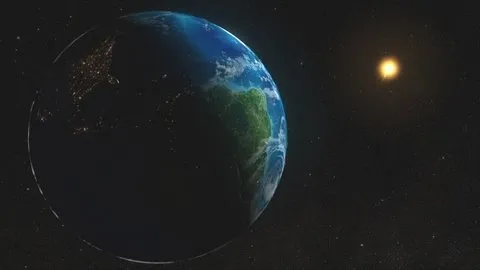
The Earth-Sun distance, calculated at 149,597,870.696 km, has its own name: astronomical unit. Formally, the measure is defined as the radius of an unperturbed circular orbit that a massless body would orbit around the Sun in 365 days (actually, in 2pi/k days, where k is Gauss's constant: 0.01720209895).
Gregoriy A. Krasinsky and Victor A. Brumberg measured an increase, confirmed by E. M. Standish, in the separation between the Sun and Earth, gradually, at a rate of 15 centimeters per year, but since that is much greater than the measurement error, something must be pushing Earth. But what?
One idea is that the Sun is losing mass, while other solutions could include a change in the gravitational constant G, the effects of cosmic expansion, and even the influence of dark matter.
For Takaho Miura and three colleagues from Hirosaki University, the effect is due to tidal interaction between the Sun and Earth.
It is the same process that is gradually moving the Moon's orbit away: the tides that the Moon produces in our oceans are gradually transferring Earth's rotational energy to the Moon's motion. As a consequence, each year the lunar orbit expands by about 4 centimeters and Earth's rotation slows by 0.000017 seconds. This is because angular momentum is conserved and thus, what the Moon gains, Earth loses.
In the same way, the team assumes that our planet is causing a small bulge to arise on the Sun. They calculate that, thanks to Earth, the Sun's rotation rate decays by 3 milliseconds per century. In other words, Earth's orbit expands because the Sun loses angular momentum.
You know, Earth: don't do to the Moon what you don't like the Sun doing to you!
Sources and related links
- Why Are We Moving Away from the Sun? by Kelly Beatty
- Secular increase of astronomical unit from analysis of the major planet motions, and its interpretation
Krasinsky, G. A.; Brumberg, V. A.
Celestial Mechanics and Dynamical Astronomy 90: 267–288, (2004)
DOI: 10.1007/s10569-004-0633-z - Transits of Venus: New Views of the Solar System and Galaxy
Contributed Papers
The Astronomical Unit now
E. M. Standish
Proceedings of the International Astronomical Union (2004), 2004:163-179 Cambridge
DOI:10.1017/S1743921305001365 - Secular increase of the Astronomical Unit: a possible explanation in terms of the total angular momentum conservation law
Takaho Miura et al.
Astronomy & Astrophysics
arXiv:0905.3008v1
About the images
Credit: NASA/Goddard