About our ability to find patterns even where there are none. Our senses deceive us, so "seeing reality" implies a constant exercise of criticism and knowledge.
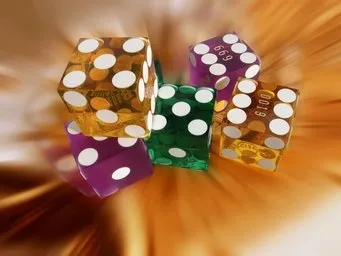
If you toss a coin in the air ten times and note whether it lands heads (x) or tails (y), which of the following sequences is more likely? xxxxxyyyyy or yyxxyxxyyx.
Phil Plait, the famous Bad Astronomy blogger, has a thing with Pareidolia, a phenomenon by which a random shape is perceived as a recognizable shape. This happens to us many times. Have you ever taken a Rorschach test and seen some recognizable shape in those "inkblots"? Well, there are people who believe they find images of divine figures anywhere. Or little green men on Mars.
That is why, on his blog, Phil refers us to think about randomness. Of course, both sequences (of the coins cited above) are equally probable, but we look at the second sequence and perceive that there is information there. We think that the "grouping" of heads and then tails in an orderly manner is not something "normal," a product of chance (or randomness). Surely, we think, the first sequence "was ordered" and the second we perceive as fortuitous.
Therefore, the concept of luck, chance, randomness is, to a large extent, a subjective definition, a perception.
In his post "Pareidolia poser," he shows us another example and refers us to another blog for more details. It is the blog "In the dark", by Peter Coles, a professor of theoretical astrophysics at Cardiff University. There, the author wrote the post "Random Thoughts: Points and Poisson (d’Avril)," where he comments on randomness, not from an ontological point of view but from the mathematical perspective of the term. These mathematical definitions are useful for creating models such as point processes, in which the random element is a "point" that occurs somewhere in time or space. These processes occur in a wide variety of contexts: arrival of buses at the station, photons in a detector, darts on a target, etc.
Suppose, he continues, we think of such a process occurring in time, although what follows can be generalized to things that occur in an area or a region of higher dimensions.
The "most random" way to construct a simple point process, also called a stochastic process, is to assume that each event occurs independently of any other and that there is a constant probability per unit time that an event occurs. This type of process is called a Poisson process, after the French mathematician Siméon-Denis Poisson, who derived a formula to give a number of random events if the probability of each is very low. The Poisson distribution expresses the probability of a number k of events occurring in a fixed time if these events occur with a known average rate and are independent of the time since the last event.
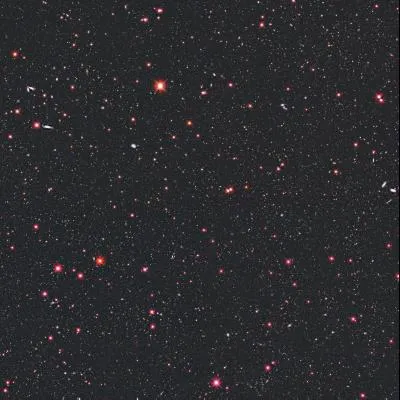
However, not all point processes are of the Poisson type. Points can be clustered in such a way that having a point at a given position increases the probability of having others nearby. For example, galaxies are distributed through space in a clustered pattern. But it is very difficult to say this just by looking at an image of galaxies and stars from the NDWFS survey that accompanies this paragraph. What is needed is a rigorous statistical analysis.
The statistical description of clustered point patterns is a fascinating topic, because it makes contact with the way our eyes and our brain perceive patterns. An example: let's look at the two patterns that follow:
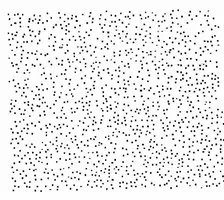
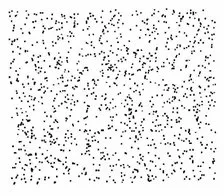
According to Peter, one of these is a realization of a two-dimensional Poisson process and the other contains correlations between the points. One, therefore, has a real pattern, and the other is a realization of a completely unstructured random process.
According to the author, he shows these examples in talks where he asks the audience which of the two is random. The vast majority usually think that the upper pattern is the random one and the lower one is the structured one. It is not difficult to see why. The upper pattern is very regular (what one naively expects for a constant probability of finding a point at any position in a two-dimensional space), while the lower one seems to offer a profusion of filamentary elements and concentrated groups.
In fact, the lower image was generated by a Poisson process using a Monte Carlo random number generator. The apparent structures in the image are imposed by our sensory apparatus, which has evolved to be so good at recognizing patterns that it finds them even when they are not there!
The upper process was also generated by a Monte Carlo technique, but the algorithm is more complicated. In this case, the presence of a point at a location suppresses the probability of having other points in the neighborhood. Each event has an avoidance zone around it, the points are anticorrelated. The result is a much more regular design than we would get in a truly random process.
The tendency to find things that are not there is well known to astronomers. The constellations that are easily recognized are not physical associations of stars, but alignments in the sky of stars at very different distances.
People tend not to understand how random processes "really" are, perhaps because we use the word "random" in imprecise ways. The fact about random processes, even the simplest ones like tossing a coin, is that coincidences occur much more frequently than one might suppose.
In other words, we tend to see what we want to see. If we are religious we will see divine images or, if we are fans of the Fantastic Four, we will see The Thing in a supernova, or perhaps we will see a cat and a dog in the Pillars of Creation and perhaps something else in the same Eagle Nebula.
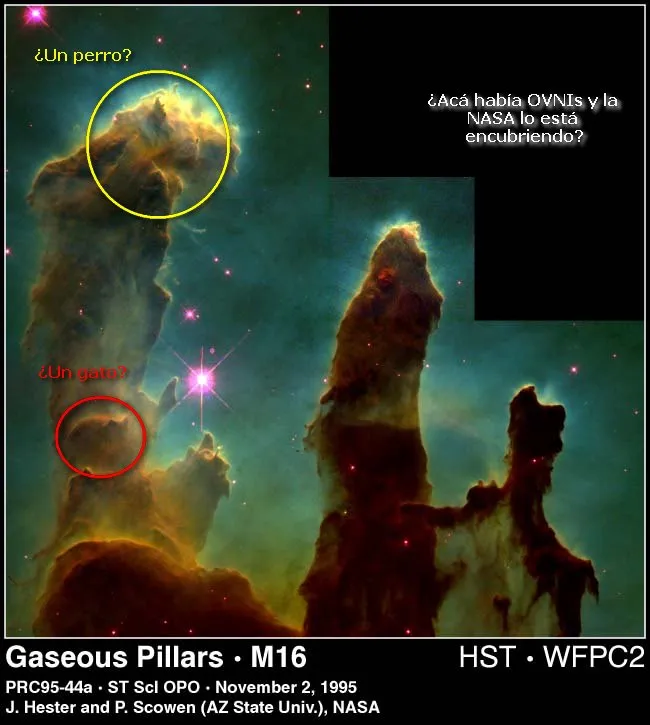
Even scientists usually use perception patterns to construct hypotheses. However, these must be tested objectively and many times the initial impressions end up being products of our imagination, like the canals of Mars.
Sources and related links
- Random Thoughts: Points and Poisson (d’Avril)
- Pareidolia poser
- Chance, of quantum
About the images
Dice. Credit:TouTouke, Stock.xchng
Image from the NOAO Deep Wide-Field Survey.
Buell T. Jannuzi and Arjun Dey of NOAO are co-Principal Investigators for the NDWFS.
B.Jannuzi, A.Dey, NDWFS team/NOAO/AURA/NSF http://www.noao.edu/image_gallery/html/im0637.html http://www.noao.edu/noao/noaodeep/index.html
M16, Eagle Nebula, the Pillars of Creation:
Credit: J. Hester and P. Scowen (AZ State Univ). NASA.
HST ST Scl OPO (2-11-95)