A new study offers an explanation for the origin of dwarf spheroidal galaxies. Through simulations, researchers think that larger galaxies strip stars from smaller ones.
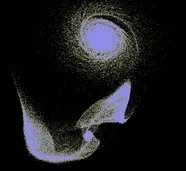
Dwarf spheroidal galaxies are small and very faint, containing few stars relative to their total mass and seem to consist mainly of dark matter.
Astronomers have found it difficult to explain the origin of this type of galaxy. Previous theories proposed that these galaxies orbit close to larger galaxies like the Milky Way, but this does not explain how these dwarf galaxies that have been observed in the outskirts of the so-called "Local Group" of galaxies formed.
"These systems are 'elves' of the early universe, and understanding how they formed is a major goal of modern cosmology," says Elena D'Onghia of the Harvard-Smithsonian Center for Astrophysics (CfA).
D'Onghia and colleagues used computational simulations to examine two scenarios for the formation of these galaxies: 1) An encounter between two dwarf galaxies far from other larger ones, with the spheroidal dwarf later accreted by the Milky Way and 2) an encounter between a dwarf galaxy and a galaxy like the Milky Way, in formation, in the early universe.
The team found that galactic encounters tend to produce a gravitational process (which they called "resonant stripping" or "removal by resonance") by which stars are stripped from the smaller dwarf galaxy during the interaction, transforming it into a spheroidal dwarf.
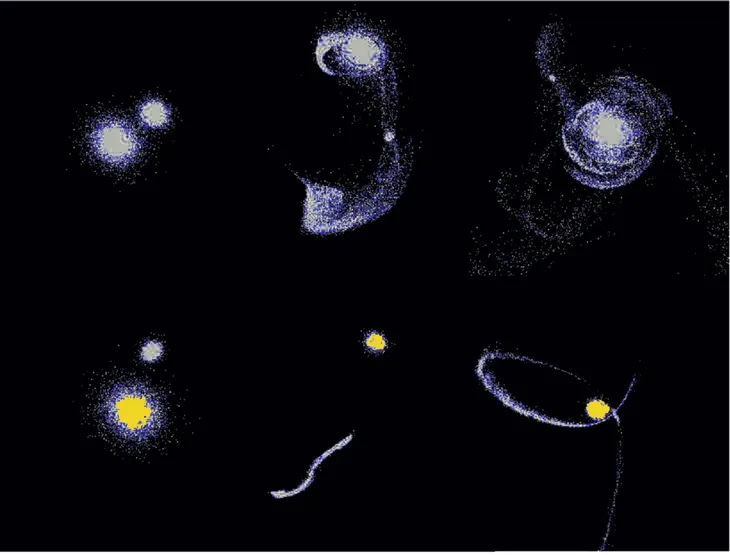
Simulations of encounters between galaxies to learn how dwarf galaxies lose their stars and gas. The top row shows interactions between a dwarf galaxy orbiting a larger galaxy (100 times its mass).
The first image (left) illustrates the start, when the two dwarfs approach. Next to it is the state of the system after 2 billion years. The last image in the first row shows the appearance after 7 billion years.
The bottom row shows the orbit of the same smaller galaxy (in white) around the Milky Way (in yellow), which is 10,000 times its mass.
"Like in a cosmic dance, the encounter triggers a gravitational resonance that strips the stars and gas from the dwarf galaxy, producing long visible tails and bridges of stars," explained D'Onghia.
"This mechanism explains the most important characteristic of spheroidal dwarfs, which is that they are dominated by dark matter," added co-author Gurtina Besla.
The long streams of stars arising from gravitational interactions should be detectable. For example, the recently discovered stellar bridge between Leo IV and Leo V, two dwarf spheroidal galaxies, could have been the result of a resonance like the one they describe.
The study submitted to Nature also shows the following diagram:
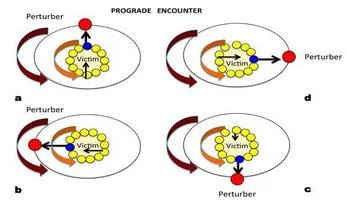
The response to the resonant stripping of stars from a smaller dwarf galaxy (the victim) orbiting a larger dwarf galaxy that causes perturbations in the former. The sequence is counterclockwise.
The stars in the victim (yellow circles), which are rotating in the disk, are continuously pushed inward or outward, depending on their initial position relative to the gravitational perturbation by the larger galaxy. As an example, one can follow the path of a star, painted blue, in the victim galaxy.
Tails and shells
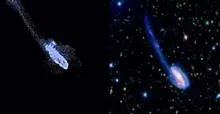
This process can produce extended streams (or "tails") (on the left) that resemble the long tail observed in the Tadpole galaxy (the tadpole galaxy) on the right.
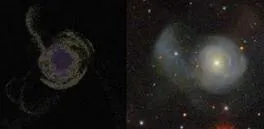
Shells can also be produced in the larger dwarf galaxy by the capture of stars from the smaller one. As an example, they show a simulation result after a few billion years (left) that resembles the stars in galaxy NGC 2782 (right).
Sources and related links
- Cosmic Dance Helps Galaxies Lose Weight
- Resonant stripping as the origin of dwarf spheroidal galaxies
Elena D'Onghia et al.
Nature 460, 605-607 (30 July 2009)
DOI:10.1038/nature08215;
arXiv:0907.2442v1
About the images
- Simulations of encounters between galaxies.
Credit:Elena D'Onghia (CfA) - The simulation illustrates the process of resonant stripping of stars. The stars of a dwarf galaxy (bottom) orbiting a larger system (top) are stripped by gravity and form long streams of stars.
Credit:Elena D'Onghia (CfA) - Resonance diagram; illustrations of tails and shells
Credit:Elena D'Onghia (CfA)