Observing almost 11 billion years into the past, astronomers have measured the motions of the stars, for the first time, in a very distant galaxy
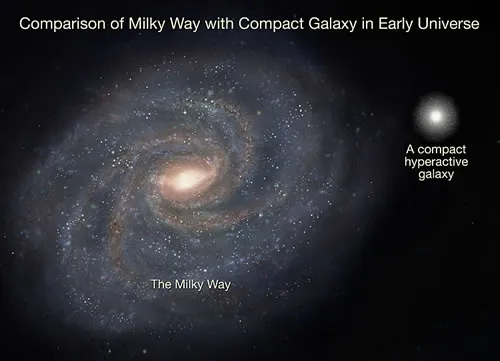
The study of these fast stars (1.6 million kilometers per hour!) sheds light on how distant galaxies, which are a fraction of the size of our Milky Way, might have evolved into the well-formed galaxies we see today.
"This galaxy is very small, but the stars are zipping around as if they were in a giant galaxy that we might find closer to us and not so far back in time," said Pieter van Dokkum, professor of astronomy and physics at Yale University, who led the study. It is not understood how galaxies like this one, with so much mass in such a small volume, could have formed in the early universe and then evolved into galaxies like those we see in the nearer and contemporary universe, which is about 13.7 billion years old. Galaxy 1255-0 is located 11 billion light-years away (z = 2.186), so the universe was about 3 billion years (only) old when the light from this galaxy, currently detected, was emitted.
The work of the international team combined data using the Hubble Space Telescope with observations taken with the Gemini South telescope in Chile. According to Dokkum, "The Hubble data, taken in 2007, confirmed that this galaxy was a fraction of the size of most galaxies we see today in the more evolved and older universe." The 8-meter mirror of the Gemini telescope then allowed them to collect enough light to determine the overall motions of the stars using a technique not very different from how police use laser light to catch speeding cars. The near-infrared spectroscopic observations from Gemini required 29 hours to collect the extremely faint light from the distant galaxy, designated 1255-0.
"By looking at this galaxy we are able to look back in time and see what galaxies looked like in the distant past when the universe was very young," said Mariska Kriek of Princeton, a team member.
Astronomers confess it is difficult to explain how compact, massive galaxies can form and why they are not seen in the local universe. "One possibility is that we are looking at what may be the central region of a large galaxy," explained Marijn Franx of Leiden University. "The centers of large galaxies may have formed first, presumably along with a giant black hole that we know exists in the large galaxies we see nearby."
To witness the formation of these extreme galaxies, astronomers plan to observe galaxies even farther away and in great detail. By using the Wide Field Camera 3, recently installed on Hubble, those objects could be detectable. "The ancestors of these extreme galaxies should have spectacular properties, having probably formed an enormous number of stars, in addition to a massive black hole, in a relatively short amount of time," added Dokkum.
This research continues recent studies revealing that the oldest and most luminous galaxies in the early universe are very compact and surprisingly have stellar masses similar to present-day elliptical galaxies. The most massive galaxies we see in the local universe (where we do not look back in time so significantly) that have masses similar to 1255-0 are typically five times larger than the young distant galaxy. How galaxies grew so much over the past 10 billion years is an active area of research, and understanding the dynamics in these young compact galaxies is a key piece of evidence to solve the mystery.
The research was published in Astrophysical Journal and as a letter to Nature, along with an editor's note and an article.
Sources and related links
- HubbleSite: Astronomers Find Hyperactive Galaxies in the Early Universe
Press release at Gemini - A high stellar velocity dispersion for a compact massive galaxy at redshift z = 2.186
Pieter G. van Dokkum, Mariska Kriek & Marijn Franx
Nature 460, 717-719 (6 August 2009)
DOI:10.1038/nature08220
arXiv:0906.2778v1 - An Ultra-Deep Near-Infrared Spectrum of a Compact Quiescent Galaxy at z = 2.2
Mariska Kriek, Pieter G. van Dokkum, Ivo Labbe, Marijn Franx, Garth D. Illingworth, Danilo Marchesini, Ryan F. Quadri
ApJ Volume 700, Number 1, 2009 July 20, 221-231
DOI: 10.1088/0004-637X/700/1/221
arXiv:0905.1692v2
About the images
- Illustration: Comparison of the Milky Way with the compact hyperactive galaxy
Credit: NASA, ESA, and A. Feild (STScI)