NASA's Spitzer Space Telescope found evidence of a high-speed collision between two planets around a star.
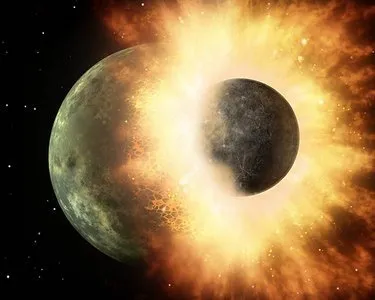
Astronomers say that two rocky bodies, one at least the size of our Moon and the other as large as Mercury, collided with each other in the last few thousand years. The impact destroyed the smaller body, vaporizing large amounts of rock and ejecting massive clouds of lava into space.
Spitzer detected the signs of the vaporized rocks and the pieces of frozen lava.
"This collision must have been huge," commented Carey M. Lisse of the applied physics laboratory at Johns Hopkins University, author of a scientific report describing the findings. And he added that it is a rare event, critical in the formation of planets like Earth.
Lisse and colleagues believe that the collision is similar to the one that formed our Moon, 4 billion years ago, when a body the size of Mars collided with Earth, as scientists think.
The researchers observed the star HD 172555, which is located 100 light-years away in the constellation Pavo. The star is very young, at only 12 million years old (compared to the 4.5 billion years of our solar system). Astronomers used a spectrograph to analyze the starlight and what they found was that the spectrum was very unusual.
After careful analysis, the researchers identified amorphous silicon, an element that can be found on Earth in tektites (objects of natural glass, a few centimeters in size that, according to most scientists, have formed from the impact of large meteorites) and in obsidian volcanic rocks.
They also detected large amounts of silicon monoxide gas, created when the rocks were vaporized, and rocky debris.
The mass of the observed dust and gas suggests the combined mass of the two bodies was more than double the mass of our Moon.
Their speed must have been tremendous: they calculate that the two bodies had a relative speed to each other of at least 10 kilometers per second, before the collision.
Spitzer had observed the dust generated by other large asteroid impacts before, but had not found evidence for the same type of violence, with vaporized and molten rock scattered everywhere. Lisse explained that almost all large impacts are much calmer and slower, like the Titanic hitting the iceberg, while the new discoveries allow us to suppose that this collision was fast and fierce.
Sources and related links
- Spitzer: Planet Smash-Up Sends Vaporized Rock, Hot Lava Flying
- Abundant Circumstellar Silica Dust and SiO Gas Created by a Giant Hypervelocity Collision in the ~12 Myr HD172555 System
C. M. Lisse
The Astrophysical Journal, Volume 701, Number 2, 2009 August 20
DOI: 10.1088/0004-637X/701/2/2019
About the images
- Illustration of a giant collision
Credit: NASA/JPL-Caltech