The first black holes in the universe had dramatic effects on their surroundings despite the fact that they were small and grew slowly, according to recent computer simulations carried out by astrophysicists.
Many popular theories say that the first black holes feasted on the clouds of gas and dust in the early universe, growing into the supermassive black holes that hide in the centers of galaxies today. However, the new results from researchers Marcelo Álvarez and Tom Abel of the Kavli Institute and John Wise of Goddard Space Flight Center, point to a more complex role.
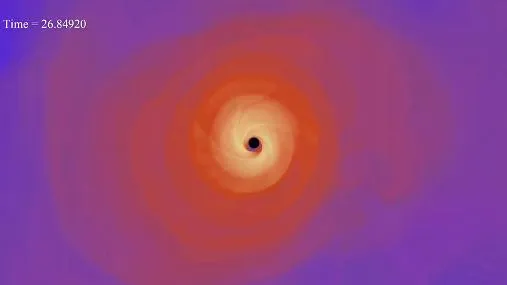
The scientists created the most detailed computational simulations to date of the first black holes in the universe that formed from the collapse of stars. The simulations began with data taken from observations of the cosmic microwave background radiation. The researchers then applied the basic laws governing the interaction of matter, allowing the early universe in their simulation to evolve as they assume it happened in reality.
In their simulation, the clouds of gas left over from the big bang slowly clustered under the force of gravity and eventually formed the first stars. These massive stars shone for a short time and their powerful starlight pushed away the gas clouds. In the simulation, one of the stars finally collapsed into a black hole, which, having no gas in its surroundings, was truly "hungry".
Quasars, sources of powerful radiation, powered by black holes a billion times more massive than our Sun have been observed in the early universe. "We must explain how these giants could grow so much in such a short time. Their origin remains among the fundamental unanswered questions in astrophysics," noted Álvarez.
One explanation for the existence of supermassive black holes in the early universe postulates that the first of them were "seeds" that grew by gravitationally attracting matter. But in their simulation, the researchers found that this growth was insignificant. Their black holes grew by less than one percent of their original mass over the course of 100 million years.
Although the simulations do not rule out that hypothesis, it makes it less likely that the first black holes grew directly into the monstrous ones known to have existed less than a billion years later, points out Álvarez.
An alternative theory
Although the first stars pushed away nearby gas clouds, some of it remained nearby and was attracted by the first black holes. This attraction that the matter suffered accelerated it and released enough X-ray radiation to heat the gas. The additional heat from the X-rays caused the gas to expand and also prevented nearby gas from collapsing to form stars for tens or even hundreds of millions of years. As a result, the researchers hypothesize, unusually large gas clouds without stars would have been created. Those large clouds would have eventually collapsed to form a supermassive black hole.
On one hand, the X-rays expanded the gas and pushed it away from the black hole, but at the same time, the same radiation paved the way for the formation of giant black holes by suppressing star formation in the gas clouds, explained Álvarez. "However, much work remains to be done to test whether this idea can be expanded; it is only the tip of the iceberg in terms of realistic simulations of black holes in the early universe," he added.
Wise noted that "this work will likely make people think again about how the radiation from these black holes affected their surroundings. Black holes are not just pieces of dead matter, they affect other parts of the galaxy".
Sources and related links
- SLAC: First Black Holes Born Starving
- Accretion onto the First Stellar-Mass Black Holes
Marcelo A. Alvarez et al
The Astrophysical Journal Letters, 701 L133-L137, August 20, 2009
DOI: 10.1088/0004-637X/701/2/L133 - Physorg: First black holes born starving (w/ Video)
About the images
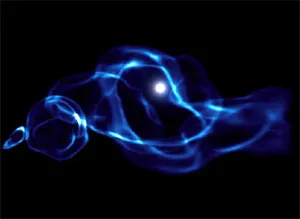
- This simulation image shows gas (blue) interacting with one of the first black holes (white) in the early universe, approximately 200 million years after the big bang.
Credit: Marcelo Alvarez, John H. Wise Tom Abel