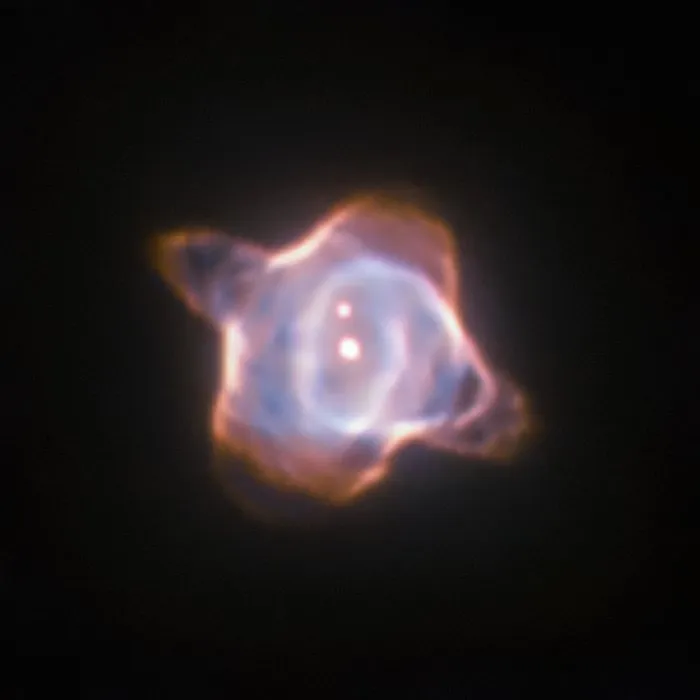
At the La Plata Observatory, a group has been conducting systematic observations of this intriguing cosmic object from the Virpi Niemela Telescope.
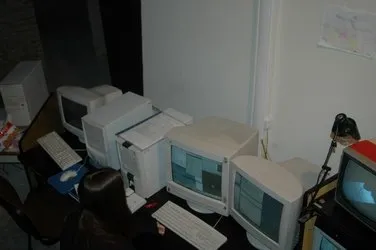
During a visit to the La Plata Observatory earlier this year, to meet there with the author and director of the documentary "El silencio de Las Campanas", I was able to see the telescope and chat briefly with Federico Giudici.
The student told me about the work of a group of students, led by Fernández Lajús, while performing calibration tasks for the Star-i CCD on the computers in the control room.
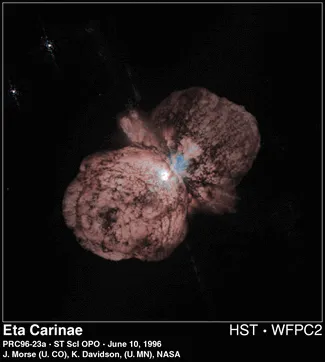
The group conducts photometric observations of Eta Carinae, an intriguing object we have discussed here on several occasions (See: "Eta Carinae, an explosive star"). It is a blue variable star surrounded by the Homunculus Nebula. It is very unstable and prone to matter ejections. It is thought that it will end its life as a supernova, which would be the greatest astronomical spectacle ever seen, given the star's proximity at 7,500 light-years. It is also believed to be a binary star, although there is no conclusive data on this.
At 18:30 hours that May, the sun was setting on a very cloudy afternoon. The only clear thing was that it would not be possible to conduct observations on that occasion.
Given the circumstances, I allowed myself to steal a few minutes from Giudici to chat about studying astronomy at the University of La Plata.
Federico told me it is not a career for geniuses. Most students are like the average students coming out of high schools, that is, with poor training in subjects like mathematics and physics. Therefore, it implies a great dedication to study. And although it is not strictly necessary to live in that city, Federico, who lived in the southern area of the conurbano, ended up moving to live in the provincial capital, thanks to the effort of his parents.
Photometric observations are very important, basic for conducting subsequent research and even more so in this case. Eta Carinae can be observed from the southern hemisphere and even using a small telescope (compared to those of large observatories) allows for permanent monitoring of objects of great study value.
They are not the only ones interested in observing the changes in this object of the Homunculus Nebula. The Astronomical Observatory of the Copernicus Institute is promoting the permanent observation of 1041-59 Eta Carinae. There is also a special Eta Carinae page http://etacar.umn.edu/ corresponding to the Hubble Space Telescope Eta Carinae Massive Star Binary Hubble Space Telescope Spectroscopy Astronomy HST Treasury Program project, from the University of Minnesota.
The work of the Faculty of Astronomy and Geophysics of the University of La Plata will be presented at the next Annual Meeting of Argentine Astronomy, to be held between September 21 and 24 at that institution.
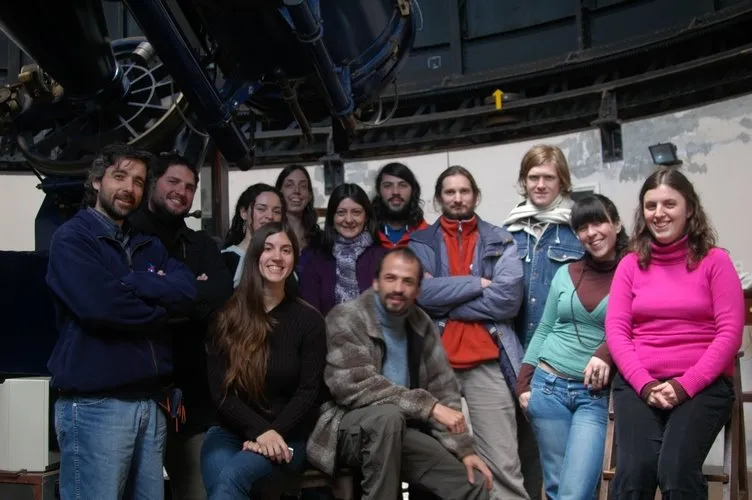
The poster will be about the 2009 optical monitoring of Eta Carinae and the "eclipse-like" event conducted by the group that includes Eduardo Fernández Lajús, Cecilia Fariña, Juan Pablo Calderón, Carolina von Essen, Martín Alejandro Schwartz, Leila Magdalena Calcaferro, Nicolás Emilio Salerno, Andrea Fabiana Torres and Giudici himself.
The person in charge of the Telescope is Eduardo Fernández Lajús and the Technical Manager of the Telescope is Martín Schwartz. They have a website for the Virpi Niemela Telescope, managed by Juan Pablo Calderón. The Eta Carinae study program was inspired by Virpi Niemela, after whom the telescope from which the observations are made is named.
The first report of their data was published in Information Bulletin on Variable Stars (IBVS) and a paper on the observations was published in Astronomy & Astrophysics.
Summary of the work
Eta Carinae is one of the most intriguing objects in the sky, mainly due to its historical and spectacular brightness variations. In particular, the so-called spectroscopic events have led to the hypothesis that Eta Carinae is actually a binary system. These events manifest photometrically as a kind of "eclipse," which have motivated our permanent monitoring program of Eta Car. In this work we present the light curves in the BV RI bands resulting from the sixth observing season of Eta Car conducted from the La Plata Observatory. After a considerable dimming experienced in 2007, the object has remained in a phase of practically constant brightness (V ~ 5.0) throughout the year.
Eta Carinae at the IAU's XVII
The presentation "Eta Carinae in the context of the most massive stars" will be given at the International Astronomical Union meeting in Rio de Janeiro between August 13 and 14, 2009.
http://www.astro.iag.usp.br/~damineli/JD13/
Sources and related links
- Virpi Niemela Telescope page
- Long-Term Optical Monitoring of Eta Carinae. Multiband light curves for a complete orbital period
E. Fernandez-Lajus, C. Farina, A.F. Torres, M.A. Schwartz, N. Salerno, J.P. Calderon, C. von Essen, L.M. Calcaferro, F. Giudici, C. Llinares, V. Niemela
arXiv:0812.1814v1
http://arxiv.org/abs/0812.1814
A&A 493, 1093-1097 (2009)
DOI: 10.1051/0004-6361:200810700 - Interview with Dr. Eduardo Fernández Lajús by EnDias
- Optical CCD Observations of Eta Carinae at La Plata Observatory
Fernández Lajús et al.
Information Bulletin on Variable Stars (IBVS) - The Eta Carinae optical 2009.0 event, a new "eclipse-like" phenomenon
E. Fernandez-Lajus, C. Farina, J.P. Calderon, N. Salerno, A.F. Torres, M.A. Schwartz, C. von Essen, F. Giudici, F.A. Bareilles
arXiv:0907.1898v1
Submitted to New Astronomy
DOI:10.1016/j.newast.2009.06.004 - Planetario Galileo Galilei: Argentine astronomers spy on the "monster"
About the images
- Eta Carinae
Credit: Jon Morse (University of Colorado)/ NASA - Virpi Niemela Telescope and the Eta Carinae Observation Group
Credit: FCAGLP - Control room of the Virpi Niemela Telescope
Credit: FCAGLP