A museum in Canada is exhibiting practical and simple solutions to a variety of problems. One of the items are street lights sensitive to moonlight.
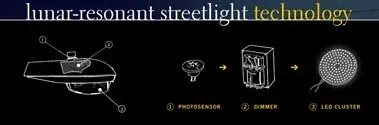
They are called "Lunar Resonant Street Light", and are the product of a group of designers called "Civil Twilight", which is a term used in astronomy (See definition of Twilight) defined as the period from morning until its height is 6 degrees below the horizon. This is the limit at which illumination by natural light is sufficient. The group is made up of three people (Kate Lydon, Christina Seely and Anton Willis) dedicated to graphic design, art and architecture.
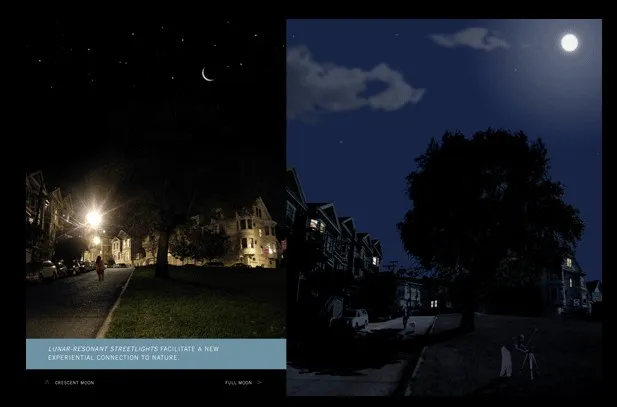
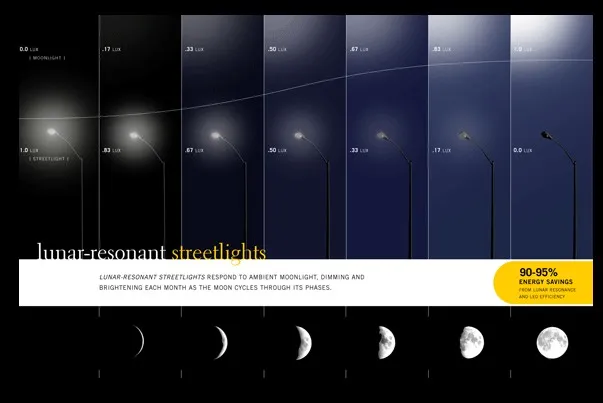
As indicated on the website Civil Twilight Collective, Lunar-resonant street lights respond to ambient moonlight, turning off and on according to the lunar cycle. The idea is to use moonlight, instead of "crushing it" with street lighting, and in that way mitigate light pollution, not waste energy, and facilitate the urban experience of one of nature's most beautiful cycles.
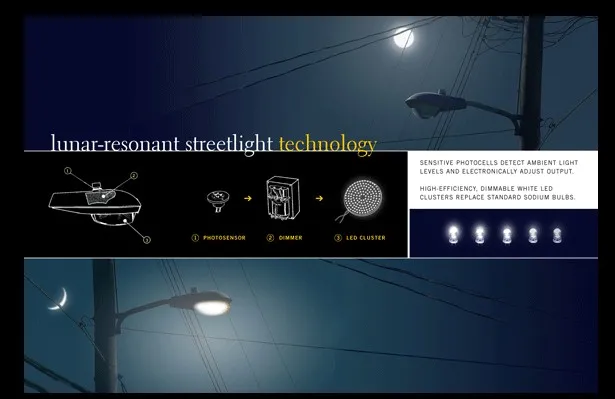
Photosensitive cells detect ambient light levels and adjust the lighting electronically. High-efficiency LED groups are used, instead of sodium lamps. The response occurs not only to lunar cycles, but also to atmospheric conditions.
The beautiful idea implies facilitating a new experimental connection with nature in urban centers, turning cities into networks synchronized with the sky.
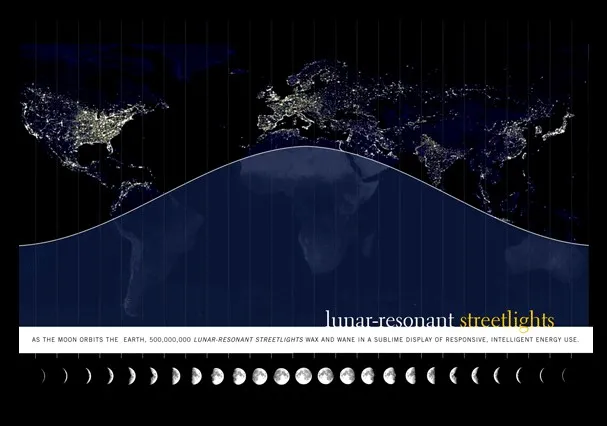
If implemented on a global scale, we would effectively have a network of public lights turning on and off in different regions of the planet, in a dance of lunar lights and shadows. Forgive me, but I think the idea, besides being innovative and efficient, is extremely poetic.
The idea that the sky, particularly at night, is a cultural heritage that we must care for has been spreading in recent years, as a consequence of the unfortunate neglect on the subject. On the other hand, we know that natural resources from non-renewable energy sources are precisely that, they are not renewed and we must care for them and use them in the most efficient way possible.
Here we have already commented several times on the subject and have spread the existence of the documentary "Apagón" about it.
The Department of Astronomy at Cornell University has a page (in English) on the subject, in which they warn us of another inconvenience produced by light pollution.
Usually astronomers want to take the light spectrum of an object, separating the light that reaches the telescope into its color components. When taking a spectrum of objects like galaxies, it is seen that it is not even, but contains a number of lines. Each line is a unique indicator of the presence of certain chemical elements. By studying those lines, astronomers can infer the chemical composition and temperatures of the objects they observe. Furthermore, if the objects approach or move away from us, they will notice a shift in those lines. A redshift, if the objects move away, and towards blue, if they approach, being able to establish the speed of movement of the objects. Spectroscopy is one of the most useful tools available to astronomy.
Unfortunately, city lights wreak havoc with the results. Let's look at the following image:
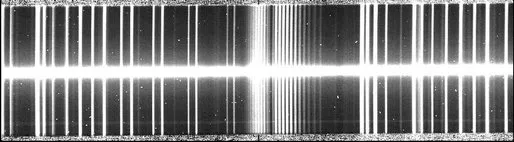
It is the spectrum of a galaxy in the constellation Hercules, taken with the 200-inch telescope at Palomar. The redder colors are on the left and the bluer ones on the right. The bright horizontal line in the middle is light from the galaxy they observed that night. The bright vertical lines we see are not from the galaxy: they are lines from mercury lamps in San Diego. The galaxy's lines are difficult to find because they get lost in the bright lines of the city.
Mercury lamps have a large number of these spectral lines all over the spectrum and interfere with astronomical observations, from infrared to ultraviolet. That's why sodium lamps are a little better, having only two lines in the entire optical spectrum. Unfortunately, there is no type of corrector lens they can use to filter this light pollution. Any filter they use would remove the unwanted light but also the light they want to see, so the change must occur in the cities and through the voluntary efforts of citizens.
In this context, the idea of Lunar-resonant lamps is another contribution to reduce light pollution, use energy more efficiently, link the unrestrained human adventure to a cycle of nature, and not the other way around, as we have become accustomed.
Sources and related links
- LUNAR-RESONANT STREET LIGHTS
- Civil Twilight Collective
- National mapping of light pollution
- Cornell University: How does light pollution affect astronomers?
- Blog: Let's fight light pollution
About the images
- Images belonging to Civil Twilight
- Galaxy spectrum image: Cornell Univ.