A team of scientists discovered a new class of object which they called "Super Planetary Nebula", around progenitor stars of up to 8 solar masses.
Planetary nebulae (PN) are objects of gas and dust expelled by stars near the end of their lives and are usually seen around stars comparable to or smaller in size than our Sun.
The team of scientists from Australia and the USA, led by Professor Miroslav Filipović of the University of Western Sydney, probed the Magellanic Clouds, the two companions of the Milky Way. They did so with the CSIRO radio telescopes and noted that 15 objects in the Clouds match the well-known planetary nebulae observed with optical telescopes.
The new class of objects are unusually strong radio sources. While the population of planetary nebulae is found around stars comparable in size to our Sun, the new population is found around larger stars.
The team pointed out that these detections could help solve a "missing mass" problem, the absence of planetary nebulae around stars that originally had 1 to 8 times the mass of the Sun. Until now, the known planetary nebulae have low-mass central stars that expelled part of it in their red giant stage, near the end of their lives. In that stage, the central part of the star is approximately the size of Earth, and the star's envelope expands about 70 times. When the core collapses, the star ejects its outer layers leaving a small body (less than 1.4 solar masses), very dense, then called a white dwarf. The ejected material expands and creates what is called a Planetary Nebula.
The progenitor stars must be less than 8 stellar masses because those that reach that limit will end their lives as supernovae. Where there seemed to be an absence (hence the "missing mass") is in the range between 1 and 8 solar masses. Known PNs seem to be up to 1 solar mass. In contrast, the new nebulae found are associated with larger progenitors, between 1 and 8 solar masses.
The discovery surprised the researchers themselves who did not expect to find these objects at radio wavelengths with the present generation of radio telescopes. "We have held back our findings for almost three years until we were 100% sure they are in fact Planetary Nebulae," said Filipović.
Some of the 15 discovered PNs are 3 times more luminous than any discovered in their counterparts in the Milky Way. But to observe them in great detail, astronomers will need greater observing power, such as that which will be obtained with the upcoming SKA.
Sources and related links
- Physorg: Super Planetary Nebulae
- Radio planetary nebulae in the Magellanic Clouds
M. D. Filipović et al.
Monthly Notices of the Royal Astronomical Society
(In press. Online: August 10, 2009)
DOI: 10.1111/j.1365-2966.2009.15307.x - RAS: Super Planetary Nebulae (RAS PN 09/51)
About the images
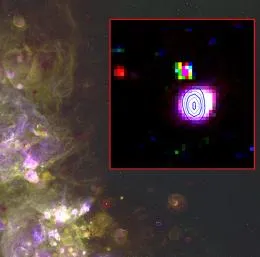
- An optical image from the University of Michigan 0.6 m Telescope of the brightest planetary nebula in the Small Magellanic Cloud, JD 04.
The inner inset shows a portion of this image overlaid with radio contours from the Australia Telescope Compact Array. (Optical images: Magellanic Cloud Emission Line Survey (MCELS).