The European Southern Observatory published an incredible new image of the nearby spiral galaxy similar to our place in the cosmos.
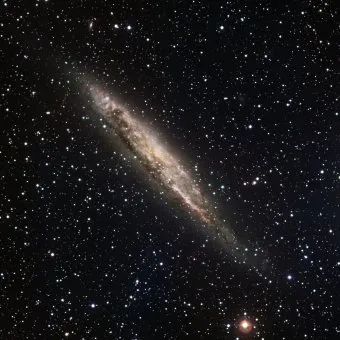
Since NGC 4645 is located only 13 million light-years away, in the constellation Centaurus, a modest telescope is enough for amateur astronomers to observe this remarkable galaxy. Its designation arises from being cataloged (with that number) in the famous New General Catalogue compiled by astronomer John Louis Emil Dreyer in the 1880s. Scottish astronomer James Dunlop is credited with the original discovery of the object in 1826 from Australia.
The new portrait of NGC 4945 is courtesy of the Wide Field Imager (WFI) instrument on the 2.2-meter MPG/ESO telescope at the La Silla Observatory, Chile. From our perspective on Earth, the galaxy appears cigar-shaped, but it is actually a much wider disk than its thickness, with bands of stars and bright gas around its center. Using special optical filters to isolate the color of light emitted by gases like hydrogen, the image shows sharp contrasts in NGC 4945 that indicate areas of star formation.
Zoom-in on NGC 4945 http://www.youtube.com/watch?v=M3OH_r60nuI
Other observations have revealed that the galaxy has an active nucleus, meaning its central bulge emits much more energy than other calmer galaxies like our Milky Way. Scientists classify NGC 4945 as a Seyfert galaxy, after American astronomer Carl K. Seyfert, who published a study in 1943 describing the rare signs of light emanating from some galactic nuclei. Since then, astronomers have suspected that supermassive black holes cause the agitation in the center of Seyfert galaxies. Black holes gravitationally attract gas and dust towards them, accelerating and heating this attracted matter until it emits high-energy radiation, including X-rays and ultraviolet light. Most large spiral galaxies, like the Milky Way, host a black hole in their centers, although many of these dark "monsters" no longer actively feed at this stage of galactic development and are therefore not active galactic nuclei.
Along with NGC 5128 and M83, NGC 4945 is part of the Centaurus Group of galaxies, also known as the Centaurus A/M83 Group or the NGC 5128 Group.
Sources and related links
- ESO: NGC 4945: The Milky Way’s not-so-distant Cousin
About the images
- NGC 4945. Credit: ESO