Amateur astronomers have different ways of documenting their observing sessions, such as taking astrophotographs or keeping a logbook. Others, like Jane Houston Jones, use an old method employed by Galileo Galilei: they make a drawing of what they see through the telescope. Thus, in this International Year of Astronomy, Jones is honoring the father of astronomy, following in his footsteps.
Jones works at Jet Propulsion Laboratory, on the Cassini mission. In fact, she is the voice on Twitter for the Saturn mission and produces a podcast ("What's up") for the NASA Solar System Exploration site.
"When I made my first telescope in 1989, the first thing I did was draw images of what I had observed. And I've continued. It builds a formidable diary of everything you do with a telescope," Jones said.
Galileo's first telescope had an objective lens 37 mm in diameter and a focal length of 980 mm, with a magnification of 21.
Jones is using a Televue Ranger refractor that has a 70 mm objective and a focal length of 480 mm, but with 19x magnification. "My field of view is larger than Galileo's, but I have less magnification, so -in the end- I get a view similar to Galileo's. But 400 years later, with better optics, mine is easier to see," explained the amateur astronomer.

Jane also keeps a logbook, but on the web. "Random thoughts about LA [Los Angeles] and the rest of the universe." There, under the title "Chasing Galileo," she tells us how she makes her observations and sketches.
A challenge
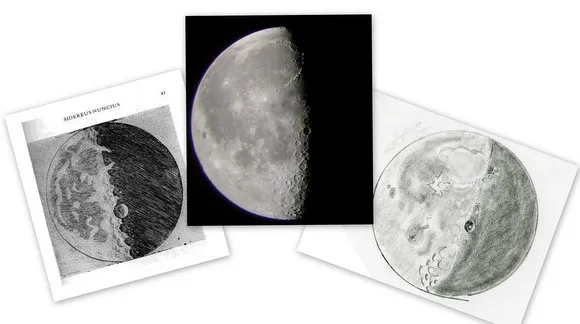
Making sketches or drawings of what is seen with a small refractor telescope is quite a challenge. To make the same drawings as the Italian astronomer, Jones had to try to draw the entire Moon. She says she has sketched parts of our satellite for 20 years, but had never drawn the whole Moon. "With this telescope, Galileo could only see a small part of the satellite, perhaps an eighth of the surface. And when he looked at a star cluster, he couldn't see, for example, all the Pleiades in a single glance."
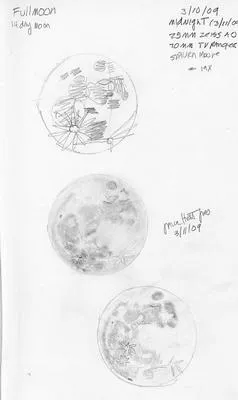
During this exercise of looking through a telescope with a view similar to what Galileo obtained and drawing our Moon and the "Galilean" moons of Jupiter, Jones believes the best part has been seeing the moons of the gas giant.
One of the most significant sights for the astronomer includes an object that Galileo did not realize was another undiscovered planet. "Galileo drew the Galilean moons and an additional fixed star, which using modern software we can go back to the same observation day and know that the fixed star was Neptune. For me, that was so incredible to see, all together, Jupiter, the four moons and another planet that, in Galileo's time, had not yet been discovered, and would not be for several hundred years."
Jones is also drawing Saturn, but it will take her a few years to make the same drawings as Galileo. "When Galileo first looked at Saturn, he thought he was seeing three objects: the planet and the rings on either side of Saturn." A few years later he looked again and the rings had disappeared (from his view), so to make the same observations and sketches, Jones will take a while. After Saturn, the next target is Venus.
When the International Year of Astronomy ends, Jones will continue with her sketches. She, like many others around the world, knows that her passion, wonder and curiosity for celestial objects lasts much longer than 365 days. The Year of Astronomy, in reality, lasts a lifetime.
Sources and related links
- Jane Houston Jones's Blog
- Universe Today: Amateur Astronomer is "Chasing Galileo", by Nancy Atkinson
About the images
- Images by Jane Houston Jones