Astronomy education begins its excursion through the Andes. Today the GalileoMobile project begins, a two-month expedition to bring the wonders of astronomy to the youth of Chile, Bolivia, and Peru. Supported by ESO, a group of astronomers and educators will travel through the Andes region aboard the GalileoMóvil, offering astronomical activities such as workshops for students and star parties for the general public. Professional film directors will produce a multilingual documentary capturing the excitement of discovery through science, culture, and travel.
The GalileoMobile Special Project of the International Year of Astronomy 2009 (IYA2009) is a global celebration to commemorate the first use of a telescope to view the universe by the Italian astronomer Galileo Galilei, four centuries ago. The project will promote basic science education through astronomy by visiting schools and communities that have limited access to outreach programs. The GalileoMóvil will provide these groups with activities and educational material from the project's international partners. The GalileoMóvil is a van, fully equipped to offer unique sky observation opportunities to young students with star parties at night and solar observations during the day. The team will use various tools including Galileoscopes, which will be donated to the schools after visiting them. To stimulate curiosity, critical thinking, and a sense of wonder, awe, and discovery of the universe and our planet, the project aims to stimulate interest in astronomy and science, and exchange different cultural views of the cosmos.
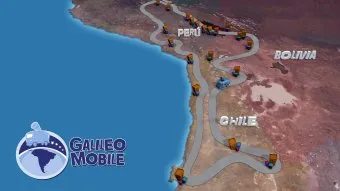
The initiative is led by a group of enthusiastic Latin American and European doctoral students from ESO, the Max Planck Society, the Munich University Observatory, and the Stockholm University Observatory. This itinerant education program is intended to reach about 20,000 people during eight weeks in October and November of this year and will cover about 5,000 kilometers. The journey will take place mainly through the Altiplano shared by Peru, Bolivia, and Chile, which are among the poorest regions of these countries.
South America and the Andes mountain range were chosen particularly for the project for several reasons. IYA2009 already has a strong presence in the region through national contacts, including three cornerstone projects: Developing Astronomy Globally; Universe Awareness, and the Galileo Teacher Training Program, which are all official partners of the project. The majority of the population in Peru, Bolivia, and Chile speak the same language, Spanish, and possess a rich astronomical heritage dating back to the pre-Columbian Inca and Tiwanaku civilizations that lived in the Altiplano. The region's high elevation and the quality of its skies for astronomical observations also make it an attractive candidate for the GalileoMóvil's inaugural journey.
The journey begins today, October 5, 2009 in Antofagasta, Chile, with an inaugural event at 19:00 at the Universidad Católica del Norte. The event, which will include observations of the night sky, is organized by ESO in collaboration with Explora II Región and the University's Institute of Astronomy. From Antofagasta the GalileoMóvil will head north through La Paz in Bolivia and into Peru. The return journey to Antofagasta will be via the Pan-American Highway and will pass near the home of ESO's Very Large Telescope on Cerro Paranal. The education and outreach coordinator in Chile, Laura Ventura, will assist the team by welcoming the communities through the northern deserts of Chile.
"The GalileoMóvil is a wonderful initiative, and a unique opportunity to reinforce educational activities in northern Chile and neighboring countries. It will promote great awareness of astronomy and science", said Ventura. "We are very excited to be able to help the team members in order to make the GalileoMóvil a great success".
We can see a map of the GalileoMobile route on Google Maps.
The GalileoMóvil
http://www.youtube.com/watch?v=d42_euL0vA8
To record the chronicle of this remarkable astronomical expedition the team members will write on the GalileoMobile blog and on Cosmic Diary and will maintain a Twitter account and a Facebook account. The team will reach newspapers, websites, and television stations during the journey and will be accompanied by a film crew that will produce a documentary of the expedition.
The project coordinator, Philippe Kobel concludes: "We hope that, by showing the excitement of astronomical discovery and the diversity and richness of South American traditions, the GalileoMobile Project will stimulate a feeling of 'unity under the same sky' among people of different cultures and history".
Sources and related links
- ESO: The GalileoMobile starts its South American voyage
- GalileoMobile
- GalileoMobile blog: http://galileomobile.wordpress.com/
- The GalileoMobile team: http://www.galileo-mobile.org/node/6
- The collaborators: http://www.galileo-mobile.org/node/26
- GalileoMobile Twitter feed: http://twitter.com/galileomobile
- GalileoMobile Facebook: http://www.facebook.com/search/?q=galileomobile
- GalileoMobile photo gallery: http://www.flickr.com/photos/galileomobile
- IYA 2009: www.astronomy2009.org
About the images
- The images belong to ESO