According to John Hearnshaw, neither. A note of color on the magnitude of the discoveries of the temperature-luminosity relationships of stars. The story behind the H-R diagrams.
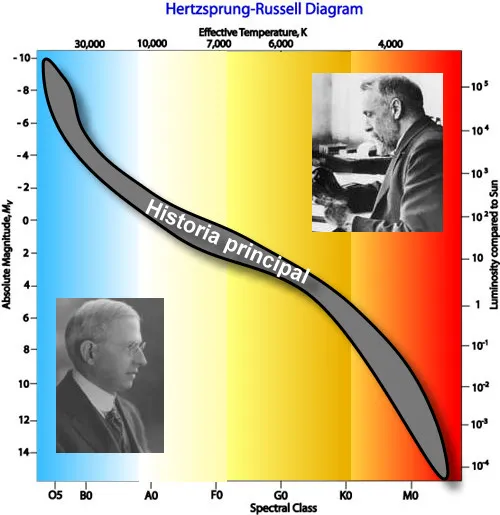
The official history postulates Ejnar Hertzsprung as the astronomer who first made this diagram in 1911. Two years later, and independently, Henry Russell did it.
The first showed the luminosity of the stars as a function of their color, while the second showed the luminosity as a function of spectral type.
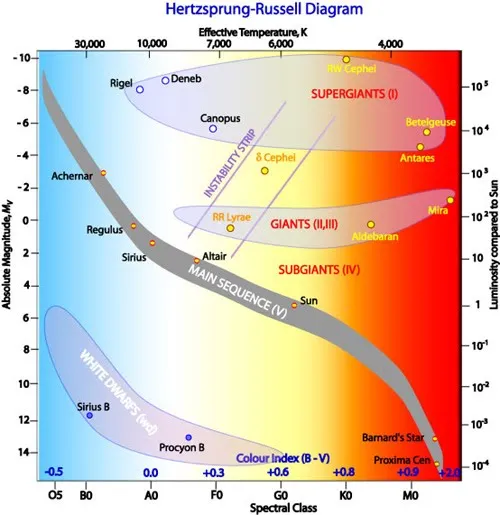
What is an H-R diagram? These schemes show the evolution of stars in relation to their luminosity and color (temperature). Thus, Hertzsprung's diagram essentially showed how much energy stars emitted as a function of their temperatures. This way he noticed some patterns.
Russell plotted luminosities against spectral types, which are also a way of measuring temperature, so the diagrams are equivalent and are known as Hertzsprung-Russell diagrams or H-R for short.
These graphs allow a glimpse into the cycle of stars: stars on the diagonal from the upper left to the lower right predominate. That diagonal is known as the main sequence. Outside the diagonal are white dwarfs (bottom left) and red giants and supergiants (top).
As John Hearnshaw tells in his blog, there is another story behind the main story.
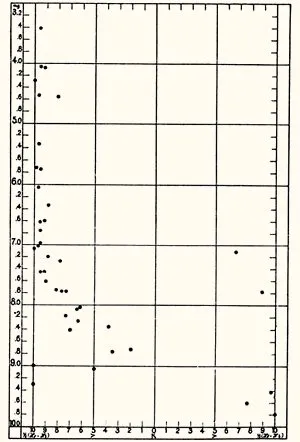
The first diagram of magnitudes versus spectral types was published by Hans Rosenberg (1879-1940) in 1910. Rosenberg was a colleague of Schwarzschild and his diagram of the Pleiades star cluster showed the apparent photographic magnitude against an index based on the strength of the Balmer lines related to the K lines of calcium and was sent to Astronomische Nachrichten in 1910.
It is known that Hertzsprung, while still an amateur astronomer in Copenhagen, produced initial versions of his diagram for clusters as early as 1908. It is those diagrams that he showed to Karl Schwarzschild that same year. It is very curious that shortly after that meeting, Rosenberg published his paper and began by saying that he was stimulated by Schwarzschild. Could it be that Schwarzschild told Rosenberg about Hertzsprung's idea?
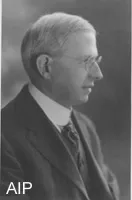
Meanwhile, Russell seems unaware of the work of the two previous ones and presented his diagram based on parallaxes and spectral types at the Meeting of the Royal Astronomical Society in London, in June 1913. He continued spreading his ideas at the Atlanta meeting that year and the publication of it contains the first printed Russell diagram.
It is often assumed that it was Hertzsprung in 1905 who drew attention to the dichotomy in luminosity shown by late-type stars. Some are very luminous and distant, with low proper motion; while others are relatively nearby stars with high proper motion, of low luminosity. They are, respectively, supergiants and dwarfs and Hertzsprung correctly recognized that they can be distinguished spectroscopically, although he did not use that terminology. He showed that the stars with the narrowest lines, cataloged as type c by Antonia Maury in 1897, were the low proper motion supergiants.
Less known is the fact that William Monck (1839-1915) in Ireland, an amateur astronomer and philosophy professor at Trinity College, also deduced that late stars could have high or low luminosity, such as Canopus (high luminosity and low proper motion) and Alpha Centauri, Procyon or Capella with high proper motion. He did not use spectral features, so Monck did not go as far as Hertzsprung, but he anticipated him by a decade by publishing it in 1895.
But who was the first astronomer to find the correlation between the apparent magnitude and the color index of stars along the main sequence of a cluster? Neither Rosenberg, nor Hertzsprung. Carl Charlier (1862-1934), a Swedish astronomer at Lund Observatory. In 1889! Long before the concept of color index which was introduced by Schwarzschild in 1900.
What Charlier did in 1889 was to study the difference between the apparent photographic magnitude m(pg) and the visual magnitude (vis) for the Pleiades. That is, the difference between the magnitude determined photographically by measuring the star images on a plate, m(pg); and that determined visually through a telescope, using the visual magnitudes of Max Wolf. To his surprise, Charlier found that the fainter stars in the cluster had progressively larger values of magnitude difference. He attributed this to an incremental systematic error in Wolf's magnitudes for the fainter Pleiades. He tabulated the results (made a table) but did not graph them. If he had done so he would have illustrated the first color-magnitude diagram showing a main sequence. By 1911, Charlier was 49 years old and by 1913, 51. Did he find out about the H-R diagrams?
Charlier was awarded the Bruce Medal (1933) and the Watson Medal (1924). In his obituary, Lundmark Knut recognized this work among his contributions to astronomy.

H-R: The software
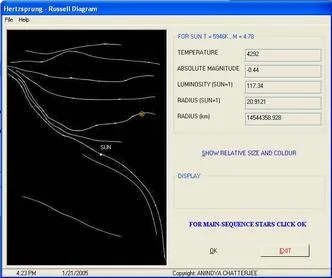
Anindya Chatterjee is an Indian developer who, besides studying computing, likes astronomy. That is why he created Hertzsprung - Russell Diagram 1.00. The program is shareware: after 7 days some functions become disabled. The software weighs 1.26 MB and requires a Windows operating system. Supposedly you can access a database with 450 stars, but that and other options have not worked for me on Win XP.
JavaHRD
JavaHRD is a Java applet that allows highlighting various parts of stellar evolution in an H-R diagram, developed by the Institute of Astronomy of the University of Bonn.
Sources and related links
- Who first published a Hertzsprung-Russell diagram? Hertzsprung or Russell? Answer: neither!
John Hearnshaw
http://cosmicdiary.org/blogs/john_hearnshaw/?p=583 - The first Hertzsprung-Russell diagram
- Obituary Notices : Associates :- Charlier, Carl Vilhelm Ludvig
Lundmark Knut
Monthly Notices of the Royal Astronomical Society, Vol. 95, p.339-341
http://adsabs.harvard.edu/abs/1935MNRAS..95..339.
About the images
- Rosenberg's color-magnitude diagram from 1910.
- H-R diagrams. Credit: Australia Telescope Outreach and Education
- Ejnar Hertzsprung
Credit: Dorritt Hoffleit, Yale University Observatory, courtesy AIP Emilio Segre Visual Archives - Henry Norris Russell. Credit: AIP Emilio Segre Visual Archives, Margaret Russell Edmondson Collection