Is it possible to do science from the browser? If a team of researchers succeeds, scientists around the world will be able to use a web platform called Science Studio.

"One of the objectives of Science Studio is to be able to access science facilities, like the Canadian Light Source (CLS). It is a complete experimental management system," said Marina Fuller, a chemistry researcher on the project.
CLS is a Canadian synchrotron, that is, a light source that scientists use to gather information about the chemical and structural properties of materials at the molecular level. It is like a very powerful microscope, similar to the Alba synchrotron light laboratory that will operate next year in Barcelona.
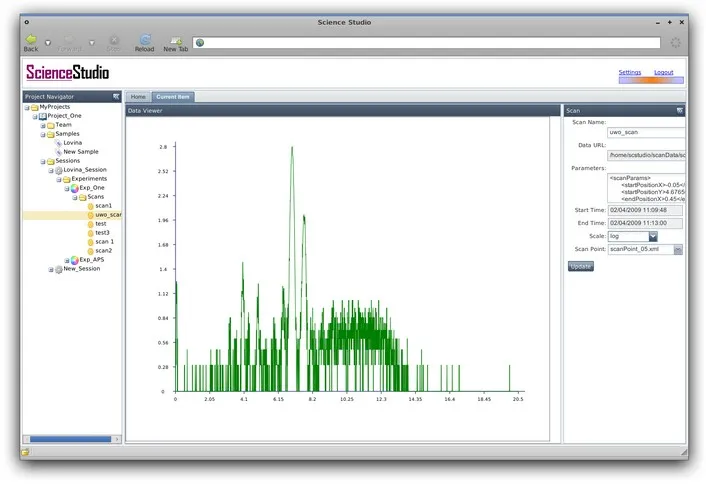
The VESPERS (Very sensitive Elemental and Structural Probe Employing Radiation from a Synchrotron) beamline operates at CLS. When Science Studio is completed, in 2011, researchers will be able to use the platform to request time on the beamline, remotely control the experiment, and receive live data analysis.
Although the ability to remotely control synchrotron experiments is rare, remote access to the Stanford Synchrotron Radiation Lightsource (SSRL) has been working for five years. Not all equipment has the necessary robotics, and those that do use proprietary software that Science Studio will not be able to connect to.
Michael Bauer, principal investigator of this new project, says he is trying to integrate an electron microscope into the system.
The platform will include interesting collaboration tools that will allow coordinating the workflow, from creating and submitting proposals for a team to data analysis and paper creation.
And while the system is being built, the next step has already begun to take shape. ANISE will be the extension of Science Studio with the goal of partnering with a variety of synchrotrons around the world.
Architecture
Science Studio is a distributed system that provides end users with an interface to the devices and analysis programs they need for their experiments. The data will be stored on a grid, so users will see an application where data arrives from different databases in different facilities.
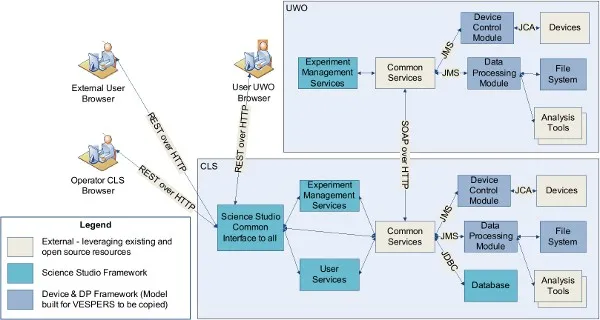
The system has three purposes:
-Management of all aspects of a scientific experiment, which includes:
data storage collaboration data processing
-Control or interaction with remote experiments
-User services (sample management, scheduling, etc.)
The system will be hosted at the University of Western Ontario (UWO) and at CLS.
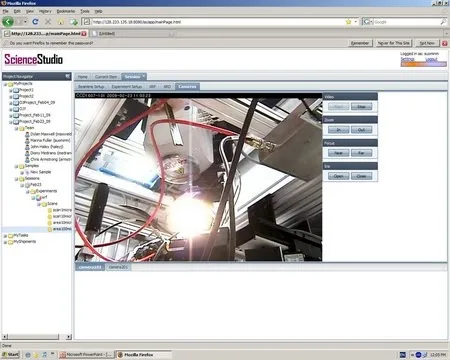
Although the project is under construction, it is possible to test some features from a simulation.
Sources and related links
- Big science facilities meet the cloud, by Miriam Boon
- Science Studio provides remote access to 'big science' facilities
About the images
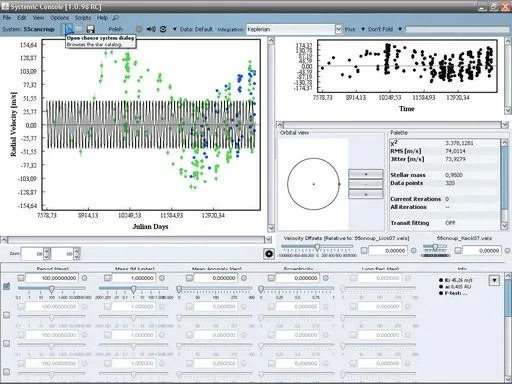
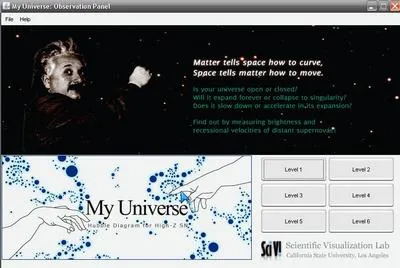
- Logo and screenshots of Science Studio