Some artistic exhibits use concepts from science to express different thoughts and ideas. One exhibit aims to be "The First Antimatter Bank", while an artist created retro-style posters for the International Year of Astronomy, a concept on which a graphic designer created a presentation about space.
The positron bank
Jonathon Keats is an artist-philosopher whose conceptual projects have examined everything, from the nature of god to the sexuality of plants.
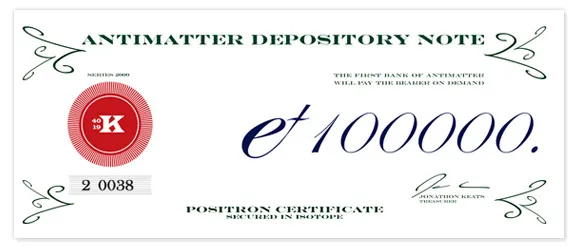
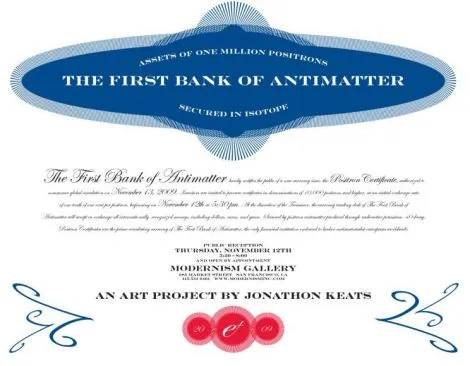
His latest work is an exhibition called The First Antimatter Bank. Instead of backing the currency in the traditional way, with gold bullion for example, it does so in the form of positrons.
Positrons are particles similar to electrons, but they have a positive electric charge, instead of a negative one. Supposedly these positrons would be obtained from 65 kilograms of potassium chloride. Statistically, 0.012 percent of that material would be potassium-40, a radioactive isotope with a half-life of 1,300 million years, which sometimes decays and releases a positron. Isotopes are atoms that differ from each other by the number of neutrons. Some are more common than others. For example, it is easier to find carbon 12 (with 6 neutrons and 6 protons in the nucleus) on the planet than carbon 14 (which has 8 neutrons and 6 protons). Radioactive isotopes are unstable and release energy when they stabilize.
We can find potassium in our diet: broccoli, beets, eggplant. But, be careful, there is also antimatter in bananas!
A deeper idea
"We have confused money, which is essentially a means of transaction, with that which is the object of the exchange. Thus, we have given value to money itself as if it were one of the things we exchange," says Keats.
The positrons that back the currency are annihilated when they come into contact with matter and can only exist in the material world for an instant, except under controlled conditions. Since the money could not really be exchanged for the thing that gives it its value, the positron bills help distinguish between our currency and the things we buy with it.
"The blurriness of that line led to many of our current financial afflictions," they point out in the magazine Good.is.
Historically, humanity exchanged goods through barter, then we used precious materials and later currency. With a world economy that today functions with "fiat money", the border between reality and fiction becomes cloudy. Thus, the anti-bank, which is an imaginary proposal, is not so different from what really happens.
One reference is the controversial documentary Zeitgeist which addresses, during the second part, the issue of money and banks.
The artist uses the principles of modern physics to highlight the ethereal nature of our world economy, with a sense of satirical humor.
The idea doesn't solve anything, nor does it intend to. It also doesn't propose a new alternative financial system. It's not an essay or a new theory of money. It's an exhibition. A show that uses the languages of art and science with no other utility than to make us think.
Although, wisely, Kat Austen points out -in NewScientist's new blog (CultureHub)- that the anti-bank could be a good source of resources for particle accelerators, like CERN.
The space of Joshua Davis
Joshua Davis is a graphic designer who used geometric concepts to create the presentation "Space". It is available for download (in a 113 MB file). The options for viewing it are simple: you unzip the downloaded .zip file, and inside the folder "joshua_davis_space_2009" there will be a file "Framework.exe". Running it will start the presentation. To advance and go back, the right and left arrow keys on the keyboard are used, respectively.
The show contains various works by the artist. One part, in which the concepts we will point out here can be seen, can be viewed in the attached video.
Video: Joshua Davis Space 2009
http://www.youtube.com/watch?v=Ad9HT_QZ6do
Davis introduces the presentation with the concept of AIA2009 (IYA2009) to create his own "space" in which objects seem to order themselves in chaos, interact according to the position of the mouse, reorganizing themselves geometrically. Among his designs he includes concepts such as Bézier curves and elliptical orbits.
Retro style
A series of beautiful images, in the form of posters for the International Year of Astronomy 2009, are available to view (and buy). They were designed by the artist Simon Page.
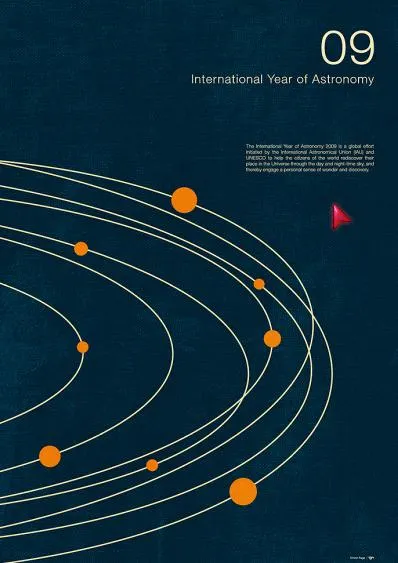
Also the designer James White created some related images.
ArtFutura and Tecnoteatro
Recently, Minister Lino Barañao together with researchers Dr. Alberto Kornblihtt and Dr. Gabriel Mindlin, and artists Fabiana Barreda, Martín Bonadeo and Luis Benedit, participated in a round table as part of the 2nd edition of the Artfutura festival in Buenos Aires (from November 5 to 8, at Malba).
On that occasion, Dr. Alberto Kornblihtt, a biologist and researcher at the Department of Physiology, Molecular and Cellular Biology of UBA, in the introduction to his talk on the intersections between biology and visual art, pointed out:
"Science produces happiness and what gives the greatest pleasure is realizing; that sensitivity for realizing unites all human activities but particularly science and art."
Over these years ArtFutura has tried to show that at the beginning of the new millennium, art and science flow more than ever along parallel paths. It is no longer possible to understand art detached from new media, the internet and digital technology.
Other expressions that combine artistic and scientific language occur in "tecno-teatro". The growth of these proposals was captured by Federico Kukso in the article "Sobre tablas" in Crítica de la Argentina.
Sources and related links
- Laughing all the way to the anti-bank, by Kate Austen
- The GOOD 100: Jonathon Keats
- El dinero imaginario, by Hugo Salinas Price
- MCTIP:Conversations between artists and scientists
About the images
- Positron bills. Credit: Jonathon Keats
- IYA2009 poster. Credit: Simon Page
- ArtFutura08: Bestiario - Electromagnetic Spectrum