The Institute of Astronomy and Space Physics held an open house day so the public could meet the scientists and learn about the activities carried out at its facilities in the Ciudad Universitaria of Buenos Aires.
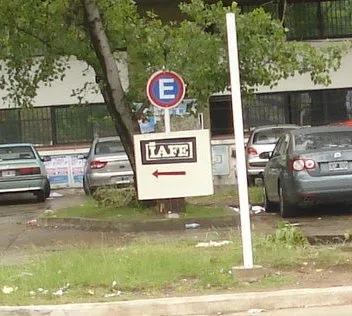
Due to prior commitments, I cannot be there for the entire event, which started at 10:30 with a talk by Dr. Diego Arbó on "light." I arrived at noon, just in time to attend the outreach talk by Dr. Susana Pedrosa. Pedrosa is part of the Numerical Astrophysics Group at IAFE, a graduate of the University of Tucumán. One of her latest works is about the response of dark matter in galaxy formation. On that topic, "Dark Matter and Galaxies," she spoke to a diverse audience of about 50 people. She talked about the preliminary studies of this strange form of matter by Fritz Zwicky and, later, the great contribution of Vera Rubin. Her trembling voice (perhaps due to nerves during the presentation, which was very good anyway!) did not stop her from spicing up the talk with a fun fact: the dark matter rap by David Weinberg. According to Pedrosa, these are the "side effects" of studying so much dark matter.
The dark rap This current professor at Ohio University, who has been at prestigious institutions like Yale, Princeton, and Cambridge, is also a spokesperson for SDSS and was the scientific consultant for the film "Dark Matter", starring Meryl Streep. But he also has his "less serious" side, enough to create a flow chart of dark matter and his famous rap, originally included as an appendix to a paper (1) with the intention of being a history of cosmology for the MTV generation (see lyrics, in English).
Simulating the universe The part I found most interesting was the end, when Dr. Pedrosa pointed out that for performing numerical simulations they use a code called GADGET (GAlaxies with Dark matter and Gas intEracT). It is a code for cosmological simulations in clusters that calculates gravitational forces with a hierarchical algorithm. The code was written by Volker Springel (2). The first public version was released in March 2000 as part of Volker's doctoral project under the supervision of Simon White and was later improved. The public version of GADGET-2 was released in 2005. For the Aquarius Project, a new version, GADGET-3, was developed. Tissera and Scannapieco worked with Springel and White, with whom they published a paper in 2005 (3) in which they indicate having used GADGET-2, and this year two papers were submitted to MNRAS in which they note the use of GADGET-3.(4) Along with using this code, the parameters of the type of universe (density, Hubble constant, etc.) must be set. We can play with these parameters by using the application My Universe.
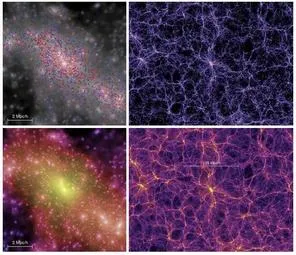
These simulations are possible thanks to the use of clusters at the institute itself, like HOPE, but she also indicated they could use a large cluster in Barcelona for which they must request usage time, as astronomers do with telescopes. Some visualizations were shown, one made at IAFE and also, because it is a huge simulation (trillions of particles), some of Millennium was shown. We had talked about that and other simulations here, in The role of the "cosmic web" and in Computers behind the mystery of dark matter. Posters and experiments After the talk, it was possible to tour the facilities. There were posters on different topics with specialists explaining their work. And we also attended (I'll explain the plural later) an experiment, on the first floor, about cosmic rays, with a homemade "cloud chamber," through which they tried to explain how muons from cosmic ray showers are detected at the Pierre Auger Observatory. The Sun, that magnetic star After leaving this cosmic ray experience, we found a poster (the photo came out bad!) about the Sun. Within the Solar Physics research area, they study the quiet Sun and transient solar activity. Transient solar activity includes highly energetic phenomena like solar flares and coronal mass ejections.
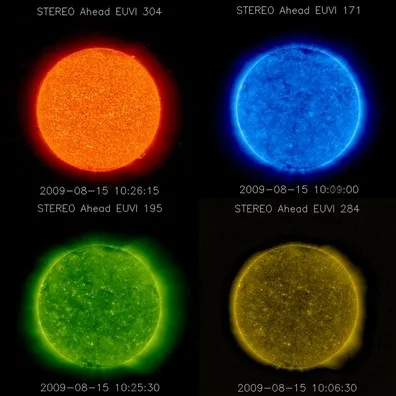
There we talked with Dr. Cristina Hemilse Mandrini (from the Solar Physics Group) and Dr. Alberto Marcos Vásquez (from the Astrophysical Plasmas Group). They are two eminences in the field who, in a very pleasant way, told us about their lines of research. Dr. Mandrini told us about her work with SOHO. Dr. Vásquez told us about his research with the STEREO probes that provide a revolutionary 3D view of the Sun. More information on NASA's STEREO page.
Vásquez's research has also been worthy of publication in top-tier journals. I mention this to account for the quality of scientists in our country and to point out how wonderful it is to be able to talk with them. With these two researchers, I was able to bring up my interest in scientific production, beyond their specific research topics. Especially to know how their research topics arise and how data publication influences them (the famous "Publish or perish"). There they talked to me about the "H-index," for example. I was also interested in the programming languages they use to create their own software. Although languages like C or Fortran are still widely used, Vásquez pointed out the IDL language as one of the most used in astrophysics. I found that the Goddard Center has a repository of IDL libraries for astronomy with links to other sites and resources. I must say I could have asked them fourteen thousand more questions, but I didn't want to abuse their trust and, also, to let the other attendees participate as well.
Ah, I also asked them how they ended up studying the Sun. There are thousands of interesting topics they are prepared for, so how and why did they choose to study solar CMEs and flares, then? Mandrini pointed out that, at the beginning, he had started studying binaries, but the Sun seemed more tangible, closer, not only in distance, of course, but in the amount of data and studies to be done. Vásquez had thought about getting into superstrings, which involves a higher level of abstract mathematical development, and decided to change, for which he had to think about different alternatives. Again, with the Sun right here close by and the quality of resolution of the data to be obtained, the amount of studies becomes extremely interesting. But plasma physicists don't live by the Sun alone, so the field is even broader. And the next one? The clock was approaching the curious hour when the small hand points to 15 and the big hand, to double that. And I had to leave, despite having a tremendous desire to continue exploring everything and consulting all the researchers eager to share their experiences. So let this serve for those who live in the Federal Capital or in the Greater Buenos Aires area and who, although these topics interest them, have not yet attended an IAFE open day. I hope these lines motivate them so that next year we meet. Time passing quickly has serious contraindications, despite which, I already wish I could attend such a formidable experience again.
Friends and eminences in sight When I left Dr. Pedrosa's talk, someone asks me "news from the cosmos?" and, pointing to himself, indicated "Universo a la vista". The good friend and blogger, with whom until now we had only been in contact by email, was there and I was lucky enough to meet him and talk with him. It's hard to find someone who has a passion for these topics, writes about them, and has their feet on the ground. There are those who assume that a certain notoriety, because their writings are public, makes them better. With Alejandro I think I share that desire to learn and the awareness of knowing that we don't know. We tackle these topics because we like them. By doing so we learn a little more, but we are far from being experts or anything like it. Although Tropea does have a brilliant talent for disseminating science with humor. And while we were telling each other what we had read, what we were writing and other bloggerly matters, figures of the stature of Dr. Gloria Dubner and Dr. Patricia Tissera (among so many others) orbited elliptically, making us feel smaller and smaller before the astronomical knowledge possessed by those who work at IAFE. Despite our smallness, something in our chests swells. It's the pride of knowing that our country continues to produce scientists of such stature, and that, as if that weren't enough, they can descend to our level and open up to the community.
Sources and related links
- (1): Galaxy Structure, Dark Matter, and Galaxy Formation David H. Weinberg arXiv:astro-ph/9610003v1
- (2): GADGET: a code for collisionless and gasdynamical cosmological simulations Volker Springel et al New Astronomy Volume 6, Issue 2, April 2001, Pages 79-117 DOI:10.1016/S1384-1076(01)00042-2
- (3): Feedback and metal enrichment in cosmological smoothed particle hydrodynamics simulations - I. A model for chemical enrichment Scannapieco, C.; Tissera, P. B.; White, S. D. M.; Springel, V. MNRAS, 2005, Volume 364, Issue 2, pp. 552-564. DOI: 10.1111/j.1365-2966.2005.09574.x
- Feedback and metal enrichment in cosmological SPH simulations – II. A multiphase model with supernova energy feedback C. Scannapieco, P. B. Tissera, S. D. M. White, V. Springel MNRAS Volume 371 Issue 3, 2006, p 1125-1139 DOI: 10.1111/j.1365-2966.2006.10785.x
- Effects of supernova feedback on the formation of galaxy discs Cecilia Scannapieco et al MNRAS Volume 389 Issue 3, 2008,Pages 1137 - 1149 DOI: 10.1111/j.1365-2966.2008.13678.x arXiv:0804.3795v2
- (4): Dark matter response to galaxy formation Patricia B. Tissera et al. Submitted to MNRAS, November 2009. arXiv:0911.2316v1
- (4): The Formation and Survival of Discs in a Lambda-CDM Universe Cecilia Scannapieco et al MNRAS in press arXiv:0812.0976v2
- Millennium Simulation
About the images
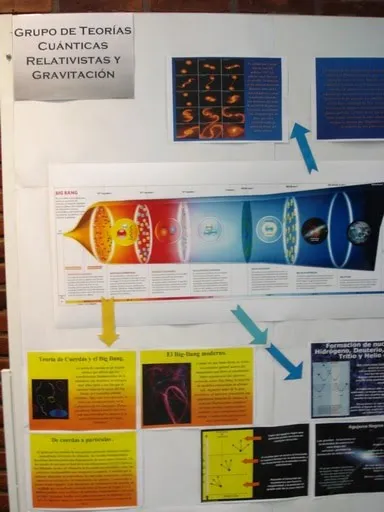
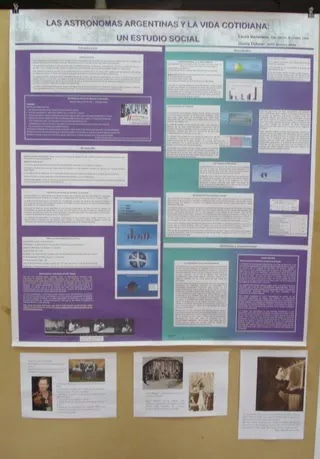
- Entrance to IAFE and Posters on various topics
- Images from the Millennium Simulation. Credit: The Millennium Simulation Project
- Images from STEREO. Credit: NASA