The completion of a 3D computational simulation to understand the mechanisms that trigger supernova events was announced. Earlier this year another one had been done and there are large cosmological simulations. There is also a work that brings together physics and art, without disguise.
from the infinite come the particles,
accelerating from above, below, in an endless dance
Lucretius, De Rerum Natura, 70 BC
The new work was done by a team from Berkeley and Princeton, led by Dr. Jason Nordhaus.
The study appears in the September issue of Astrophysical Journal and required 4 million hours of computer processing at NERSC (the computing center) on a Cray XT4 "Franklin" system.
The simulations were run using a code called CASTRO, developed by two of the paper's authors.
It is possible to see some images of the simulation:
Image 1:
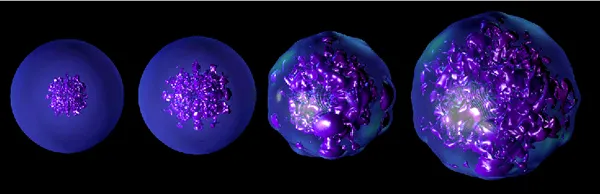
The colors show differences in entropy values. In this shot, the star is exploding and the wave is propagating.
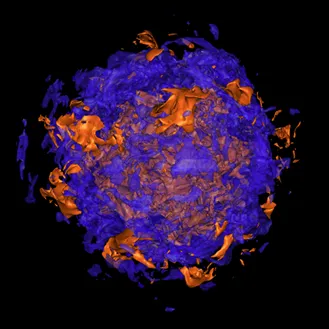
A series of the development and expansion of the supernova event. The purple/violet part is an entropy isocontour and the blue-greenish part is a density isocontour.
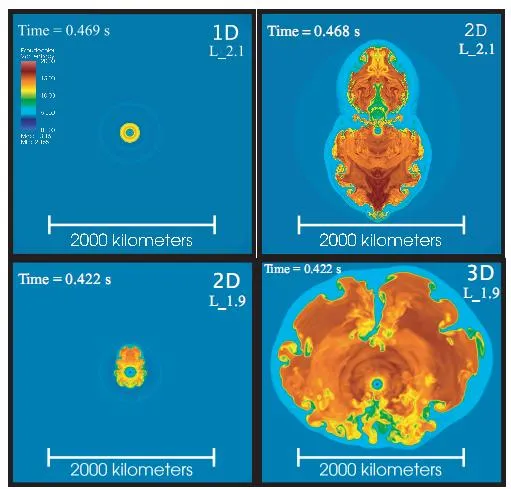
The panels compare entropy maps from two simulations, with different dimensions. The top panels correspond to 1D (left) and 2D (right)
The bottom panels are 2D (left) and 3D (right).
Background
In May, a team from Max Planck proclaimed the same thing: a three-dimensional supernova simulation.
Read the details at Universo a la vista.
Images and videos were also published then:
Image 1B:
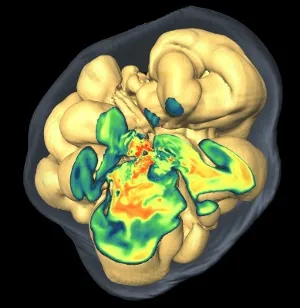
Three-dimensional simulation of about 0.5 seconds after the core bounce. The bluish, almost transparent surface is the shock front with an average radius of 1900 km.
The images show the bounce of the external mixture of certain elements in the supernova explosion from two different viewing directions: in the two upper panels: 350 seconds after the core bounce and after 9000 seconds in the two lower panels. The surfaces designate the radially outermost locations of carbon (green), oxygen (red) and nickel (blue) with a constant mass fraction.
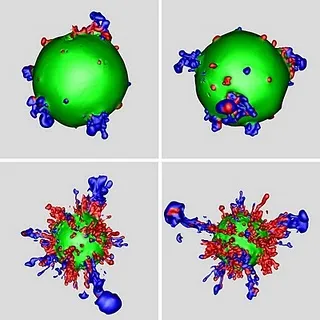
Supernova explosion: Computer simulation up to 9000 seconds
http://www.youtube.com/watch?v=8YFov4qOByA
SN1987 A
In August of this year, the obtaining of a three-dimensional view of the famous event SN 1987 A in the Large Magellanic Cloud was announced.
Images and videos can also be seen in the press release. This is not a simulation, but images with which a 3D view could be "reconstructed."
http://www.eso.org/public/spain/news/eso1032/
Watch video on Youtube: http://www.youtube.com/watch?v=37BSGdws84M
OTHER SIMULATIONS
Other simulations of this type of event were done before, but the advent of more powerful computers (clusters) only recently allowed running models with high computational requirements.
Simulations have been done using Argonne Blue Gene/P by the Flash Center at the University of Chicago. For example:
- Supercomputer to simulate supernovas
- Scientists Compute Death Throes of White Dwarf Star (03/19/2007)
- Scientists simulate natural phenomena, by Steve Koppes (04/17/2008)
- Videos on Space.com
Video 1
Video 2 - Spectacular simulations of a Type Ia supernova explosion (08/19/2008)
Differences
The different simulations make sense because they focus on different aspects, use different codes and parameters and can still reach not very different conclusions, but at the same time contribute new knowledge.
The two works from this year could be considered complementary, but they are very different. In the latest one (published, the first mentioned here) it is about comparing simulations in one, two and three dimensions. What they find is that with the same parameters, in the 3D models the events occur faster.
It is striking (or perhaps I'm looking at it wrong), but in this latest paper the previous one, from Garching, is not mentioned, although previous research by H.T. Janka, one of its authors, is mentioned.
In the earlier research, from the beginning of this year, a 3D simulation of a supernova event from a 15.5 solar mass blue supergiant is performed. They also note that, compared to 2D models, the event occurs more rapidly. They indicate that their results could be compatible with SN 1987 A, although they are cautious in this regard and point to further studies to reach that conclusion. This is because the progenitor and the parameters used do not match that event, so establishing a comparison would not be appropriate.
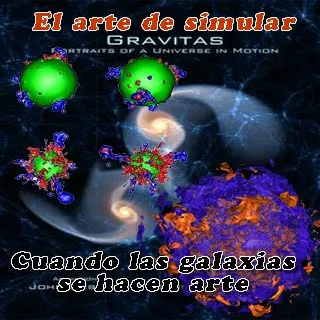
Gravitas: the art of simulation
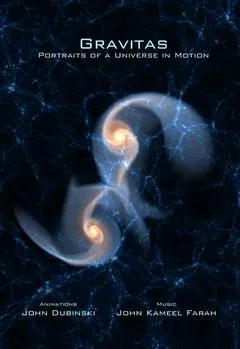
I am referring to Gravitas. It is a DVD with images and sound of galactic transformations performed on a supercomputer by astronomer John Dubinski of the University of Toronto.
Dubinski is a Canadian born in 1963, with a doctorate from the University of Toronto, who since 1993 has received fellowships and awards for galaxy simulations.
Gravitas contains animations made by him along with music contributed by John Kameel Farah. Nine computed animations are presented that show us the universe as a place in constant motion, evolving and changing in complexity over billions of years.
Gravitas presentation video by John Dubinski
The entire DVD can be viewed freely and/or downloaded as a torrent from Dubinski's website http://www.galaxydynamics.org/.
He also has videos on YouTube and an image gallery.
I invite you to download or view Gravitas, another example of the frontier between art and science, another way of saying that man is "the great simulator."
Gravitas video: Chapter "Cosmic Cruise"
http://www.youtube.com/watch?v=1xvCwVoJmRA
Sources and related links
- Dimension as a Key to the Neutrino Mechanism of Core-Collapse Supernova Explosions
J. Nordhaus (Princeton), A. Burrows (Princeton), A. Almgren (LBNL), J. Bell (LBNL)
DOI:10.1088/0004-637X/720/1/694
arXiv:1006.3792v2 - Berkeley and Princeton Scientists Watch Stars Explode in 3D
- Three-Dimensional Simulations of Mixing Instabilities in Supernova Explosions
N.J. Hammer, H.-Th. Janka, E. Mueller (Max Planck Institute for Astrophysics, Garching)
arXiv:0908.3474v2 - Visualizing Astrophysical N-body Systems
John Dubinski
arXiv:0805.4397v1
About the images
- Images 1, 2 and 3 by Jason Nordhaus and Adam Burrows, Princeton University.
- Images 2b and 3b by Max Planck Institute for Astrophysics.
- Images and videos from Gravitas by John Dubinski.