Today we celebrate Pi Day and Albert Einstein's birthday.
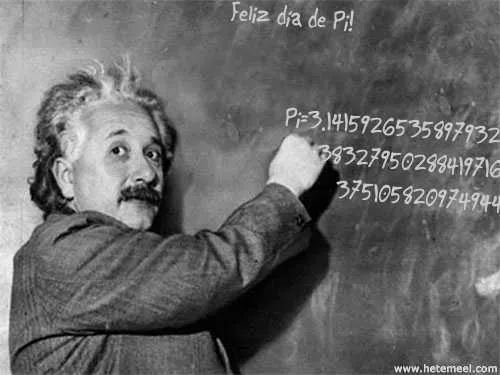
For Americans, who write the date in MM/DD format, today is 3/14. Physicist Larry Shaw then came up with the idea of celebrating Pi Day on this date.
Pi is an irrational number that has generated all kinds of studies and discussions.
It should be noted that since the rest of the world does not use the American date notation, Pi Day is celebrated on other dates such as 22/7, since dividing the numbers yields a good approximation of Pi. Those days are called "Pi Approximation Days".
Rare birds
Among the curious applications is the Pi year calculator. It is a web page where we enter our birth date and it returns the number of "Pi years" we have and the past and future "Pi birthdays".
I suppose it works this way: Our birth date is subtracted from the current date. For example, I was born on 01/14/1973. Subtracting that date from today, 03/14/2010, gives about 13573 days, which divided by 365 (an approximation that does not account for leap years) results in 37.1863 years. Divided by Pi, I then have 11.83 years.
To calculate past and future Pi birthdays, it's a bit more complex, but basically the idea is that every 3.14 years (more decimals for greater accuracy) we will turn a year older. If I was born on 01/14/1973, the first Pi birthday was 3.14 years later, on March 6, 1976, and I would reach the age of majority on August 2, 2029!!!
Albert Einstein, following the same logic, having been born on 03/14/1879, would be 41.73 Pi years old.
Writing in Pilish
Pilish is a "language" in which the length of the words matches the digits of pi (=3.14159265358979323848...):
| Today | and | yesterday | and | then | I will celebrate | the | glory |
| 3 | 1 | 4 | 1 | 5 | 9 | 2 | 6 |
| Never | more | never | will I embrace | custom | opposite | symbolic | ugly |
| 5 | 3 | 5 | 8 | 9 | 7 | 9 | 3 |
One way to search for words of a specific character length is to consult palabras.net, and in the process, expand our vocabulary.
Pi in the sky
Robert Matthews combined, in 1995, astronomical data with number theory: he used the fact that for a collection of random numbers the probability that two do not have a common factor (relatively prime or coprime) is 6/pi2. We recall that numbers have a common factor if they are divisible by the same number (not including 1). For example, 4 and 15 are not divisible by the same number, but it does occur with 12 and 15, since both are divisible by 3.
Matthews calculated the angular distance between the 100 brightest stars in the sky and thus obtained a set of numbers, of which 61% have no common factor, obtaining a value for pi of 3.12772, which is 99.6 percent correct.
To verify this with any set of random numbers we must proceed as follows:
We take a set of integers greater than 1, for example {2, 3, 4, 5, 6}. Then we must know in how many ways we can combine them. In this case there are 10 possible combinations: (2,3), (2,4), (2,5), (2,6), (3,4), (3,5), (3,6), (4,5), (4,6) and (5,6). Six of these 10 pairs have no common factor (except 1): (2,3), (2,5), (3,4), (3,5), (4,5), and (5,6).
6/pi2 = 6/10. Solving for pi we get 3.1623.
To know how many possible combinations there are we must use combinatorics. A formula used is:
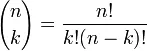
The symbol ! means factorial and n is the number of elements in the set and k the desired subsets. For 5 elements taken 2 at a time, n=5, k=2.
With the formula, n! /k!(n-k)! we will do 5! /2!(5-2)!:
120 / 2x3!
120/2x6
120/12=10
If we don't have a calculator at hand, we will simplify:
5x4x3x2x1 /2x1(3x2x1)
and we are left with:
5x4/2=10
Note:(The indicated formula is used and not another similar one, where the divisor is directly (n-k)!, since this second form would imply duplicating values. The combination (2,3) and the combination (3,2), for this case, are the same, when looking for whether there is a common factor between two numbers because it does not depend on order. If we applied that form, the result would be 20 (120/6) and not 10. The indicated formula, therefore, does not include these duplications).
Pi on TV
Alterados por Pi is one of the best programs on television, at least for those of us who are curious and interested in mathematics, even if we are a bit slow! Adrián Paenza hosts this series on Canal Encuentro and this is a good excuse to recommend it again. Greetings, Adrián!
Sources and related links
- Gaussianos: Celebrating Pi Day infinitely
- Pi Day
- Happy Pi day!
About the images
- Pi illustration. Steph Goralnick/Getty