Astronomers will spy on the deep universe in five directions to document the early history of star formation and galactic evolution in an ambitious project that will require a large amount of observing time from the Hubble Space Telescope.
By observing more than 250 thousand distant galaxies, the project will provide a comprehensive view of the structure and formation of galaxies during the first third of cosmic history (z=8 to 1.5). It will also provide crucial data on the early stages of supermassive black hole formation and will find distant supernovae, important for understanding the dark energy that, they say, accelerates the expansion of the universe.
The project leader is Sandra Faber, from the University of California, Santa Cruz, who noted that the effort will rely on the power of the new infrared camera, the WFC3 as well as Hubble's Advanced Camera for Surveys (ACS). The proposal includes an international team and was awarded a record 902 orbits of observing time, as one of the three large projects chosen for the Hubble Multi-Cycle Treasury program. The observing time, over about three and a half months, will be used over the next two to three years.
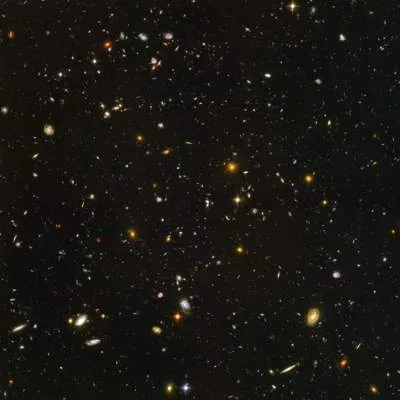
Let's remember the power of Hubble, with the famous HUDF (Hubble Ultra Deep Field) image, which was re-released last year.
"This is an effort to make the best use of Hubble while it is at the peak of its capabilities, providing a great legacy of data for the future," said Faber.
The committee that reviewed proposals for the large Hubble Multi-Cycle Legacy Program asked Faber to combine her proposal with a similar one from Henry Ferguson, an astronomer at the Space Telescope Science Institute (STScI), so they will work together with more than 100 researchers from dozens of institutions in several countries.
"We want to look very deeply, very far back in time, and see what galaxies and black holes were doing back then," commented the scientist.
Faber and her colleagues expect the first data to be available by the end of the year. The project data will be available to the astronomical community without a proprietary period for Faber's team to conduct its own analysis. The result will be an intellectual race of scientists to publish the first results from this new treasure trove of data. But, according to Faber, the project will generate so much data that it will keep astronomers busy for several years.
Sources and related links
UC Santa Cruz: New Hubble treasury project to survey first third of cosmic time
About the images
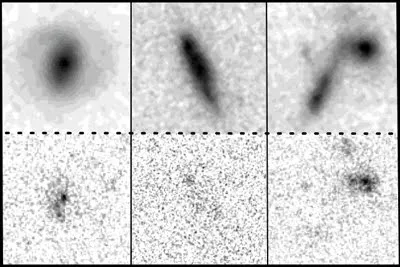
Top: The galaxy images in the Hubble Ultra Deep Field show the power of the new WFC3 camera (top row) and the previous ACS (bottom row).
Middle: 2004 HUDF image.
Credit: NASA, ESA, S. Beckwith (STScI), HUDF Team.