Researchers developed software that uses mathematical models to help astronauts better adjust to shift changes and will also serve outside of space.
Shift changes at work can wreak havoc on a person's ability to sleep and result in poor performance.
Researchers at the National Space Biomedical Research Institute (NSBRI) developed a program to help people with sleep problems due to their schedule changes, focusing on the issues of astronauts, although it will also serve other people here on the Earth's surface.
"The best methods we know to help people operate at their peak performance are, first, to ensure they have adequate sleep and, second, that their work shifts are designed to be aligned with the body's natural clock," said the project leader, Dr. Elizabeth Klerman.
The physician, from the Division of Sleep Medicine at Brigham and Women's Hospital, commented that the software has two components. The Circadian Performance Simulation Software (CPSS) uses complex mathematical formulas to predict how an individual will react to specific conditions. It also allows users to interactively design a schedule and predicts whether that schedule is expected to work well or not.
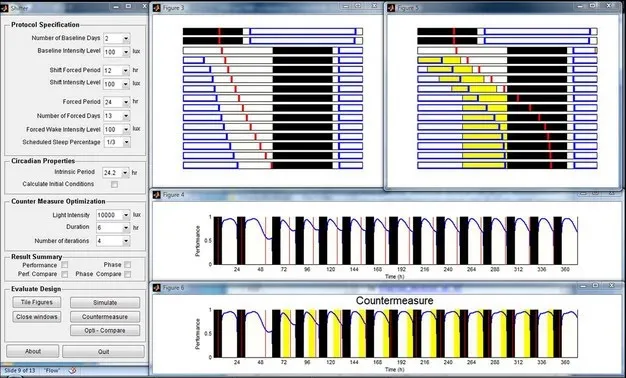
The second component, known as Shifter, "prescribes" the optimal times in the schedule to use light to shift the person's circadian rhythm to improve performance at critical moments.
"If there is a mission event, like a spacewalk, scheduled at one or two in the morning, what can we do to help the astronaut stay alert and functioning well the whole time? Do we suggest they take a nap or caffeine? Do we change the sleep schedule? There are a variety of options we would like to be able to provide," explains the scientist.
Researchers know that an individual's performance and ability to stay alert are regulated by several factors related to circadian rhythms and the sleep-wake cycle, but also by the intensity and wavelength of light, the amount of sleep from the previous night and our body's perception of time. As a result, most people are not able to operate at peak performance on the night shift.
The situation on the International Space Station (ISS) for astronauts is complicated because they face irregular schedules and unforeseen or last-minute changes.
With the basic program completed, researchers are working to individualize the model. They want to determine what personal data is necessary to provide appropriate recommendations.
Outside the ISS and the space industry, the program could help medical, security, firefighter, transportation personnel and other professions that face this type of schedule change or night shift. In many of these professions being alert and having good performance will not only help those workers, but the rest of society, due to the importance of their tasks.
Klerman warns that lack of sleep can affect more than people's performance. General health is affected, with lack of sleep being associated with an increased risk of obesity, pre-diabetic conditions, reduced response to vaccines and changes in cardiovascular functions.
Mathematical modeling is one of several efforts carried out by NSBRI to improve these situations and to determine what type of lighting can improve astronauts' performance.
The biological clock under the Argentine microscope
In our country, Diego Golombek has studied the topic and published, for example, «El ciclo sueño vigilia», Cronobiología humana. Buenos Aires: Editorial Universidad de Quilmes, among other works.
"We have a biological clock. And it's not a concept, it exists: it's an area of the brain that tells the body what time it is and that controls the biological rhythms of the organism. Among them, the cycles of sleep and wakefulness," explained Golombek in a Clarín article about how to adapt children to this cycle before the start of school.
How do astronauts sleep?
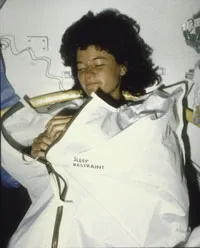
On the space shuttle astronauts must strap themselves to the seats or use sleeping bags that must also be strapped down to avoid floating and they avoid the pilot's cabin to stay away from the light. On the ISS astronauts have the Zvezda module with small compartments where they hang sleeping bags and other personal effects.
Studies on astronauts make sense despite President Obama's cuts and in light of Obama's recent changes for NASA.
Sources and related links
- What is it like to sleep in space?
Sue;o espacial
Las Siestas en la NASA
Bien Despiertos en el Espacio Exterior
Sleeping Better in Space
¿Dormir, tal vez soñar en el espacio? - Sleeping in Space is Easy, But There's No Shower
About the images
Image of Shifter, courtesy of Elizabeth Klerman, M.D., Ph.D./Brigham and Women’s Hospital.
Astronaut Sally Ride, in her sleeping bag during a flight aboard Challenger II. Credit: NASA
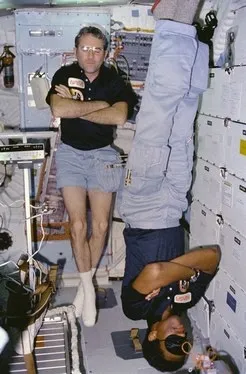
Photo of Richard Truly and Guion Bluford. Credit: GRIN NASA
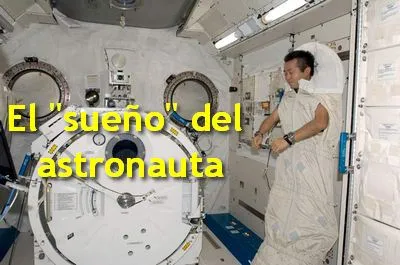
Japanese astronaut Koichi Wakata sleeps in the Kibo laboratory of the ISS on May 7, 2009. Credit: NASA