The Icarus Project is a theoretical study with the goal of designing an interstellar probe that serves as a concept for a potential mission that could be launched before the end of the century. Icarus will use fusion-based technology that will accelerate the spacecraft to nearly 10% of the speed of light.
This post is part of the III Carnival of Physics (CdlF) which, on this occasion, is hosted by the blog Leonardo Da Vinci, by Toranks.
It is an initiative of the Tau Zero Foundation in collaboration with the British Interplanetary Society (BIS). Both organizations, as indicated on the Icarus Project site, promote the vision of human space exploration.
The goal of designing a credible interstellar spacecraft, not science fiction, is enormous, so they divided the research into 20 modules, each of which has submodules. The project has three stages:
- Establish an initial design team and complete the terms of reference by September 2009
- Finish assembling the design team
- And build a research program for early 2010.
These three stages are like the major parts of a book that, in addition, contain chapters. In this case, the parts must be broken down into phases, which are 10.
They estimate that, with 20 volunteer designers, the Icarus Project will require about 35 thousand man-hours in total, over 5 years.
A continuation of the Daedalus Project
In comparison, the Daedalus Project began on January 10, 1973 and the final reports were published on May 15, 1978. That project was also carried out by the BIS with the same objective as Icarus. The goal was to reach Barnard's Star, almost 6 light-years away, with an unmanned probe, which at that time was believed to have at least one giant planet. The idea of exoplanets in Barnard was suggested by astronomer Peter Van de Kamp, however the planets were never found. Furthermore, they wanted to examine the Fermi Paradox: the contradiction between estimates that state there is a high probability of the existence of intelligent civilizations in the universe, and the absence of evidence of said civilizations.
For economic reasons, that project does not seem viable in the 21st century.
Interstellar Communications
On the weblog of the Icarus Project we can find some interesting articles, like the one by Pat Galea about interstellar communications. There Galea indicates that when sending a spacecraft to a star we wish to collect data and send it to Earth. This may be possible in several ways, such as
- Sending another smaller spacecraft to Earth with the data
- Using radio signals
- Using optical signals
- Using exotic techniques
The first option is not as absurd as it may seem, Pat indicates and refers to the idea of high latency, high bandwidth. In Centauri Dreams, the Tau Zero blog, they recall Vint Cerf, the TCP/IP guru, reminding a small group of JPL researchers to "Never underestimate the bandwidth of a truck full of DVDs," a reference commonly used in latency descriptions in those days.
In short, it takes a long time, but a lot of data is also sent. But they have serious drawbacks. If a "load" is lost, a lot of data is lost. Not to mention the fact of having to have a small spacecraft, with all that implies and which seems to rule out the option.
Option 2 is an extension of current systems. Radio signals have longer wavelengths than light, but the beam disperses significantly. For that, the Daedalus Project made two suggestions:
That the reaction chamber of the spacecraft's engine be shaped like an antenna and used for that purpose, after the propulsion phase; and that on Earth (or in near space) a huge array of receivers be created.
Option 3 is an alternative to the previous one, but with lasers. Here, according to Pat, the problem is keeping the target with precision.
Option 4 covers a very broad range. A suggestion by Claudio Maccone is the use of gravitational lenses, like a large telescope that uses the gravitational power of two stars. One of the stars would be the one the spacecraft approached to study. The other would be our Sun, near which - at 700 Astronomical Units - there should be another spacecraft. The interplanetary probe would send the data, the nearby star would gravitationally focus them and send them through space. Years later they would reach the Sun and from there to the spacecraft in its vicinity.
Other suggestions included using gravitational waves or neutrinos to send data. The strange thing is that interstellar communication problems were thought of so early, around 1977.
A little problem: propulsion
The basic principles of rocket propulsion are described by Newton's 3rd law of motion, commonly called "action and reaction." A rocket propels itself by expelling material at high speed, in a direction opposite to its motion. The material is usually a gas and the heat of a chemical reaction imparts the speed. The heat generates pressure in a combustion chamber and is converted into exhaust velocity by means of a properly designed pipe. The principle is quite generalized and applies equally to the motion of a garden sprinkler as to the powerful thrusters of the space shuttle.
In current rockets it is necessary to carry the fuel (liquid or solid) and the oxidizer, normally oxygen.
Let's move on to fusion
On Earth we benefit daily from the nuclear fusion reactions that occur permanently in the Sun. A fusion reaction occurs when two hydrogen atoms collide to create a helium atom that releases energy. The process includes the combination of the two hydrogen atoms to form one of deuterium, a positron and a neutrino. A proton combines with the deuterium and forms helium-3 (two protons with one neutron) and gamma rays. Two helium-3 atoms combine and form helium-4 (two protons and two neutrons) and two protons.
This is possible because stars are very hot environments (plasma) impossible to achieve on Earth. However, plasma is a good conductor of electricity, which is possible to sustain thanks to accelerated magnetic fields.
NASA has a set of pages on propulsion alternatives at Warp Drive, When?
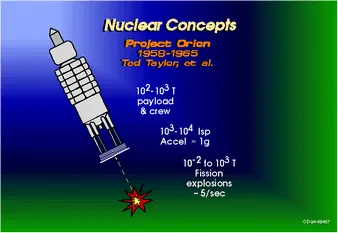
Project Orion: The first example is from the 1950-1960 decade. Project Orion used nuclear bombs. Kelvin Long comments on the motivations behind fusion propulsion and alludes to arguments by Freeman Dyson in his autobiography Disturbing the Universe in which he clearly does not support the Orion proposal, due to the radioactive waste it would leave behind.
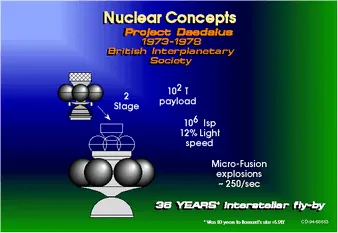
Project Daedalus was designed to use micro-explosions that relied on obtaining fuel from appropriate isotopes from Jupiter.
The Bussard design was based on not carrying the fuel, but on collecting protons from interstellar space.
Another possibility is light sails. When light hits an object, it pushes it slightly. With a lot of light over a very large area, the force becomes noticeable. It is a proposal by Robert Forward using a 10 million gigawatt laser, a level 10,000 times greater than the energy used on the entire planet today.
Variable Specific Impulse Magnetoplasma Rocket
VASIMIR is a plasma rocket, a precursor to fusion propulsion. The project's intention is to create a plasma ion engine that serves as a cheap and effective alternative as a propulsion power source for spacecraft.
Another considered option is the Gas Dynamic Mirror Fusion Propulsion (GDM) which uses a solenoid (a coil) around a vacuum chamber with plasma trapped in the magnetic fields created in the central section.
See: Gasdynamic Mirror (GDM) Fusion Propulsion Engine Experiment
Gas Dynamic Mirror Fusion Propulsion Engine
These are not the only options. Many more have been proposed, such as using antimatter. Even antimatter factories in space and somewhat more viable ways of trapping antimatter have been proposed.
NASA's Breakthrough Propulsion Physics (BPP) Project ended in 2008, but its contribution was assistance in compiling a technical book: Frontiers of Propulsion Science, by Marc G. Millis published by the American Institute of Aeronautics and Astronautics. Millis is the founder of Tau Zero. It is a collection of essays on propulsion alternatives.
The myth of Icarus, aeronautics, and obedience

In Greek mythology, Daedalus was a very skilled architect and craftsman, famous for having built the labyrinth of Crete in which King Minos wanted to imprison the Minotaur. In this labyrinth, Daedalus and his son Icarus were imprisoned. To escape, Daedalus built wings of feathers and wax for himself and his son. The father warned the little one not to fly too high because the heat of the Sun would melt his wings. The impatient Icarus ignored his father and as he ascended high, the wax melted and he fell mortally into the sea.
It is to be hoped that, if Project Icarus is finally realized, those who handle the spacecraft will not ignore Daedalus and will obey him. And, if we are talking about obedience, Yves Montand stars in a film -that no one should miss- called I... as Icarus. There, a prosecutor tries to get too close to a Truth, with its predictable and dire consequences for him.
But the film also includes an experiment linked to obedience and the roles of supposed scientists. It's better to watch the film and, in any case, read an analysis of the experiment later.
Ah...Daedalus is also an eponym for a crater, on the dark side of the Moon.
Sources and related links
- Icarus: An Early Look at Communications
- Project Icarus
- Space Communications Technologies for Interstellar Missions
- The Encyclopedia of Astrobiology Astronomy and Spaceflight:Daedalus, Project
- Starship Daedalus
- The Daedalus Starship, by Alan Bellows
- How Fusion Propulsion Will Work
- Project Icarus and the Motivation Behind Fusion Propulsion, by Kelvin Long
- The rocket engine
About the images
- Project Icarus logo. Credit: Tau Zero/BIS
- Tau Zero Foundation logo
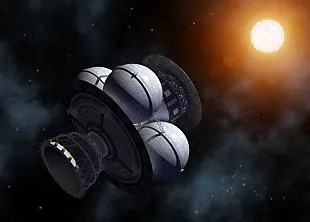
- Project Daedalus illustration. Credit: Adrian Mann
- Nuclear Concepts Orion and Daedalus images. Credit: NASA