KOSMOSLOGOS ARCHIVEAutomatic translation of the original Spanish post by Gerardo Blanco (KosmosLogos, CC BY-SA 3.0). Read the original in Spanish. /2010/04/un-decimo-de-uno-por-ciento-de-nada.html
How much do we know about the universe, the world, nature? A lot, a little, a tiny bit?
Wayne Hale, a NASA engineer, reflects on his blog about the state of science and the future.
"There are more things in heaven and earth, Horatio, Than are dreamt of in your philosophy." Hamlet, Act 1 Scene 5
"We like to believe we know everything, or almost everything. Ask someone on the street and they will tell you exactly how the world works," notes on his blog Wayne Hale, a 55-year-old NASA engineer who was a space shuttle flight director.
What follows is a translation, not verbatim, not complete, of his reflections, which can be read, in English, in his article "One tenth of one percent of anything". The title of this blog post is a translation of the title with which the NASA man heads his online thoughts.
In Shakespeare's most profound work there are several remarkable statements about who we are and really how much we know. Horatio and Hamlet are students at the University of Wittenberg. Horatio studies natural philosophy, the "science" of that time. Like all good students of the subject, he believes the universe is well understood and that we know our place in it. Hamlet, on the other hand, is not so sure.
In those days, the future was unimaginable. [...] But a revolution was lurking, because the "natural philosophers" were discovering a little bit more about how the universe works.
Copernicus and Kepler, based on Tycho Brahe's observations, found that we are not the center of the universe, other planets orbit the Sun, just like Earth. This improved the understanding of the universe, along with, perhaps, an apple falling from a tree that inspired Newton to formulate new laws of science. Laws that became the basis of a social and technological revolution: the industrial revolution. Shakespeare, Hamlet, the ancient Greeks and Romans could not imagine the steam engines, railroads and industry that would come in the following centuries.
In the midst of the industrial revolution, everyone was sure, like Horatio, that we perfectly understood our place in the cosmos and the laws that govern the universe. But William and Caroline Herschel made incredible observations that, again, changed the understanding of what we are. We live in a galaxy of stars, the Milky Way is not just a bright cloud, but an island universe. Herschel did more, by discovering what we now call infrared radiation. [...]
In the 19th century we also kept believing we knew everything. But radio, television and the applications of electricity were impossible to dream of. Only after James Clerk Maxwell and after his theoretical work was put into practice did new industries emerge that until then were inconceivable.
[...] Shortly after, Edwin Hubble began his observations with the Hooker telescope on Mount Wilson and found other galaxies moving at incredible speed. At the same time, an employee of the Swiss patent office postulated new laws of physics. The previous century no one had imagined electronics, computing.
Now, of course, we believe we know everything about the universe. All the laws of nature were discovered and published by Einstein, Maxwell and Newton. All possible industries have been invented. Perhaps it's time to close the patent office.
But, wait a minute. With the Hubble telescope, problematic observations were made, almost impossible to understand. Not only are we not the center of the universe. We don't even know what the universe is. We have only seen 5% of the universe. Dark matter and dark energy, both unobserved, would make up 95% of the cosmos. [...] Where does this lead? Who will explain it? When will the new Newton, Maxwell or Einstein appear?
Unfortunately serendipity does not arrive on a precise schedule. The great leaps in knowledge are not predictable. But one thing is certain: we must first understand that we do not understand. [...]
It is clear that Hale is not trying to say that the acquired knowledge is useless, but that there is much we still do not know. And being aware of that is vital to continue exploring, asking, observing. We don't know where this will lead us.
According to Hale, each step improves the life of humanity. This is true. Although, I say, there are unwanted "side effects" and undesirable consequences that were achieved on purpose.
Aside from the technological consequences, I think that in human beings there is a search for knowledge, a perhaps innate curiosity, maybe a product of us thinking that everything has a cause.
Hale ends by exhorting us to keep searching.
"If we do not continue searching, observing, exploring, we will cease to innovate, we will stop growing, and we will begin to die."
A great American inventor, Thomas Alva Edison once said: "We don't know a tenth of one percent of anything." Better to leave the patent office open.
And Hale ends his blog with another quote, from Robert Goddard, clearly linked to space exploration: "It is difficult to say what is impossible, for the dream of yesterday is the hope of today and the reality of tomorrow."
So far an extract of the main paragraphs from the NASA engineer's blog. In the comments, Donald Rumsfeld is quoted, who was U.S. Secretary of Defense under the presidency of Gerald Ford and George Bush. Rumsfeld's resume may not be likable, but his words are food for thought:
"There are known knowns. These are things we know that we know. There are known unknowns. That is to say, there are things that we now know we don't know. But there are also unknown unknowns. These are things we do not know we don't know." It should be said that Rumsfeld's reflection has been as praised as criticized.
Hale's post reminded me of a story by Isaac Asimov, "The Secret of the Universe."
In that story, the prolific popularizer and scientist begins by talking about paradoxes, among which he mentions the famous Achilles Paradox. From there he continues with the concept of infinite series, convergent and divergent.
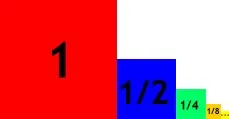
Consider, regarding the first ones, the series 1+1/2+1/4+1/8+1/16... How to represent this?
Imagine squares with those numbers as the length of their sides, placed side by side, from left to right, from largest to smallest:
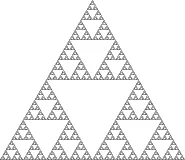
All these squares, all of them, would occupy a length of two centimeters. The squares become extremely small as the series progresses. The 27th square has a side of 1/100,000,000 of a centimeter. But let's imagine now that we enlarge it one hundred million times and it will seem to us to have a side of 1 centimeter and then we can continue as if we started another series equal to the previous one. This is self-similarity, which we can also find in divergent series, in a snowflake, in a tree, and so Asimov goes on to tell about Mandelbrot and fractals.
At that point, the story changes and veers towards the conversations the author of "Foundation" had with physicist Heinz Pagels. On one occasion the latter asked Asimov, "Do you think it's possible that one day all the questions of science will be answered and there will be nothing more to do? Or is it impossible to find all the answers? Is there any way we can know right now which of these two situations is the correct one?" To which Asimov replied: "I believe that, essentially, the Universe presents very complex fractal properties, and that scientific activity shares these properties. Consequently, any aspect of the Universe that is not yet understood and any aspect of scientific research that has not yet been resolved, no matter how small compared to what is already understood and resolved, is of a nature as complex as that of the original Universe. So we will never finish. No matter how far we go, the road ahead will be as long as at the beginning, that is the secret of the universe.