Astronomy is an observational matter where the possibilities of discovery play an important role. A wide range of these findings is continuously made, from the trivial to the highly significant. But, as Pasteur expressed, chance favors the prepared spirits.
The English term used to designate fortuitous scientific discoveries is "serendipity" and comes from the story of three Persian princes who lived on the Island of Serendip and solved their problems by chance. This is how Horace Walpole in a letter to Horace Man coined the term.
The Real Academia Española has not incorporated the idea, although Wikipedia has: Serendipia.
What follows is a translation, not complete nor verbatim, of an article by Andrew Fabian, from the University of Cambridge.
In contrast with laboratory science where the goal is to plan and carry out experiments under controlled conditions, astronomers, in general, cannot do that exactly and must rely on or find something or a situation that fits. Usually, the possibilities thrown by a phenomenon are only appreciated a posteriori, after the naked surprise.
A good example is the discovery in 1979 of the volcanoes on Io by Voyager I. This phenomenon was seen by a navigation engineer, Linda Morabito, instead of one of the project scientists. Io, we know today, is the most volcanically active body in the Solar System.
That "chance favors the prepared minds" implies both an element of luck and a prior understanding of what is normal. Making a successful discovery in astronomy is not comparable to buying a lottery ticket and then waiting sitting down, but rather requires a deep familiarity with the sky, the universe, the physics of the cosmos. Discoveries are not made without observations and they cannot be identified without recognizing when something is new. As some examples in chemistry clearly demonstrate, a certain "clumsiness" or at least a deviation from what would be best practice also seems necessary. The history of synthetic indigo illustrates this point. (1)
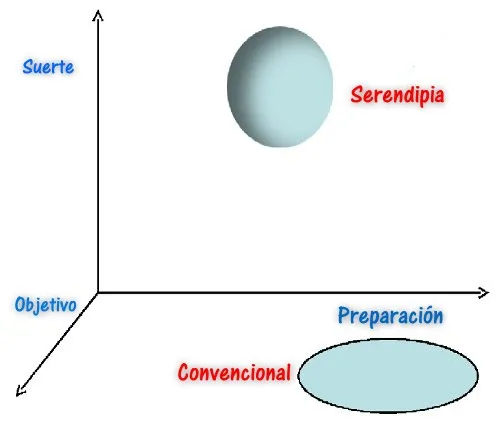
A graph on how I define serendipity is shown in figure 1. The axes of this three-dimensional figure are: luck, preparation, and goal. Pure serendipity lies in the luck-preparation plane, while perfectly planned or Kantian (2) experiments are in the preparation-goal plane. In reality, fortuitous findings have some goal (Archimedes was surely thinking about the problem of estimating the volume of an irregular object when he took his famous bath.
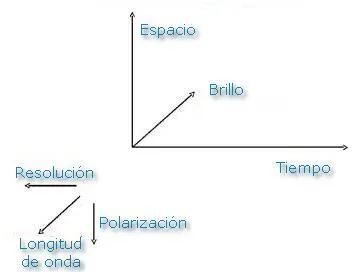
A way to categorize discoveries is through figure 2, Discovery in space.
New things are generally found when exploring new parts of space. We need to go more than three times deeper into space to find new things. Here there are not only dimensions of time and space, but also of spectral band (radio vs visible), resolution (different frequencies or colors), polarization, etc. A familiar analogy to multi-dimensional space is provided by our senses: hearing is different from smelling or seeing and if we improve those senses we will discover new things. Imagine having the olfactory sensitivity of a dog or the sensitivity to electrical activity of a shark!

Serendipity usually involves an element of surprise, which implies an emotional quality to scientific work. Like a good joke that seems to head in one direction before jumping to another, the same with fortuitous discoveries: a "Eureka" moment can make our train of thought jump to new directions.
Note that the discovery will not always make us famous. Stigler's law of eponymy says that no scientific discovery is named after the person who discovered it in the first place. In fact, the discovery of that very law is attributed to Robert Merton.
The term "fishing expedition" is used in the legal field (3) for example when trying to review a place in greater depth with the aim of finding anything that could reveal evidence about the existence of a crime. It is also applied, in a derogatory manner, in other fields, for example when requesting observation time from observatories and funds.
Despite this, much new scientific knowledge arose from the mix of chance, preparation, and goals. Being in the right place and time, but without the necessary knowledge to know how to interpret a phenomenon, would not produce a finding because we could not discern the novelty.
Some cases:
-Jocelyn Bell and team were looking for the so-called "radio stars" in the late 1960s and ended up discovering pulsars.
-Gamma-ray bursts (GRBs) were discovered by US military satellites in 1967 that were doing intelligence on Soviet military activity
-In 1979 it was believed that a double quasar had been discovered, but it was actually a gravitational lens.
-The cosmic microwave background radiation was accidentally discovered by Penzias and Wilson when installing an antenna, although it had been theoretically predicted by Gamow, Alpher and Hermann. It is possibly the best evidence about the big bang. In the same sense, Edwin Hubble was not looking to determine if space is expanding when he made his famous observations around 1929.
An area of astronomy in which serendipity plays an important role is the search for extraterrestrial intelligence, says Fabian and explains the famous Drake equation.
Certainly a casual finding could be made if a signal of extraterrestrial intelligence ended up being discovered in a way different from current conscious efforts. It could happen that an advanced civilization, instead of communicating with radio signals, did it in another way and that we discover it while looking for something else.
Martin Harwit, a Czech-American astronomer predicted that these casual discoveries will decay as more and more things are discovered.(4)
As we pointed out in the section below, unexpected findings have been made in astronomical observations in recent years.
There are those who claim that, since serendipity has given good results, we should look for patterns of nature where they are not thought to exist. But if that is the goal, as graphed above, we would already be in the territory of conventional discovery. However, there are initiatives with broad or not so specific goals, for example, the cross-referencing of different data already acquired in search of some "abnormality". A project in that sense is DASH, as we told in "Searching in the archives of the universe".
Therefore, the degree of preparation and the pursuit of the objective will continue to be part of the scientific procedure. But also the surprise. Nature is everything we already know. And everything we have yet to discover, in part, thanks to serendipity.
Everyday serendipity
It goes without saying that new knowledge found by chance occurs in many other human activities, and not only scientific ones, although the term Serendipity is generally applied to the latter.
Many software programs contain a random help or tip, called a "tip of the day".
And it may also have happened to you with photography. It is possible to discover a detail of the landscape or of the people that was not sought to be portrayed and that is found when examining the result.
Another form of non-scientific fortuitous discovery is very close at hand. The famous "I'm feeling lucky" button on Google. But there are those who have gone further and see serendipity as a new paradigm for information search.
At this point, it is often very satisfying to find something valuable "by accident", whether on the web, in a book, or simply, in a conversation.
Latest fortuitous discoveries
At least, in recent years, this has not stopped happening. I review some of the notes published here related to "unexpected" discoveries:
Hubble solves mystery of lonely galaxy
The study leader, Alessandra Aloisi, and her team, discovered the new distance of galaxy NGC 1569 by accident.
Massive cluster in the distant Universe:
The new object had been observed for the first time, by chance, when ESA's orbital X-ray Observatory, XMM-Newton, was studying another celestial object, and was listed in a catalog for future follow-up.
A not-so-normal supernova:
On January 9, 2008, the Swift satellite accidentally discovered a long 5-minute X-ray burst in the spiral galaxy NGC 2770. The satellite was studying a supernova (SN 2007uy) that exploded the previous year in the same galaxy, but the burst came from another supernova: SN 2008D.
Chance finding of rare event in a quasar:
The discovery was initiated by Kyle Kaplan, a student from Santa Cruz who noticed peculiarities in the spectrum that had been recorded of the quasar.
They find the galactic center while it is off:
They expected an active center and found much less activity than expected.
Runaway stars shine in the cosmos:
The team examined 35 objects that appeared as bright infrared sources. They were looking for pre-planetary nebulae when they found these runaway stars.
Sources and related links
- Serendipity in Astronomy
A.C. Fabian (University of Cambridge, UK)
arXiv:0908.2784v1 - Centauri Dreams: The pursuit of serendipity
- Serendipi...WHAT?
Notes
- Science by chance
- (1) History of Technology, Volume 3, page 796
Thomas Krusston Derry, Trevor Illtyd Williams - (2) Immanuel Kant versus the Princes of Serendip:
Does Science Evolve through Blind Chance or Intelligent Design?
Sheldon Lee Glashow - (3) Criminal Procedure: "Accidental discoveries in the course of a house search or an interception of communications", Juan Tapia
- (4) Cosmic Discovery: The Search, Scope, and Heritage of Astronomy
Harwit, Martin, Basic Books, NY, 1981; MIT Press, 1984.
About the images
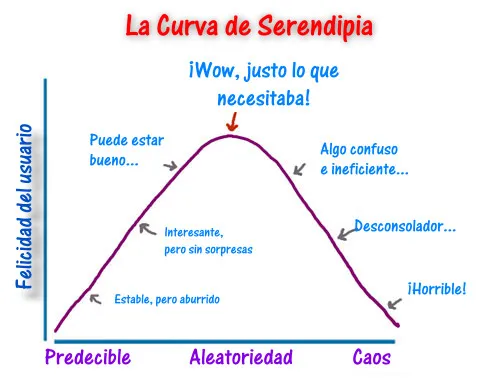
- Serendipity Curve. From "Add a little more random to your product"
- Cover image of the book On the serendip road at
The Three Princes of Serendip - Graphics 1 and 2, Credit: A Fabian