What do science and morality have to do with each other? Is thinking about multiverses immoral? Is doing non-useful science immoral? Is researching astrophysics immoral?
A while ago I participated in a talk among several people, many of whom are related to the world of art. The conversation revolved around the low participation of art in the media. A young lady noticed my stern expression and asked me if I disagreed. My answer was that I actually see the opposite, particularly on television, and that what I do see with concern is the lack of science in the media.
The first part of what followed was a distinction between the concepts of art and spectacle.
Then, regarding the importance of science, they talked about a news item from those days, linked to NASA, and from there they moved on to the enormous amounts of money "spent" on space exploration, something that many there considered "immoral".
Since then I've been wanting to address these ideas here and add others that have been discussed on the subject.
Last year Sam Harris gave a talk at TED that I recommend listening to carefully. I think it's brilliant, not so much for its answers, but for its questions.
What I remember from the talk, or part of what I took away from watching it that time, was the following: science influences our moral ideas.
Let's think about this: many people become vegetarians. I myself have been trying lately to eat less meat. That is generally reached because of the fact that we "kill" to eat, in the case of animals, and we make them suffer mercilessly, but it doesn't seem that vegetarians care much about that same thing with respect to plants.
Potatoes and beets don't scream like a pig.
But what would happen if science proved that beets suffer as much as a pig when pulled from the ground?
Our moral dilemmas can be constrained by imperfect notions, by ignorance. Science, therefore, by answering those questions, marks a moral path.
We believe it is immoral to kill cows or monkeys, but not insects. Traditions and organizational needs, in each country or region, influence what we believe is right or wrong. From there arises morality, from customs and practices. But we are progressing, we have more knowledge, and that also influences.
Of course, I cannot even think that science MUST mark the path of morality, nor that it is the only way to see things. But yes, I say, whether we like it or not, the knowledge given by scientific progress changes our moral vision.
Let's think about climate change, for example, or ecology, to be more general. Let's think about smoking. Two, three decades ago, smoking was seen as sensual in women and a sign of virility in men. Today smokers are expelled from all enclosed spaces, even from open places already.
While the risk of passive and active smoking is widely publicized, this generates a moral view of smoking. A view that arises from facts, not just ideas.
This TED talk generated several interesting repercussions and debates on the web, for example with physicist Sean Carroll, whose point of view includes Hume's assertion that you cannot derive what OUGHT to be from what IS. The is–ought problem, related to the naturalistic fallacy.
The different points of view on the issue are enriching. I leave, below, some links to follow the topic.
Ethics in multiverses
Recently, following the publication of a new book by Brian Greene, titled The Hidden Reality, in which he talks about the possibility of the existence of multiple universes, voices arose proclaiming such claims as immoral.
John Horgan points out that multiverse theories share the same defect: they cannot be confirmed or falsified, so they do not deserve to be called scientific, according to Karl Popper's criterion.
But he also indicates that those ideas seem immoral to him for two reasons:
First, because at a time when we desperately need to solve problems, it is irresponsible for prominent scientists like Greene to show such contempt for basic standards of evidence. Second, as in religious visions of paradise, the multiverse represents an escapist distraction from our world.
Another concern arises because some point out something similar to what I indicated before (above, in bold). That when something is promoted for years, it ends up in textbooks and becomes part of the conventional wisdom about how the world works.
By the way: on January 27, Greene appeared on the famous TV show The Colbert Report to promote his book. Those who know English can watch the video on the show's site. Since it cannot be viewed from some places, it is possible to see the video embedded in Sean Carroll's article. You will notice that more than a physicist, he seems (they make him seem) like a religious leader.
Well, it's important to say that the researchers who truly study things like these are really few in the world and that their ideas, despite being supported by previous scientific concepts, are not considered facts of nature, but educated speculations, hypotheses. Thinking about these concepts is not wrong at all. Unless we confuse this "believing" with "knowing". I do not believe that 2+2=4. I know it. I believe that extraterrestrial intelligence may exist, but I do not know it.
What harms is not making this distinction, not differentiating the real from the hypothetical. Thinking does not harm. Confusing does.
On the other hand, there are those who say they "know" that life is not solely material and that there is a spiritual life, and that everything works like in a school. We go through this life as we go through a grade in high school. Then, in another life, we advance to other grades that can take place in this world or in others. This is not often told as a "remote possibility impossible to prove", but as a reality. There is a famous character on Argentine television who talks about this, more or less covertly.
Between those ideas and those of the multiverse there are similar moral implications, with the radical difference that in the case of the multiverse only those who are not scientists can postulate it as something real. Physicists, Green himself, point to it as "possible".
In both ideas (I use the idea of the multiverse as a single one, although there is more than one), what is potentially dangerous is the relativization of our actions, from an ethical point of view. If anything will happen in the multiverse (in this one I am altruistic, but in another I am greedy) then nothing has any reason to be. It will make no sense to be altruistic in this universe because in another I will NECESSARILY be greedy.
Of course this "ethical problem" exists. It exists insofar as ideas are postulated as real, like those formulated by some pseudo-scientists and new age gurus. What sense would there be in "doing things right" in this life, if after all there are others?
So up to this point what I recount is that the concept of the multiverse is attacked because it is not science, insofar as it is unfalsifiable, because they are escapist ideas from a harsh reality and because it would be better if scientists got to work on useful things.
The first thing that would be good to make clear, up to this point, is that it is science even if it is unfalsifiable. It is not being suggested that this IS so, it is only being investigated to know if it is possible. And few do it. Reality is not confused with hypothesis in Green.
Then, yes, they are ideas that have no relation to people's daily lives and they are non-useful ideas in the pragmatic-empirical sense. What to say about that?

Science and utility
To do science you need money. In some cases a little, in others a lot or a huge amount.
And the money that countries invest in science is a resource that must be managed, how?
Should we attend to what is most NEEDED?
Should we think about doing USEFUL science?
I don't know if you notice, but there is a certain moral bias in these questions. Is it ethical to allocate a lot of money to studying the multiverse while people are dying of the flu?
Do you notice now what I'm saying?
It is logical to try to measure scientific efficiency and that, before the measurement, when distributing resources -especially economic ones- one thinks about what kind of "return" that investment will have. Hence one of the importances of having a scientific policy. But, with what criteria?
Is it necessary to allocate all available funds to the development of practical solutions to concrete problems of society?
Is it wrong to allocate funds to basic science that will not always have a practical application, but is driven by the simple desire to know?
Astrophysics and morality
I have reached this point, only to ask you, who reads this astronomy blog, you who undoubtedly must enjoy the Hubble images, the new 3D images of the Sun, space missions, deep sky objects. I ask you, in this landscape, is it ethical to do astrophysics in a world with hunger and malnutrition?
Let's think about the utility of the other sciences. Physics, chemistry, biology, bioinformatics, nanotechnology. They have a direct impact on people's quality of life, while studying binary stars, white dwarfs or black holes is far from the same.
One could point to technology transfer and the virtues of teaching astronomy as a path to physics, mathematics and critical thinking. But that points to the value of education, not research.
It is true that the study of the star of our solar system, as well as the investigation of NEO trajectories (just think of that Apophis thing!), results in concrete and necessary benefits for the inhabitants of the world. Are there more, or do the benefits of astrophysics end there?
What use can there be in studying binary stars, white or brown dwarfs, exoplanets, variables, large-scale structures?
Is it necessary to study the Sun and NEOs to spend huge amounts of money like those spent today on astronomy and astrophysics?
Here I stop. If you were expecting an answer from me to these questions, I will leave you wanting. Not because I don't have an answer. I have more than one. For example, what would it imply to do something different, something that supposedly would be "ethical" in this context? What would happen if we acted that way? and fundamentally, is it necessary?
But retracing that path would be long and this post already has many characters. On the other hand, I think it is interesting, before getting answers from others, to think for ourselves.
I add two variables for you to consider:
Astrophysics and astronomy will always be done, whether there are terminal illnesses and hunger in the world or not.
That research -amateur, professional, ProAm- will require funds. They can be public or private. There is a not unimportant distinction.
And, finally, if the concept that seems to be used is related to efficiency and utility, do we consider Bach's works as useful? Is art useful? Would it be correct to interpret the value of the arts in relation to their utility?
Note that indeed there are people who ask themselves this question, sometimes some scientists. But there are also those who ask this because they must distribute funds from a country to do science, so it is not unimportant how to answer. And note, if you follow the link immediately above, that sometimes very weak, very soft answers are given.
I hope that after this long harangue the reader has not lost their appetite. The idea is precisely the opposite.
Sources and related links
- Is the Multiverse Immoral?
- Is speculation in multiverses as immoral as speculation in subprime mortgages?
- Can Science Answer Moral Questions?
- The Moral Equivalent of the Parallel Postulate
- Toward A Science Of Morality
- Moral Hazard of the Multiverse
About the images
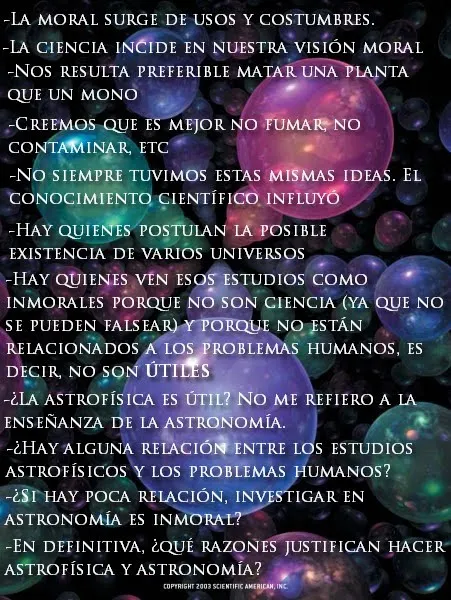
- The truth about multiverses. Credit: Alejandro Tropea/La Risa de la Ciencia.
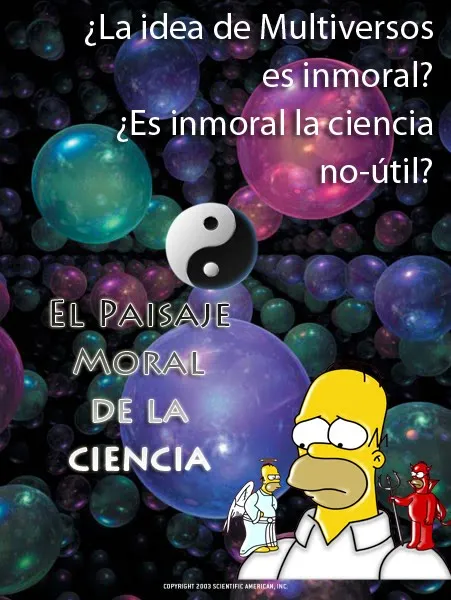
- Multivesos-YinYan-Homero: Combination of images in which an image of Homer from Fondos de escritorio was used, an image from Scientific American from PhysicsOfTheUniverse and a YinYan image from A veces dices a veces no.