On Saturday I attended the Buenos Aires Book Fair and here I recount the experience and take the opportunity to invite you to visit it.
The 36th Buenos Aires Book Fair was an ocean of people on Saturday, May 1st, as expected due to the Workers' Day holiday.
The five-block-long line just to get in was already a bit scary and invited escape down Avenida Santa Fe, towards the other used book fair in whose stands you can find true relics and important works at modest prices.
However, that sea of people moved quickly and in less than half an hour I was entering with enough time to attend the Leopoldo Lugones Hall.
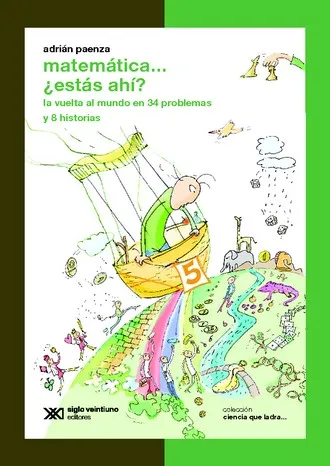
There, at 18 h, the talk by Adrián Paenza presenting his latest book was scheduled. La vuelta al mundo en 34 problemas y 8 historias is the fifth episode of Matemáticas...¿estás ahí?, which we recently commented on here along with the possibility of getting a free copy by participating in our "Concurso 42", which is still open until May 8.
The fair is a monster of imposing size and it is difficult to cover it completely if we stop at every stand. Also, time flies and you have to be attentive to the talks, which can take place in halls at the opposite end from our location.
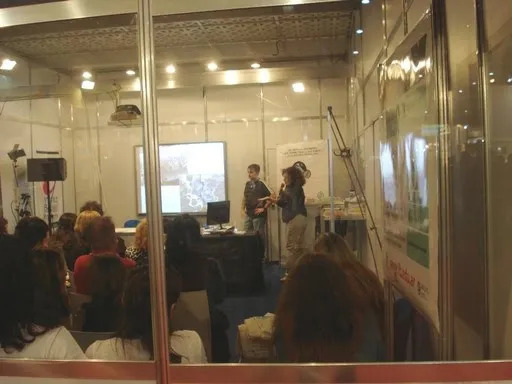
The Lugones hall, near the entrance to the Grounds, was already quite full when I entered and people kept coming in, already past six in the evening. I think there were about a thousand minds waiting to be told about mathematics. It was incredible. We might be tempted to say that the turnout was due to Dr. Paenza's talent and charm. That would be a simplification, I think, and a way of underestimating the audience. I believe people went looking for both things: Paenza's charisma in telling stories in a friendly and even fun way, and for those "tales" to include the different forms that mathematics takes in everyday life and beyond.
The talk was opened by the director of the Ciencia que Ladra collection published by Siglo XXI Editores, Diego Golombek. He alluded to this new "phenomenon" of science book sales and, in passing, mentioned that the stories included in this latest episode are marking a change in the series, something we commented on here in due time and for which we are grateful. He also gossiped, in passing, that there will be a sixth episode and, if everything continues like this, many others.
I insist that storytelling is fundamental, beyond presenting problems to solve. Stories of mathematics and science that must fill Paenza's life due to his training and his various jobs, which allowed him to meet very lucid people.
The talk lasted longer than usual and I think it somewhat surprised the organizers. The hall had some inconvenient columns in the middle, but Paenza knew how to deal with them, making them participants.
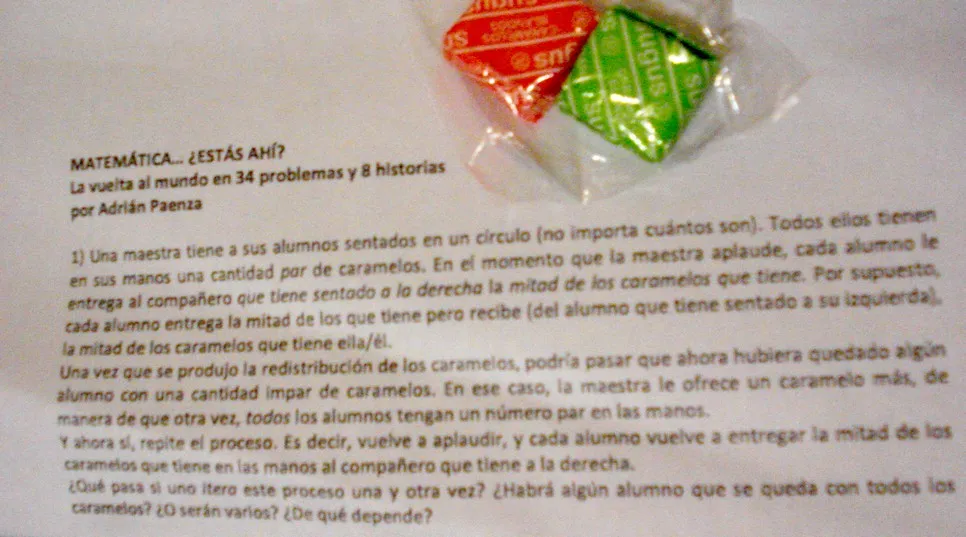
Upon entering the hall, participants received a sheet with some problems, and a little packet with two candies.
Not all the initially planned problems were solved. Luckily, the talk took on a life of its own and Paenza decided to go down another path.
But the story of the candies is one to tell and retell. To keep thinking about. Because the story is about mathematics and it's about an idea, I think, powerful both for its mathematical, even organizational meaning, but also as an allegory. I will tell it at the end.
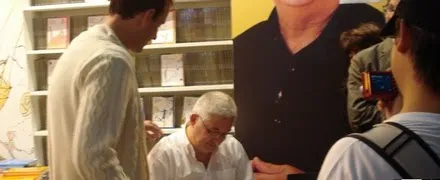
After the book presentation, Paenza went to the publisher's stand where he spent a very long time (hours?) signing autographs and taking photos with people. I lost track of time at that moment. Hunger was calling. After all, you have to fill your belly before filling your brain, and it was already a bit late to attend the talks that would take place in a distant sector about CASLEO, which I would have liked to attend, as I had planned.
Then I was walking around the multiple stands. There is a lot of Argentine history, due to the Bicentennial, but also specific stands with engineering books, dictionaries, books in other languages, children's books, etc.
I would like, as a way to invite the blog reader to go, to mention that Ediciones De Mente is there, with its magazines and books of puzzles, lateral thinking and the like. It's possible to get some magazines for ten pesos and the books were around thirty.
There is a formidable cartography stand with incredible maps and educational prints, of the Solar System, for example, although also on many other topics. Right there they have globes, even one with the constellations and another of the Moon. There are small and large ones, with the consequent price difference. The small ones cost from forty-two pesos. The larger ones, even illuminated or with wooden bases, beautiful, cost a fortune! The prints vary in cost and size, but they start at ten or twelve pesos, if I remember correctly.
What else is at the fair?
Books are not the only actors on the Grounds. The talks offer what we cannot obtain as easily as books, which, although in many cases can be obtained there with some discount, are the same works we can buy in any bookstore in Buenos Aires.
But the talks, that's another thing. The CNEA (Comisión Nacional de Energía Atómica) has a great participation, with permanent talks. Also the Planetarium and the Faculty of Geophysics and Astronomy of the University of La Plata invite you to look at the stars. All this in the so-called Espacio Joven, at the back of the Yellow Pavilion.
There I spoke with very young people about biodiesel created from waste, in whose process what is not used is recyclable in other industries (like soap and glycerin).
I attended a talk on nanotechnology and the use of optical and electron microscopes, very interesting. When leaving they give you a CNEA brochure with its academic offerings, promoting the Instituto Balseiro.
Then I attended a talk by Dr. Alberto Rojo, on Art and Physics, focused on painting. The physicist seemed a bit displeased, probably because outside the space where he was supposed to speak, the Grounds' announcer was deafening with her loud messages and hindered the development of the talk.
Rojo's talks are always interesting and, although one may know many things, at least I took some homework home, to investigate things I didn't know. And that alone is already a lot.
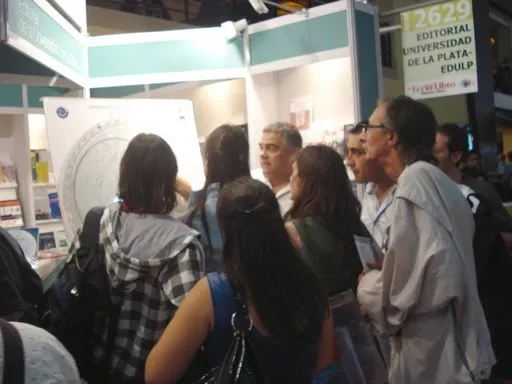
Then, outside the Espacio Joven sector, I came across a booth from the FCAGLP and with Constantino Baikouzis, a character, a wonderful astronomer. With a frightening patience and an admirable simplicity. He is the usual creator of the sky maps.
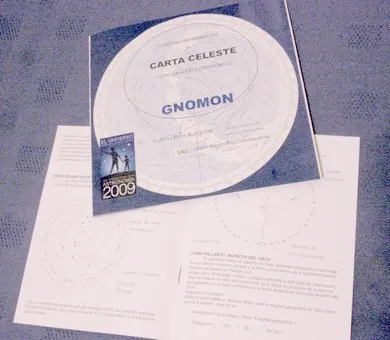
For the International Year of Astronomy 2009, Baikouzis designed the Gnomon celestial chart and on several occasions has given talks on how to use the instrument, as well as the Horologium, to tell time by looking at the stars and the sundial.
The Gnomon celestial chart ended up in my hands, as in those of many who passed by there, for forty-nine pesos, along with the explanations that Constantino gave to each one who approached, including that if there was any need, he could be consulted by mail!
At the booth there is also a sky guide ($60) incredibly well printed that also tempts the pockets.
Is there more?
For me there was nothing left but tiredness when it turned Sunday and still the internal streets of the fair were packed with people and children everywhere. Outside, Caetano Veloso was preparing. I hope he sang that line Chica anillo, star and the moon, ray of sun in the city sky...
The Moon was full in Sagittarius and I was full of papers, a book, a celestial chart and all this to tell, perhaps to spread the desire to go. There are many other talks, every day, until May 10. Admission is $15.
Tomorrow maybe I'll go back, at night, because I can say, with pride for someone else, that a high school classmate will give a talk there, as part of the cycle "La ventana del Conicet". I remember that Marian Hernández, when we had barely 18 trips around the sun, wanted to be an oceanographer. And she is a doctor in biology, at CENPAT, with an 11-page curriculum. That's certainly not little. I hope I can go, again, to swim in that other sea of people.
The candy round
The problem was something like this (I have the paper, but I think I can quote it without a cheat sheet):
Suppose a circle of people. It doesn't matter the number of people in the circle, but to make it simpler we can imagine a circle with few people. Each person has candies in their possession. An EVEN number of candies.
The idea is that each person will give half of the candies they have to the person on their left (or right, it's the same, I prefer left...).
Everyone in the circle does this once. After that, is it possible that some person is left with an ODD number of candies?
Yes, it is possible: if I have two candies and I give half (1) to the person next to me, I'm left with 1. But at the same time I receive candies from the person on my other side. If the other person has four, they give me two and I end up with three.
So, at the end of the round, the people who have an odd number of candies are given one more, so they have an even number.
Now then:
If all the people had the same amount of candies and we do this once, what will happen? And if we do it many times? Does it depend on the amount of candies?
If everyone has two candies, the same thing will happen as if everyone has one hundred candies.
Let's think: I have four. I give two to the person on the left and receive two from the person on the right. I still have four. That is, if we all have the same number of candies at the start, regardless of the number, no matter the number of people in the circle or how many times we iterate the process, in the end, we will all have the same.
Is this remarkable? Wait a moment, let's not rush.
What happens if we don't all have the same number of candies? Whoa. Here we have to think.
Let's say I have 6. Let's also say I'm the one with the most, in a circle of 4 people. On my left I have a person (A) who possesses 4 candies and on the right person (B) has two candies. The round goes. I, who had 6, give half to A, who had 4, but they gave two to the person on their left. That is, 4-2=2, then they receive my candies 2+3=5.
I gave 3 of the six, but the person on my right gives me half of their candies. B had two, gives me one. I'm left with 4.
What happens with B. They had two, gave me one, is left with one, but receives from the person on their right. The person on their right may have two or more, so they receive one or more than one. If they receive one, they still have two, otherwise they will have more.
I, who was the one with the most, 6, now have 4.
A, who had 4, now has 5.
B, who had 2, now has either the same or more.
What happens to B and what happens to me is key. I am the one with the most and if we do the round, can I end up having more than I had?
B, who is the one with the least, when doing the round, can they have less than they had?
And if we iterate this process, what happens?
What happens is that those who have the least will have in each round either the same or more. Little by little, those who have the least will be less.
On the other hand, those who have the most cannot have more, but the same or less in each round.
Do you realize what happens?
This is an idea. Nothing more than that. One of those ideas that can be told in five minutes and change a life. Maybe I'm exaggerating. But doesn't something happen to you with this? Hasn't something similar happened to you sometime reading a good book or watching a good movie or in some class with a good teacher?
It is precisely that. A simple mathematical idea, with a wonderful power.
You saw that TEDx promotes itself with the slogan "Ideas worth spreading", well this one seems to me one of those. Maybe I'm a bit of a zombie, but I think it's valuable.
A wonderful idea told by Paenza. Narrated in the Bicentennial Year. I believe this is much more than mathematics, isn't it?
Sources and related links
About the images
Photos taken by me, who was not born to be a photographer, certainly.