The renowned Uruguayan science communicator Gonzalo Vicino proposes in his book "Relatividad y Cosmología" to travel through the history of modern physics to understand, through relativity, current cosmology, with some controversy.
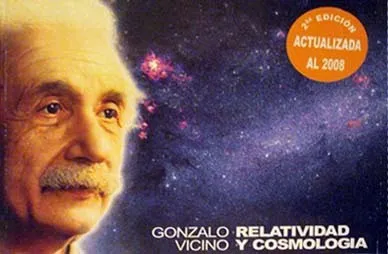
Book data
Relatividad y Cosmología by Gonzalo Vicino
Fundación Astronómica Uruguay
Pablo Ameneiros Editor
Montevideo, 2001
2nd updated edition (to 2008)
ISBN 978-9974-34-100-5
I met Pablo Ameneiros last year, via email, on the occasion of the reissue of the work in question, which I commented on here at the time.
Publishing a book is always difficult, although certain topics and authors seem to have guaranteed success. Except for those cases, it is a hard work that implies an economic investment, sometimes without return.
Ameneiros sent me a copy of the book and, through the blog, offered the possibility of purchasing it through a generous discount.
The commentary on the work had been pending for two reasons. It is a book so beautifully printed and bound that, unlike what happens with many current editions, more rustic and economical, it does not deserve to suffer the hustle and bustle of the masses to read it on the subway. Also, the content deserves a more detailed or leisurely reading than the one that can be done lightly on the bus.
Precisely this second reason opens another: the author's references and comments deserve to be internalized for other topics, some of which generate more attention than others, as I will indicate later.
Well, it must also be said that several interesting books have appeared in the meantime that postponed the reading of this work.
But here we are, pushed, why not say it, by the publication of a comment about this same book, recently made in El País de Uruguay by Daniel Veloso.
I think the comment deserves three parts: the book object, the popularizing content and the opinion. I will also talk a bit about the author, in a separate section.
The object
Every book prides itself on its content, but not exclusively. The object itself can attract us for its print quality, cover design, format, or the opposite.
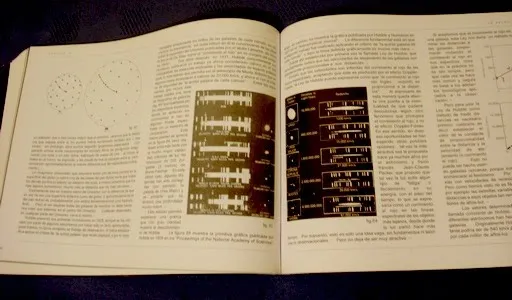
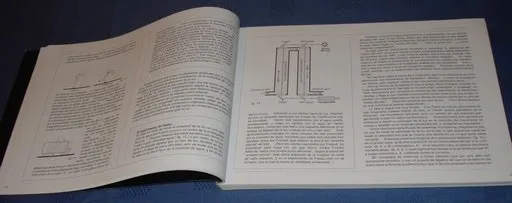
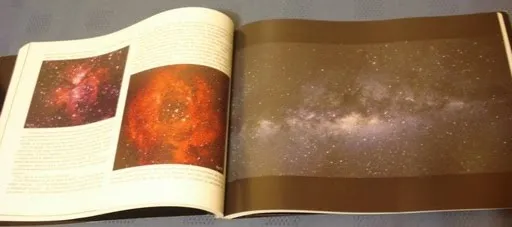
The editor Pablo Ameneiros did a beautiful job through a quality coated paper that allows us to visualize the beautiful images contained inside. The cover is softcover, with a flap. Despite having only 198 pages, for any other type of format, it would be double. It's that the design is out of the ordinary: it is a landscape printing, 28.5 x 21 cm, that is, almost an A4 sheet, printed in two columns.
Despite its beauty, it must also be said, the book has a hard time fitting on the bookshelf or being handled on public transport, as I noted before.
But, on the other hand, it is an object that stands out from the rest, demanding attention and proclaiming its authenticity.
The content
The work is divided into introduction, twelve chapters, suggested bibliography, alphabetical index and general index. I review here, very succinctly, the content of each of the chapters.
1-Of the ether and other issues: if we are going to talk about astrophysics, we certainly have to talk about light, the famous dichotomy between the corpuscular and wave theories, and that strange figure of the ether, whose end is glimpsed in the next part.
2-The fall of the ether: as expected, the Michelson-Morley experiment and spectral analysis are explained clearly and simply.
3-From Galileo to Einstein: as he points out at the beginning of the chapter, when thinking about "relativity" one usually thinks of the figure of the white-haired scientist so popular in the 20th century. However, it is clear that we must first talk about Galileo.
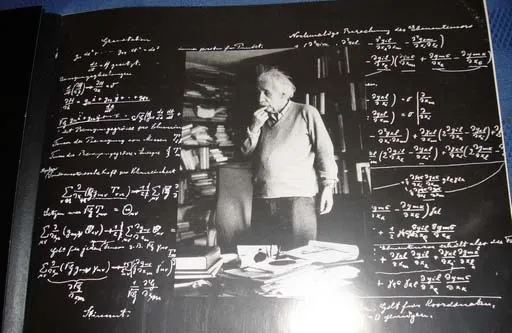
4-The mathematics of Dr. Einstein: introduced to Special Relativity, we get on the train to evaluate, mathematically, the simultaneity of events. An advanced level of mathematics is not needed to understand this part and it is formidable that it exists, even though it tries to reach a general public. Many times authors -and editors- fear equations as "reader-scarers". Luckily, this is not the case.
5-The theory extends its reach: We now get into the General Theory, acceleratedly, to understand a topic of great weight (mass).
6-The geometry of space-time: the curvature of space, the geodesic, and the fourth (temporal) dimension
7-Some interesting consequences of relativity: the twin paradox, time travel, tachyons and frame dragging.
8-Putting the theory to the test: the eclipse, atomic clocks and gravitational lenses
9-A look at the universe: Milky Way, Clusters, Nebulae and galaxies, in a review of the history of astronomy with beautiful photos.
10-Relativity in the universe: Hubble and expansion. And also the Steady State Theory.
11-The new universal bestiary: quasars, neutron stars, black holes, gravitational lenses, the background radiation
12-Current state of cosmology. Affirmations, dissents and opinions: comments on the "official theory" of the Big Bang and the Steady State one.
The opinion
I was getting along marvelously with the book, stopping at some parts more than others, until the last chapter. The first thing it produced in me was..."rejection". I say it like that, in quotes, because over time I learned that one must reread and, if possible, remove prejudices. With prejudged ideas one does not advance, that would be dogmatism and I, on the contrary, aspire to critical thinking, which would be the opposite.
But it is true that I quickly asked myself: Steady State Theory in the year 2000?
I'm not saying that the famous Standard Cosmological Model doesn't have its gaps. But the background radiation is there. Ah, but no, it might not be "background" and be only "local". COBE, WMAP, now Planck have detected the radiation "all over the sky".
However, the objections pointed out about the idea of inflation and the big bang don't bother me as much as some of the arguments used. Vicino says that by saying "official theory" he hides an irony because:
"It happens that I have serious reservations about scientific theories that are adopted by the pressure of majorities, or as I have already said, by philosophical positions that identify with ideologies. Let us remember, for example, the genetic theories of Lysenko in Stalin's time".
Well, I'm probably wrong, after all I don't have Vicino's deep knowledge, but it seems to me that between 1948 and 1965 the "official theory" was not exactly the Big Bang, but the one he now shows as a "victim", the steady state one.
Dark matter is also spoken of with irony, quoting George Abell. The quote is good, perhaps he is right, but then why don't we say the same about the "C Field".
To put it more simply: I get the feeling that, sometimes and in this case for example, people speak of "dogma" or "establishment" as "ideas established by pressure from the majority." Similar arguments are heard from creationists against evolution. And it is no coincidence, the current "standard" cosmological model is "evolutionary," while the matter-generating "steady state" model is "creationist."
Isn't it time to talk about evidence? In this corner, the CMB. And in the other?
Well, no more than a paragraph from Vicino to point out that for some cosmologists that radiation is not "cosmic," but generated by dust in our galactic halo or in intergalactic space.
That said, and as I noted before, I don't stay only on the surface of a feeling: there is a reality in Vicino's comment. Science is part of human beings, who are imperfect. We have prejudices, ideas we don't want to abandon, that we like more. The steady state theory "was liked more" than its rival for decades. Now another one "is liked more." And like a pendulum that moves now here and then there, the great majority of researchers moves to one side, when we already know from the history of science that there are usually shades of gray.
Vicino points out:
"The cosmologists who have proposed these theories complain that the 'official' scientific community does not dedicate time or effort to studying them, and to confronting them with observations. I wonder if we are not witnessing a new version of the episode in which Galileo wanted the Doctors of the Church to look through his telescope and see with their own eyes 'the stars of the Medici,' and they refused to do so, answering him 'and why should those stars exist?'".
A bit strong. Do I think he has no reason at all? No, I think that does happen. It has happened and will happen in the history of science. Nature is elusive, but it does not hide. It is only up to the human being to know how to search for it. Sometimes it will not be searched for in some place, for various reasons, and it will be found anyway, serendipitously. Was the chaotic discovery of Lorenz applauded the next day?
This should not let us see that indeed, scientific politics exists. Researchers work in state institutions, regulated by the governments of countries, or in private organizations, regulated by "the market."
The scientific spirit is not always present, not in a pure state, mixing with interests somewhat foreign to the enterprise of discovery.
The Steady State was a valid hypothesis that was embraced by the majority of cosmologists of its time. It has great advantages over an inflationary universe: density is maintained and the universe would then be, broadly speaking, the same in the past as in the future. That was the idea of the time. And that idea also responded to philosophical and political ideals. Arguing against the Big Bang with similar arguments lacks support. In contrast, the holes in the model, with a scientific basis, are important.
At the beginning I pointed out that the book forces one to stop more in some part than in another. This will depend on each person, on our interests and knowledge. The last chapter was for me the most juicy. Despite my disagreement with the use of certain arguments, one always learns more from those who think differently. Some reasonings we will not take, but there will be others that will leave some mark. That, by itself, already justifies a work. And that also happened to me reading Vicino in the last chapter, particularly in his mention of Lysenko.
When I got to that part, I went to the computer and entered, for the first time, that name into the internet search engine. That forced me to go off track for a while on those readings that justify this late comment on the book, but that enriched my knowledge of the history of science and its political and philosophical vicissitudes.
While that was happening, a reader of the blog, at the beginning of the year, sent me a link to a work by Juan Olarieta Alberdi titled:
Lysenko. The materialist theory of evolution in the USSR.
It is an extensive essay (on A4 sheets it reaches 195 pages) about the Russian biologist, in which the "official" genetic theories are criticized, especially the synthetic theory:
"Exposing the limitations of genetics does not mean combating or belittling it, but quite the opposite. In history there have been worse starting points than that. We know the cases of astrology or alchemy. Today they are, at the very least, despised disciplines, but in their time they were the starting point of astronomy and chemistry. That astronomy has far surpassed astrology does not mean that absurd ideological conceptions do not periodically infiltrate it, like the big bang hypothesis. No one is denigrated in that discipline or expelled from it for criticizing that or other hypotheses, no matter how much they are presented in society as theses and have -never by chance- such media repercussion."
I will refer again to Lysenko's work when I finish a couple of books I am reading on evolution.
But, as the reader may notice in the quoted paragraph from Alberdi, not very solid arguments are also used to try to demonstrate a point of view that can indeed occur in reality. Assuming that the big bang is an absurdity, even if it were, what does it gain in its favor? And why is it? Not a word.
I repeat: the last chapter by Vicino, like the text by Alberdi and other referenced works, are enriching, but -at least for me- it was hard to go through them as if I were making my way through a jungle of weeds.
The same has happened to me in other passages that took me down other paths, always enriching, although I do not always agree with their points of view.
Conclusion
Vicino's book is a wonderful work of popularization of modern physics, that which is generally not taught in high schools, but which can be read about on multiple internet sites, magazines, and other media. As often happens, when trying to explain something in a simple way, one goes from simplicity to oversimplification. Hence the need for books like Relativity and Cosmology that popularize with simplicity and depth at the same time. It not only states the scientific propositions as they are known today, it also includes the account of their discoveries and advances in astronomy, which is formidable as a frame of reference. The graphics allow for a better understanding of the narrative, which is itself engaging. It is, therefore, a beautiful work for its design and printing, and also for its content. The author's comments, despite the previous objections, allow one to learn about the "dissident theories" and the dark areas of the standard model. Furthermore, it has an update to 2008 with the news produced in the field and a complete bibliographical section to access other related sources.
The book can be purchased through Pablo Ameneiros's page, within the virtual shopping/category science, we will find the book's information sheet.
The author
Gonzalo Vicino is a renowned popularizer, who has been on radio broadcasts and in teaching. He was Head of Educational Programming at the Montevideo Municipal Planetarium, Professor of the Secondary Education Council, Educational Inspector of Astronomy, consulting member of Commission 46 of the IAU, and author of several works dedicated to astronomical popularization.
Since his retirement he has developed his activity at the Eta Carinae Observatory in Villa Serrana, Department of Lavalleja.
He also developed the Amateur Astronomy Workshop, around which he created the Uruguayan Astronomical Foundation. That Workshop gave impetus to expand and update the draft notes on Relativity that he had scribbled down, and thus the idea arose to combine the fundamentals of Einstein's theory with the development of Cosmology.
Sources and related links
Relativity and cosmology from Uruguay
About the images
All images are photographs taken by me of the book, whose credit belongs to Gonzalo Vicino/Pablo Ameneiros.