The transformation of energy into various forms does not occur only in rare laboratory experiments, but in everyday life. Physics has something to say in athletic events. And the physicist also has an influence.

What we are going to talk about is kinematics.
Although it seems illogical, Galileo demonstrated that all bodies falling from the same height acquire the same speed in a vacuum. Of course, this does not happen in our daily life due to a decisive factor: air resistance. But on the Moon, it's a different story, as the astronauts demonstrated.
This type of motion is called free fall.
What happens when it occurs in reverse? No, not when we turn a hammer upside down and drop it, but when we throw something upward, instead of releasing it from a height.
That other type of motion is called Vertical throw when the trajectory formed by the thrown object forms a right angle with the local horizontal.
In these types of motion, energy transformations occur. The energy that depends on height (position) is usually called "potential energy" and the energy due to motion, "kinetic energy".
In some circumstances, one kind of energy transforms into the other.
In the fall, potential energy becomes kinetic. "Height is lost and speed is gained".
The inverse occurs in the throw, "height is gained and speed is lost".
And if we talk about speed and height, we can think of a pole vaulter.
What height does a vaulter manage to reach?
The following expression can be applied:
h max =vi^2/2*g
The maximum height reached by a projectile, launched vertically upward, is equal to the square of the initial velocity divided by twice the acceleration of gravity. In this case, the projectile is the vaulter.
And how do I know the velocity? Well, we could deduce it in the same way if we knew the height reached, but that is precisely what I want to know.
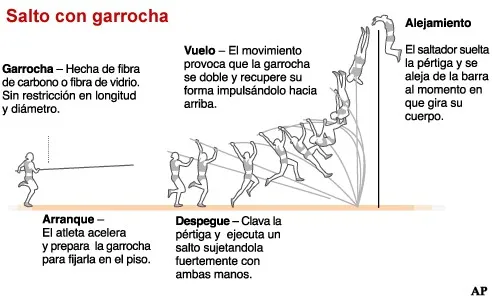
Let's suppose then that a vaulter, who must run before jumping, achieves a speed equal to that of 100-meter dash runners. Let's suppose then that Usain Bolt, the record holder of this athletic event who achieved a mark of 9.58 seconds to cover 100 meters, performed the high jump.
If he covers 100 meters in 10 s (to round off), then his speed can be expressed as 10 m/s.
I cannot easily find what speed a high jumper or a pole vaulter reaches, if it was ever recorded, but according to EFDeportes, for men a speed of 8 m/s is achieved in the high jump.
If we go to the formula expressed before, it turns out that, with an initial velocity of 10 m/s, the height to be reached should be 5.11 meters.
For 8 m/s, the height should be only 3.27.
How high does a pole vaulter rise in the Olympic Games?
The world record in pole vault, according to IAAF, is held by the Ukrainian Sergey Bubka in 1994 with 6.14 (versus the 5.11 that Bolt should reach).
The Cuban Javier Sotomayor, in 1993, reached 2.45 in the high jump obtaining the record of the category (versus the 3.27 he would achieve if his speed were 8 m/s).
Let's now calculate the velocity, knowing the height reached:
vi=raíz(2*g*h)
For a height of 6.14, the vi must have been 10.97 m/s (versus Bolt's 9.58), and for a height of 2.45, the vi must have been 6.93 m/s (versus the 8 m/s used before).
Where does the difference come from?
In the case of the pole vault, we can say that the vaulter rises a little more by pushing off the pole. This makes him gain a few centimeters. But we must also consider that to the five meters we first obtained for the jump with a vi of 10 m/s we should add the difference of the center of gravity. That is, the result represents not the elevation of the vaulter's foot, but the elevation of his center of gravity, which is normally in the stomach. With vaulters who are more than 1.80 meters tall, the center of gravity is somewhat above one meter from the ground. This difference already brings us closer to the result obtained.
In the case of the high jump, the motion is uniformly varied rectilinear motion, the speed changes in each unit of time: they take a few first steps to break inertia and, at the end, there is a deceleration before the jump.
And, evidently, the techniques in each case are different and, at a professional level, all possible aspects are polished so that each variable is the best possible. Motion is essential, but the athletes' build and muscular strength are also decisive. But, even in a sporting or recreational activity, physics has something to say about it.
In other words, physics and the physicist play a fundamental role in athletic disciplines. And in the case of the Australian Melanie Adams, who reached 4 meters in Perth and only 3.8 in Sydney, her marks do not dazzle physics, but the physicist is another matter! I don't want to make a low comment about the athlete, but there is no doubt that the vaulter accelerates hearts!
Note written for the VII Carnival of Physics, in this edition hosted by El Navegante. To join and read the entries, there is a social network on Ning.
Sources and related links
Físicamente, Claudio Sánchez. Ediciones De Mente.
About the images
Pole Vault Infographic from Aztecadeportes.com