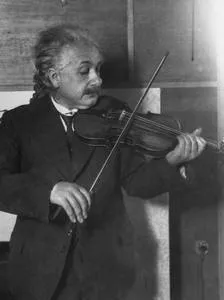
Albert Einstein is that kind of physicist you really don't see anymore, producing such notable contributions in different areas. But besides his scientific achievements, he had a rich and colorful personal life among which his passion for music can be highlighted.
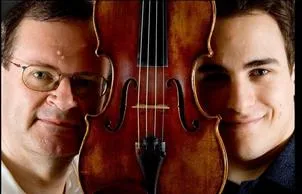
Brian Foster shares both physics and music with the one who won the Nobel Prize for the photoelectric effect. This scientist from the University of Oxford joined the British musician Jack Liebeck to create a show about Einstein. They are currently on tour in Britain with "Einstein's Universe," which explores his legacy to physics, as well as the role music played in his life.
Physicworld.com conducted an interview with both in which Foster alludes to music offering a form of escape valve from his research to the well-known scientist. "He said many times that he felt more pleasure in life playing the violin than in anything else."
It coincides with the memories of his eldest son Hans Albert: "Whenever he found himself at a dead end or in a difficult moment in his work, he sought refuge in music. That usually solved all his difficulties."
They also point out that they have hints -communicated by his wife in a letter- that the physicist would stop researching, when they lived in Berlin, scratch his head, play a few notes on the piano and then return to his study to write new ideas.
"I think it's true that Einstein was a very good, competent violinist in his youth. It's clear he could play on stage in front of an audience with professional musicians and not make a fool of himself," said the Oxford professor.
His fame, they note, would have helped him become known and a friend of many of the great musicians of his time, like Fritz Kreisler, the violinist, and Gregor Piatigorsky, the cellist, with whom he played chamber music together.
How was this duo of physics and music formed?
The idea of both is to maintain interest. And they believe that just talking about science for an hour and a half would make more than one person's eyelids droop, so besides popularizing this science, both join on stage in a violin duet.
Einstein's Universe is not the duo's only creation. "Superstrings" is a talk that links the popular scientist's favorite instrument with many of the concepts of modern physics that he helped found. It begins with an introduction to the physicist's life and how his ideas shaped our concepts of space, time, and the evolution of the universe. The presentation is accompanied by selections from J. S. Bach.
The talk Einstein's Universe explores another part of the German's work, quantum theory.
The creator of a new vision of space and time has inspired many artists. An opera has even been written called "Einstein on the Beach" (Einstein on the beach).
We don't need to go to the United Kingdom to get an idea of how the duo sounds. Physicworld.com was able to make an exclusive video that allows us to enjoy a bit of this musical collaboration in an arrangement of Mozart's violin sonata in C Major k.296.
Video: When worlds collide: physics meets music
http://www.youtube.com/watch?v=oer7JgH-DEo
Sources and related links
- physicsworld.com: Einstein's Universe: the scientist, the man, the musician
- Einstein and music, by Dr. Antonio Moreno González
- When music gets physical
- Einstein and his love of music
- Einstein and Mozart: two geniuses united through a violin
About the images
- Physicist Albert Einstein playing the violin. E. O. Hoppe (1878-1972). Published in LIFE.
- Photo of Foster and Liebeck. Credit: Foster/Liebeck.