In "Poética astronómica" Argentine astrophysicist Alejandro Gangui unveils the astronomical knowledge in the monumental work of Dante Alighieri.
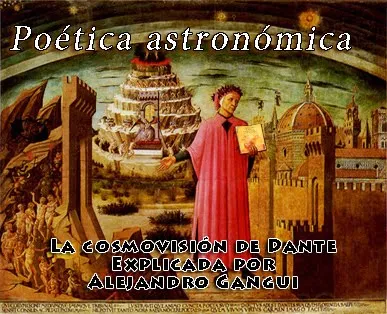
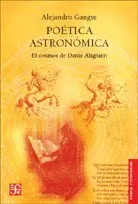
Work details
Poética astronómica
El cosmos de Dante Alighieri
Alejandro Gangui
1st Edition, Buenos Aires
Fondo de Cultura Económica, 2008
Colección Ciencia y Tecnología
128 pages 23x16 cm
ISBN 978-950-557-759-0
After an introduction, Gangui begins to tell us about Dante's life and his early works. Then he gives us an overview of the motion of the heavens, especially the precession of the equinoxes. That third chapter is not an astronomical whim of the author. That knowledge will allow us to dive "scientifically" into the beginning of La Vita Nuova through an astronomical calculation by Dante.
Next, Gangui points out the great dark mantle that covered the Old World, which led to the rich cultural development, particularly in astronomy, being set aside in favor of a series of religious dogmas.
That story would be incomplete without adding the subsequent resurgence in the Near East, which, for example, materialized in a new Christianized Aristotelian cosmos.
From here, the narrative of the Italian poet's life resumes, his political phase in 13th-century Florence.
The first part of the work does not end without three boxes on different aspects of Dante and his work. In the first we have a description of what the dolce stil novo was, a literary movement that was emerging at that time, founded by Guido Guinizelli, whose footsteps Dante would follow.
The next two boxes are linked to astrology. The first allows us to understand what Alighieri's position was regarding the supposed causal relationships between the stars and earthly events. It is also a good excuse to point out that the ecliptic passes through 13 zodiacal constellations (not 12) and that the slow precession, over the years, has caused the Sun's passage through those constellations to no longer match that recorded two thousand years ago. Which makes us ask: What is your sign?
The other box is related to the difference we currently establish between scientific knowledge (astronomy) and beliefs (astrology).
In the second part, Gangui dives directly into the poet's work, beginning with La Vita Nuova and the meaning of numbers, especially the repetition of the number 9.
The following chapters allow us to understand the universal Divine Comedy and its architecture of the afterlife. It also explores the reason for the title. Is it a comedy? And from this point on, we begin to walk with Dante. At first, guided by Virgil, we enter Hell, through 34 cantos in which we will pass through nine circles, where the "sinners" lie, among them, those who believed they could predict the future:
"When I bent my gaze more upon them, it seemed to me that each of those damned was twisted in a strange way from the chin to the beginning of the chest; for they had their faces turned towards their backs, and they had to walk backwards, because they had lost the ability to see forward." (1)
From the center of the Earth we will pass to Purgatory. Already in the first canto, Gangui warns us of an astronomical reference:
"The beautiful planet that invites to love was making the whole East smile, vanquishing the sign of Pisces, which followed it. I turned to the right, and directing my spirit towards the other pole, I distinguished four stars seen only by the first humans. The sky seemed to rejoice in their splendor. Oh Septentrion, truly widowed site, since you are deprived of admiring them! When I ceased contemplating them, I turned somewhat towards the other pole, from where the Wain had disappeared...".
The beautiful planet that invites to love is Venus, at that moment in Pisces. It is great to understand, from what Gangui explains, that the pilgrims are enjoying the dawn of Easter Sunday on their fourth day of travel. How does he know this if Dante doesn't say it? He says it implicitly with the data indicated, for example, in the previous paragraph.
The four stars alluded to would be the Southern Cross. In my annotated version it is indicated that Dante could have known about them from the tales of navigators.
But Gangui does not stop there and although he does not reach a definitive conclusion, it is much more complete and worth knowing, as well as other astronomical references in Purgatory, in its 33 cantos.
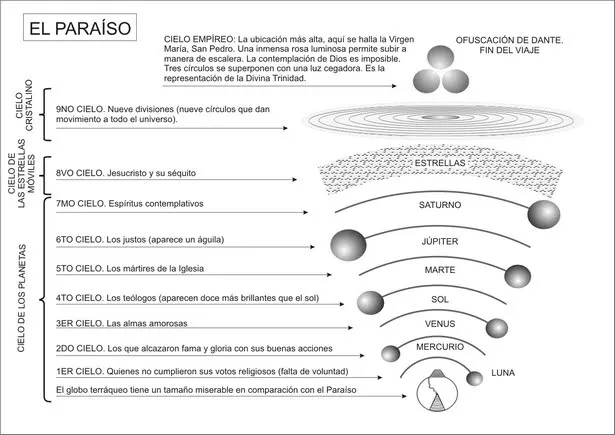
And finally we reach Paradise. Here appears Beatrice, the poet's sweet muse, who takes over from Virgil and will be his guide through the heavens: The heaven of the Moon, that of Mercury, Venus, Sun, Mars, Jupiter, Saturn, Fixed Stars (Stellatum), Primum Mobile, Empyrean
In the Moon are the inconstant ones like diffuse images or blurred reflections. Mercury houses the active spirits and the leaders, in Venus are the famous lovers. In Mars those who fought for the Faith. In Jupiter the just and pious spirits. To the Sun correspond the wise and philosophers and in Saturn are the contemplative spirits.
"With the integration of the spiritual world into the Aristotelian cosmos, Dante's genius provided a possible solution (within the framework of a literary work) to the philosophical-religious discomfort that had characterized the cosmological models of the Middle Ages," explains Gangui.
Before the end, there is a fourth box about the angels and the turning of the world. And then a Coda in which the author points out the importance of Alighieri's monumental work that allows us to reconstruct "the image of the universe" predominant in his time.
AstronomArte
I recently wrote here about AstronomArte as a form of artistic expression that includes astronomy as a theme, background, or figure.
We could include The Divine Comedy as a literary form, astropoetry, of these manifestations. However, we could establish different categories of AstronomArte. One possible criterion is that which divides works with "scientific" content from those that use astronomical objects only as metaphors, perhaps not "scientifically".
For example, saying that "when a lady opens her eyes they are as bright as a star at birth" (sorry for such a corny example!) would contain an astronomical object, but not much science.
On the other hand, if we were to say that "the gaze of a fifteen-year-old girl changes tremulously like the brightness of the fifteenth star of The Whale," we would be comparing the girl's gaze to the variable star Mira (Omicron Ceti, the fifteenth brightest star in the constellation Cetus, the whale).
However, in this second example, it may happen that a reader without knowledge of astronomy misses the true comparison the author intended to convey.
We can read The Divine Comedy several times without noticing the astronomical background that floods its pages. We will think they are beautiful allegories about how beautiful Beatrice or Nature is, without truly understanding the original meaning.
Hence, works like Poética Astronómica allow us to immerse ourselves in the text in a different way, not only from an artistic perspective. And not to perform a very, let's say, "far-fetched" or strained analysis, but because they are allusions that in many cases have been purposely included by the author. And that we miss, by virtue of not having fully understood them.
On the beauty of science and the science of beauty
Often lovers of poetry, or of art in general, believe that adding this knowledge detracts from the artistic content. As if explaining what a phrase or idea truly means would take away its poetry. Certainly, art does not have to be tied to the empirical data of nature. But when it is, knowledge does not bring less art; on the contrary, it magnifies the content.
We know that a star is a body that shines with its own light thanks to nuclear reactions that can form objects up to two hundred times the size of our Sun. And that they are, in general, fiery bodies, with surface temperatures of 6000 K and a diameter of one and a half million kilometers (approximate data for the Sun). These ideas are far removed from the concept of a "star" as a light in the night tapestry. They are much more powerful data.
I reiterate that poetry does not have to use scientifically precise metaphors. But when an author does so, it is ignorance of the true meaning that detracts, not the other way around.
And if, as if that weren't enough, we take this to a work so widespread in the world (in the West at least), it is much more important to explain what is being talked about.
It is, at the same time, a way of bringing those distant objects closer. And, let's agree that mathematics and physics, as background knowledge, are also perceived as distant objects. Gangui's work, in my opinion, allows us to "manipulate" these scientific ideas in an agile and entertaining way, to better understand the Renaissance worldview, without taking a single cent away from the artistic value of Dante's work.
It is, finally, another effort by this Argentine astrophysicist to popularize science, astronomy and cosmology in particular, as he has been doing not only through other works and articles, but also through various educational actions.
The book is easy to read, with simple explanations, graphs and illustrations that support the text. It is worth mentioning that the author has also published articles on this topic in the magazine Ciencia Hoy, which I also recommend reading.
I also want to say that reading Poética Astronómica made me check the library shelves for a copy of The Divine Comedy/La Vita Nuova and review both texts read two decades ago. Although the prose is different, I cannot help but relate, in some way, this mystical-scientific-religious-loving tale to two other texts, read by me much later. I refer to Adán BuenosAyres (in which there is also a metaphysical transit, let's say, through Villa Crespo!) and Star Maker. Perhaps something of Dante filtered, subtly, into the works of Leopoldo Marechal and Olaf Stapledon. In any case, those other two jewels of world literature are among my favorites and I recommend them emphatically whenever I can.
I must announce, to conclude, that the next "literary criticism," if one can call this that, I think will take a while to appear here. It's that I am immersing myself in the complex and wonderful text of GEB.
About the author:
Alejandro Gangui was born in Buenos Aires in 1964. He holds a doctorate in astrophysics from the International School for Advanced Studies in Trieste, is a CONICET researcher and a professor at the Faculty of Exact Sciences of the UBA. He is a member of IAFE and author of several works such as El Big Bang. La génesis de nuestra cosmología actual (2005) and compiler of El Universo de Einstein (2007).
Sources and related links
- (1): The quotes from The Divine Comedy were taken from a copy by Editorial Porrúa (that publishing house from Mexico located on Av. República Argentina), 29th Edition, with introduction and commentary by Francisco Montes de Oca. The edition includes La Vita Nuova and is part of the "Sepan cuantos..." collection.
- FCE: Poética Astronómica
About the images
- Combined image of "Dante Alighieri and the universe of the Divine Comedy represented by Domenico di Michelino in the cathedral of Florence." Credit: Wikipedia, and cover of Poética Astronómica, credit: Fondo de Cultura Económica.
- Map of Paradise by Álvaro Felipe.