The traveling exhibition "Ocean is Desert" by an artist who uses satellite images for his creations is presented.
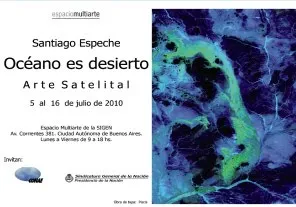
The Sindicatura General de la Nación and the Comisión Nacional de Actividades Espaciales (CONAE) inaugurated this Monday, July 5, 2010 at 17 h. an important art exhibition as part of the Bicentennial Celebrations.
Right in the city center, you can see works made with satellite images of the world's deserts, mostly obtained by the Argentine satellite SAC-C.
Espeche was born in Rome in 1973. As the son of diplomats, travels were his siblings. He lived in New York, Buenos Aires, Algeria. After settling again in our country and developing different activities, he began working at CONAE in digital image processing. And there he discovered the artistic potential of the images.
"Ocean is desert" attempts to capture becoming. According to Heraclitus, we cannot bathe in the same river because the river is no longer the same, because we are no longer who we were. Those deserts that we can traverse in the world today were not such once, something the artist understood walking through the Sahara. Secretly (or not so much) there is a symmetry with Espeche's own life. The desert is the home of nomads, something the artist experienced firsthand due to his family journey.
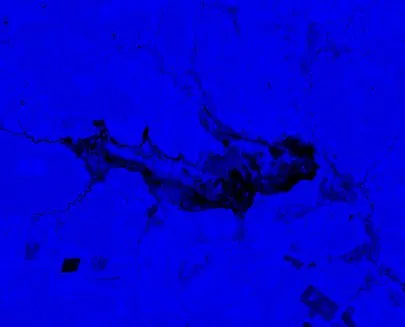
The series "Ocean is Desert" consists of ten works by Santiago Espeche, printed on photographic paper measuring 1.20 x 1.40m., in which the artist used satellite images of different deserts of the world, mostly scenes captured by the Argentine satellite SAC-C, developed by CONAE and launched into orbit on November 21, 2000.
As Espeche explains, satellite art is a new art in the world. "In my case, it is a new neo-figuration. I start from a satellite image of some part of our planet, and I use it as a virtual canvas. The variety of tones is given to me by the diversity of the soil, both from its topography and from the energy radiated by the elements. Thus, what for an Earth scholar is information, for me is, in addition to that, an infinite possibility for artistic play. Art for me is and must be playful," states Espeche, and adds "the great variety of information offered by the Argentine satellite SAC-C through its five sensors and the wide sweep of the MMRS camera, gives me the necessary versatility to create without limits, thus uniting science with art."
The boundaries between art and science blur in these creations of the "artistic cartographer" that Espeche became, who had previously presented "Satellite Eye."
Certainly, a satellite is not built and launched into orbit just to obtain images for artistic purposes. On the contrary, this use is a byproduct of the main intention to study terrestrial and marine ecosystems.
Sometimes it is necessary to step back to appreciate and understand reality. The planet's surface often seems flat to us, "stuck" to it by gravity. But from the heights it is possible to appreciate its real geometry (even though Eratosthenes was able to measure the circumference without great artifice). We recently commented on SkyTruth, a project that also uses satellite images to monitor the environmental disasters we usually cause around the globe.
And these new "orbital eyes" allow us to appreciate another reality, which is the same one we perceive with our senses from the surface and, at the same time, it is not. From above, perhaps, something more than our view of the world changes. Astronauts who had the opportunity to observe Earth from the shuttle or the space station often say that it changed their appreciation of the world, as a totality in which borders are fictitious, expanding their consciousness of humanity, as well as a greater appreciation of natural resources. That vision changes the astronauts themselves. And, thanks to satellite technology, it has also been changing us.
The artist's vision, in this context, adds a plus, because it does not settle for the "coldness" of the pixels and transforms the reality of the images to also express his own change.
In the digital images, obtained via satellite and retouched by Espeche, it is possible to visualize many scenes related to the marine: whales, dolphins, algae. It seems to me that another message (or meta-message) is hidden there. Just as the exhibition contains the work Piscis, there is also one called Expiscis, conjugation (present indicative) of the Latin verb expiscor which means "to fish something out," in the sense of finding, discovering, prying, snooping.
The exhibition was launched by the Síndico General, Dr. Daniel Reposo, and the head of CONAE, Dr. Conrado Varotto, in the Multiarte Space of SIGEN (Avda. Corrientes 381 – Capital).
The exhibition will remain open to the public until Friday, July 16, Monday through Friday from 9 to 18.
Sources and related links
About the images
- Images of works by Santiago Espeche.