Galaxies have different shapes: spirals, ellipticals, irregulars. But what are "chain galaxies", "tadpoles" and "clump clusters"?

The vast majority of galaxies we see today can be grouped into a few categories: there are spirals, lenticulars, ellipticals and irregulars.
Studying the morphology of galaxies is interesting and gives astronomers clues to understand the formation processes.
Edwin Hubble established a classification of galaxies, which was recently reviewed by Verónica Casanova for the VIII Carnaval de la Física in her post on the Hubble sequence.
However, due to the blurring effect of the Earth's atmosphere and the fact that galaxies are very far away, it was not possible for a long time to recognize the morphologies of distant galaxies. With larger telescopes, however, it is possible to determine some data, such as brightness and color. From those measurements it is clear that very distant galaxies were very different from those that are closer. This implies, due to the constant and finite speed of light, that the oldest galaxies were distinct from the modern ones. In this way, astronomers can study the evolution of galaxies in the history of the universe.
The Hubble Space Telescope, together with the WFPC2 camera, managed to surpass the observational limits of observatories on the planet's surface. Freed from atmospheric effects it could observe details ten times finer and see distant galaxies clearly enough to study their morphology. The studies showed that the types of galaxies seen in the present and nearby universe were present in the distant universe, but somewhat different.
The first works on the subject are by Lennox Cowie and Sidney Van den Bergh (Cowie, Hu & Songaila in 1995 and van den Bergh et al, 1996).
And the most interesting thing is that in the distant past, types of galaxies are seen that are not observed in the nearby universe. Many of these galaxies comprise knots or groupings. In particular, many galaxies appear as several groups arranged in a line and were named "chain galaxies". Pairs of groupings were simply called "doubles". Galaxies with the appearance of a grouping and a tail (similar to a tadpole) were also seen: tadpole galaxies.
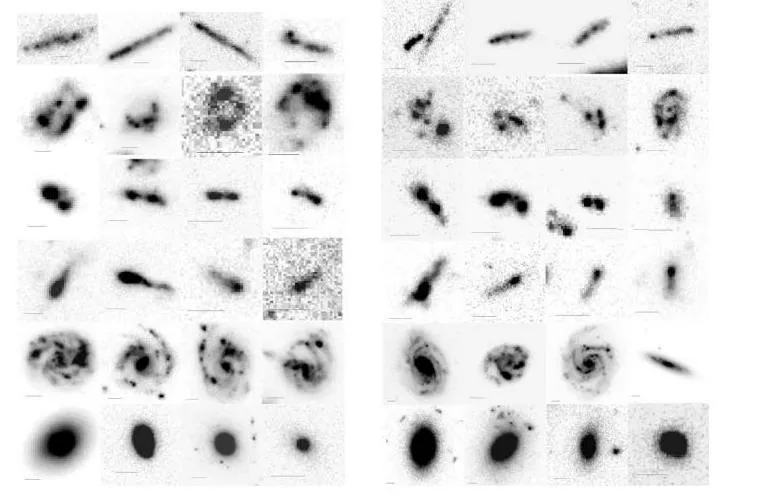
Images from Elmegreen et al (3)
For many years, most studies of galaxy morphology with the Hubble Space Telescope (HST) focused on galaxies at intermediate distances, where HST provided details impossible to obtain from the surface, without requiring such long exposures. Then that HST camera was replaced by the ACS and gave a new impetus to the subject. It was found that clumpy galaxies were extremely common in the early universe. That data revealed a population of galaxies that did not appear "in a chain", but rather with circular shapes or groupings. They were called "clump clusters" which share similarities with current irregular galaxies, but with important differences.
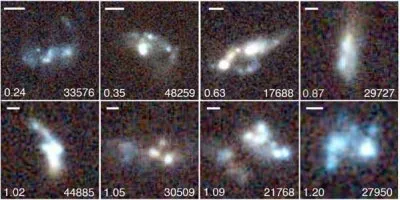
Clump clusters are generally much more massive and current irregulars will look like this from any direction they are observed. The similarity between clump clusters and chain galaxies implies that they are the same type of object, but seen from different directions. This means that the clumps are distributed in disks that appear as chains when observed edge-on.
Studies confirm that they are very young galaxies with great star formation. Their predominance implies that they are probably a previous stage in the development of most, or all, galaxies.
Let's see what the experts say:
Cowie and others indicate in their work (1):
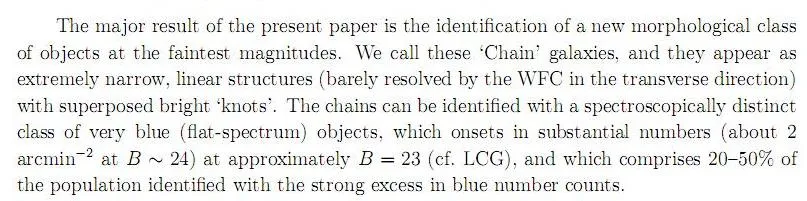
The main result of the present paper is the identification of a new morphological class of objects at the faintest magnitudes. We call them "chain" galaxies, and they appear as linear structures with some bright "knots".
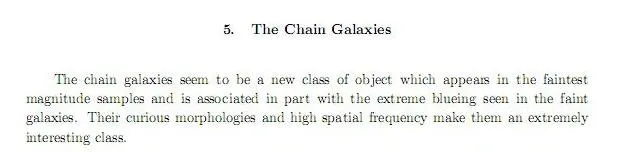
Chain galaxies appear to be a new class of object (...) Their curious morphology makes them an extremely interesting class.
Two experts on the subject, with several papers published on it, are Debra and Bruce Elmegreen. In one of their works (2) they point out the characteristics of the main types of galaxies in the Hubble Ultra Deep Field:
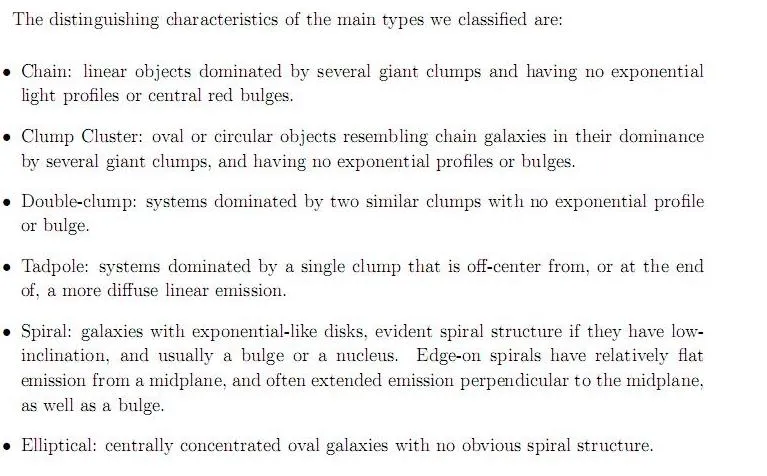
Chain: linear objects dominated by several giant clumps and without bright central bulges.
Clump cluster: oval or circular objects that resemble chain galaxies in their dominance of several giant clumps, without bulges.
Double clumps: systems dominated by two similar clumps, without a bulge.
Tadpole: systems dominated by a single clump, offset or at the end of a more diffuse linear emission.
Spiral: galaxies with disks, evident spiral structure if they have low inclination and usually a bulge or nucleus.
Ellipticals: centrally concentrated galaxies without an obvious spiral structure.
They then point out that the morphological distinctions between these types of galaxies do not necessarily imply that there are significant physical differences. For example, double galaxies could be minor versions of chain galaxies and tadpoles even smaller versions. Furthermore, chain galaxies and clump clusters could be the same type of object at different orientations.

And in another they say (3):
Chain galaxies appear to be edge-on versions of clumpy, disk-shaped, irregular galaxies.

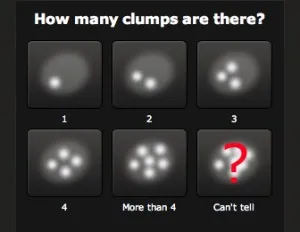
The Galaxy Zoo project is collecting information, provided by users, about these primitive galaxies, by analyzing Hubble images. For example, users can recognize if the clumps are less than four or more, if they appear in a straight line, in a chain shape or in a spiral shape. By comparing the number and properties of these types of galaxies, it will be possible -the site administrators believe- to be able to confirm or refute this picture of chain galaxy generation previously narrated and, perhaps, better understand the origins of the galaxy population in the universe.
Note written for the IX Carnaval de la física, in this edition hosted by Experientia docet. To join and read the entries there is a social network on Ning.
Sources and related links
- A brief history of clumpy galaxies
- Classification tree tweaks
- (1):Faintest Galaxy Morphologies From HST WFPC2 Imaging of the Hawaii Survey Fields
Cowie, Lennox L.; Hu, Esther M.; Songaila, Antoinette
arXiv:astro-ph/9507055v1 - Bulge and Clump Evolution in Hubble Ultra Deep Field Clump Clusters, Chains and Spiral Galaxies
Bruce G. Elmegreen et al.
arXiv:0810.5404v1 - Chasing Hubble's shadows: the search for galaxies at the edge of time by Jeff Kanipe, pp 129-142
- (2)Discovery of Face-On Counterparts of Chain Galaxies in the Tadpole ACS Field Debra Meloy Elmegreen et al. arXiv:astro-ph/0402477v1
- (3)Galaxy Morphologies in the Hubble Ultra Deep Field: Dominance of Linear Structures at the Detection Limit Debra Meloy Elmegreen et al. arXiv:astro-ph/0508216v1
- Chain Galaxies in the Tadpole ACS Field
Debra Meloy Elmegreen et al.
arXiv:astro-ph/0401364v1 - Clumpy Galaxies in GOODS and GEMS: Massive Analogs of Local Dwarf Irregulars
Debra Meloy Elmegreen et al.
arXiv:0906.2660v1
About the images
- Images of chain, double, tadpole galaxies Credit: Debra Elmegreen et al. ArXiv:astro-ph/0401364v1
- Clump Clusters from Elmegreen et al. 2009