A pair of astronomers point out that after the discoveries of recent decades, Ultra-Compact Dwarf Galaxies and Dwarf Spheroidals could be classified as globular clusters. What then is a galaxy? They propose an online survey.
Astronomers like to classify (well, everyone does). Initially, classification can be done only by appearance to the human eye, but to progress in this taxonomy, some physical basis for the objects is needed. With new data, classifications may no longer work. The typical case is that of Pluto. If the previous definition were maintained, several objects would be added to the Planets category and perhaps even more in the future.
What about galaxies?
Are dwarf galaxies very different from star clusters?
In the Oxford-Complutense dictionary by Ian Ridpath, galaxy is defined as:
System of stars, often with interstellar gas and dust, bound by gravity.
It then defines dwarf galaxy as
"Small galaxy of low luminosity. Dwarf ellipticals (dE) and dwarf irregulars (dIrr) are probably the faintest examples of these general types of galaxies (the prefix d comes from dwarf). A separate type, dwarf spheroidals (dSph) are similar to ellipticals in that they contain little or no interstellar material, although they are not so concentrated at their center, having low density and low surface brightness, and show a decrease in their light emission with radius that implies they have a closer relationship with small disk galaxies. Most of the galaxies in the Local Group are dwarf spheroidals, probably the most common type of galaxy in the Universe".
Duncan Forbes and Pavel Kroupa point out in a recent paper that there is no widely accepted definition for the word galaxy. They indicate that Tammann suggested in 1994 a definition for dwarf galaxy as those whose blue magnitude MB is fainter than -16 and more extended than globular clusters. At that time, Ultra-Compact Dwarfs (UCD) and dSph had been discovered. UCDs are objects with properties intermediate between those traditionally recognized as galaxies and globular clusters. And some dSph contain so few stars that they can be fainter than a single bright star and contain less stellar mass than some globular clusters.
UCDs have size, luminosity, and mass intermediate between globular clusters and dwarf galaxies.
The authors take three definitions of galaxy: The one from wikipedia (massive system of stars, gas clouds, planets, dust, and perhaps dark matter, and dark energy, gravitationally bound.
Another, from the Oxford dictionary: Any of the many groups of stars and other matter that exist in space as an independent system.
And another: a gravitationally bound entity, typically consisting of dark matter, gas, dust, and stars.
Thus, it seems necessary for a galaxy to:
1-Be gravitationally bound
2-Contain stars
If nothing else is added, globular clusters and UCDs would be included in this definition.
According to my dictionary, a globular cluster is:
Approximately spheroidal group of old stars in the halo of a galaxy.
Here the drama ends. The Milky Way is not in the halo of any other object, so it is a galaxy. If a group of stars is in the halo of a galaxy, it is a globular cluster. Done and dusted.
But...
Some dwarf galaxies have no globular clusters. In the Local Group, the dwarf galaxy WLM has a single cluster, but the Aquarius and Tucana galaxies have none. If the presence of a globular cluster were a requirement for a galaxy, then compact dwarf galaxies (UCD) and some of the smallest dwarf galaxies would not be galaxies.
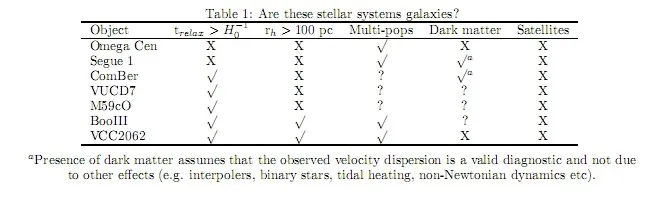
Other possible requirements are the effective radius, perhaps greater than 100 pc. UCDs are usually less than 40, leaving an empty interval. (between 40 and 100). Another criterion could be the presence or absence of dark matter, under debate.
The authors point out special cases like Omega Cen, a massive globular cluster in our galaxy that due to its size, elongation, multiple stellar populations, Helium abundance, and retrograde orbit suggests it is the remnant core of a dwarf galaxy and represents a low-mass example of a UCD.
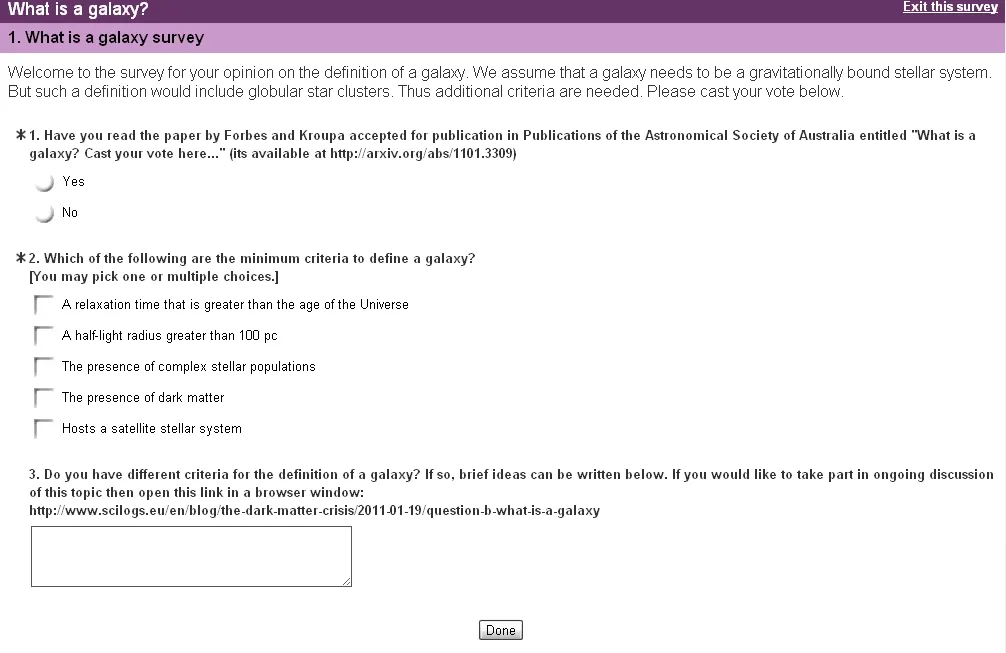
The decision on how to define a dwarf planet and the fate of Pluto was decided by 424 astronomers at the 2006 Prague meeting. The authors, therefore, invite the audience to express their opinion through a form of collective wisdom (crowd-sourcing) in an online survey.
The logical thing would be to first read the authors' article in full, then think of a definition, then look for examples that contradict the definition and so on in a loop until arriving at an unbeatable definition. Is there one?
Sources and related links
- What is a Galaxy? Cast your vote here...
Duncan Forbes (Swinburne, Melbourne), Pavel Kroupa (AIfA, Bonn)
arXiv:1101.3309v1 [astro-ph.GA] - Astronomers Crowdsource The Definition of a Galaxy
- Astronomía: Diccionario Oxford-Complutense, Ian Ridpath, Editorial Complutense, Madrid, 1999.
- Question B: What is a galaxy?
About the images
- Table taken from Forbes, Kroupa 2011.