The first results from Herschel reveal previously hidden details of star formation. The new images show thousands of distant galaxies furiously creating stars, as well as beautiful star-forming clouds across the Milky Way. One image even captures an "impossible" star in the act of formation.
The results were presented today at a symposium of the European Space Agency (ESA) and challenge old ideas about the birth of stars and open new paths for research.
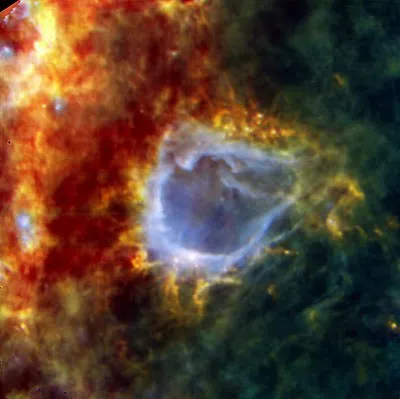
Herschel's observations of the star-forming cloud RCW 120 revealed an embryonic star that could become the biggest and brightest in our galaxy in the next few hundred thousand years. It already contains eight to ten times the mass of the Sun and is surrounded by gas and dust of about 2000 solar masses that can feed it.
Massive stars are rare and short-lived. Capturing one during formation is a golden opportunity to shed light on and understand the star formation process. "According to our current knowledge, stars larger than eight solar masses should not form," said Annie Zavagno, of the Laboratoire d'Astrophysique de Marseille.
This is because the fierce light emitted by stars this massive should destroy their birth clouds before they can continue accumulating mass. But, somehow, they form. Many of these "impossible" stars are already known, some with up to 150 solar masses, but now that Herschel has seen one near the beginning of its life, astronomers can use this data to investigate how this phenomenon occurs.
Herschel is conducting a census of star-forming regions in our galaxy. "Before Herschel, it was not clear how the material in the Milky Way formed into densities high enough and at temperatures low enough to form stars."
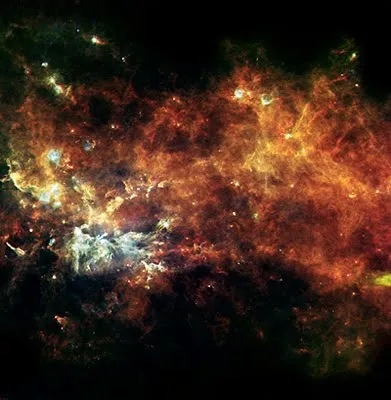
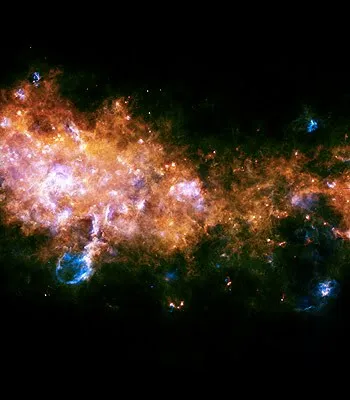
A new image, covering a number of stellar nurseries in the Milky Way, shows how this happens.
Star embryos first appear within filaments of dust and gas across the galaxy. This forms chains of nurseries, tens of light-years long, turning the galaxy into a network of star births.
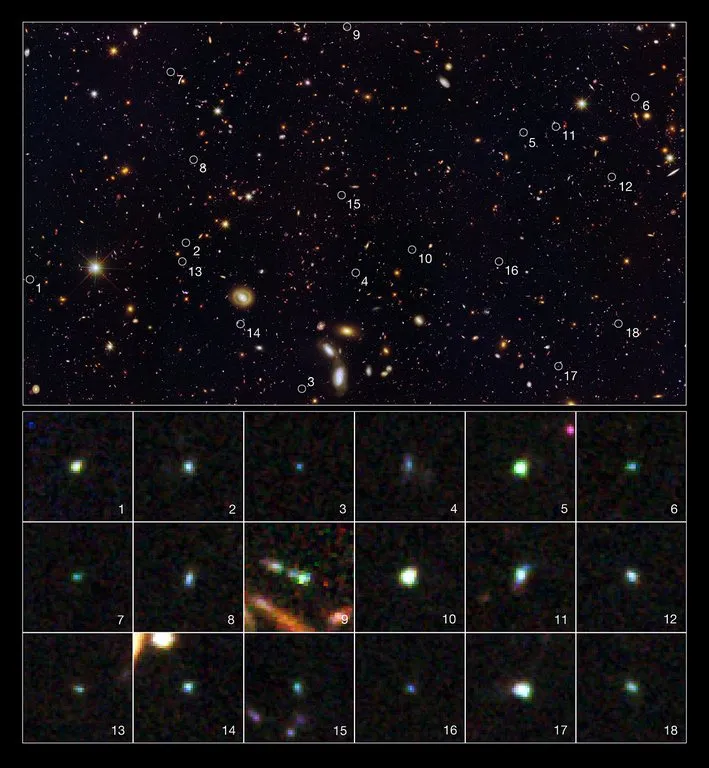
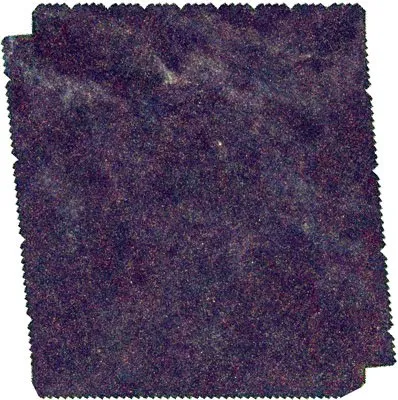
Beyond our galaxy, Herschel measured the infrared light of thousands of other galaxies. Here too the instrument challenges previous expert knowledge by showing that galaxies have evolved through time faster than previously thought. Astronomers believed that galaxies have formed stars at the same rate for the last three billion years. But the new data would show that this is not the case.
In the past, there were many galaxies with enormous star formation. These galaxies are called "Starburst," and they formed stars at 10-15 times the rate seen in our galaxy today. It is not well known what triggered such activity. "Herschel will now allow us to study the reasons for this behavior," said Steve Eales, of Cardiff University.
The images were presented at ESLAB 2010, a symposium taking place from May 4 to 7 in the Netherlands. There, the first results from the observatory launched on May 14, 2009, are being presented.
The first image in the post corresponds to RCW 120: a bubble with a big surprise: a star embryo of about 8 times the mass of our Sun. It lies 4300 light-years away.
These images can be obtained at higher resolution at ESA.
Sources and related links
Herschel reveals the hidden side of star birth
About the images
Image credit: ESA/Hi-GAL Consortium