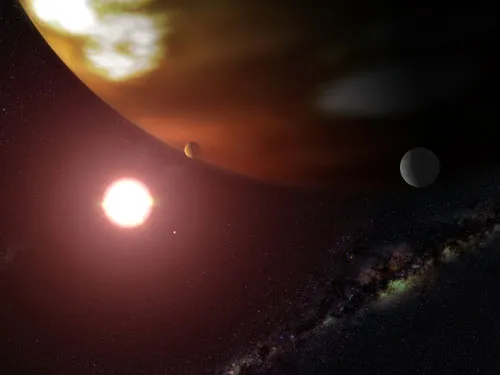
The team that used the novel technique, which uses known exoplanets to search for transit timing variations, announced the possible discovery of WASP-3c.
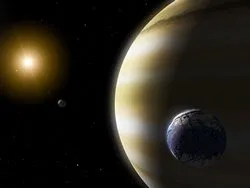
There are two major methods for searching for exoplanets: the technique that uses radial velocity and the one that observes regular variations in a star's brightness attributable to possible transits of an exoplanet.
These methods, although very productive, have limitations. The vast majority of planets orbiting a star other than our own are gas giants, similar to Jupiter, but closer to the star, which is why they are called hot Jupiters.
But a group of astronomers from Germany, Bulgaria and Poland used another technique that could be sensitive enough to discover smaller planets, like Earth, around other stars.
The group, led by Dr. Gracjan Maciejewski of Jena University in Germany used Transit Timing Variations (TTV) to detect a planet about 15 times more massive than our planet, in the WASP-3 system, 700 light-years from the Sun, in the constellation Lyra.
Transits occur when a planet moves in front of the star it orbits, temporarily blocking its light. This method has been used until now to detect many exoplanets and is used by the Corot and Kepler missions.
Now, after having discovered an exoplanet, we can go further and analyze its motion to discover a potential planet "hidden" from observations. Let's remember that Neptune was discovered by noticing that the orbits of Uranus, Saturn and Jupiter were not what they should be according to Kepler's and Newton's laws, as pointed out by Le Verrier and John Adams. Later Galle found the planet.
Something similar happens here. If an object is present in the system, even if it hasn't been observed, it will generate "traces" that astronomers can detect. In particular, it will generate a gravitational effect on the planet that was discovered. The TTV technique compares the deviations with computationally made predictions to infer the possible existence of a new object.
For this search the team used the 90 cm telescopes of the Jena Observatory and the 60 cm telescope of the Rozhen Observatory in Bulgaria to study WASP-3b, an exoplanet that had already been discovered -by the SuperWASP team- as large as 630 times Earth's mass.
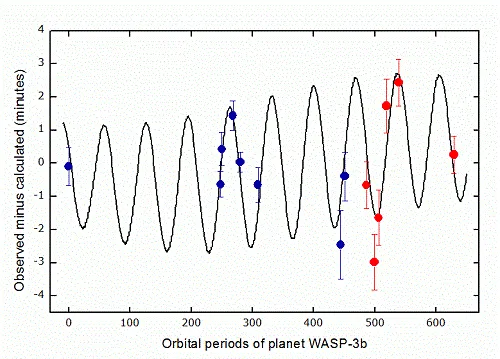
"We detected periodic variations in the transit of WASP-3b. These variations can be explained by an additional planet in the system, with a mass of 15 Earth masses (similar to Uranus) and a period of 3.75 days," said Maciejewski.
In line with the naming of these objects, they call it WASP-3c and it is among the least massive found to date and the first to be detected using this technique.
If the finding is confirmed, it would make the WASP-3 system more interesting than it already is, among other things because the new planet would be "trapped" in an orbit twice as long as that of the more massive planet.
The new technique also has its limitations, in particular because it requires the already known presence of an exoplanet in a system to infer the presence of another. But the possibility of discovering smaller exoplanets and, perhaps, within the so-called habitable zone in which an exoplanet could have an atmosphere and liquid water is attractive.
If a planet like Earth were found orbiting a gas giant that, in turn, orbits close to its star, like those found so far, the deviation that the smaller planet would generate in the transit of the larger one would be up to 1 minute.
The effect would be large enough to be detected even with small telescopes, although larger instruments would then be required to complete the study and confirm the presence of the object.
The team that announced this new exoplanet is now using the 10-meter Hobby Eberly Telescope in Texas to follow the possible WASP-3c in more detail.
Sources and related links
- WASP-3c: Implications for Finding Earthlike Planets
- Physorg: A New Way to Find Earths
- Transit timing variation in exoplanet WASP-3b
G.Maciejewski et al.
arXiv:1006.1348v1 - Prospects for finding new Earths boosted by new planet-hunting technique
About the images
- Graphic by G.Maciejewski et al.
- Illustration by PlanetQuest