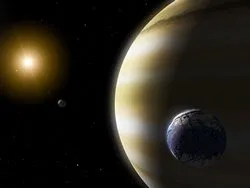
A group of astronomers found two pairs of planets in very close orbit, around subgiant stars.
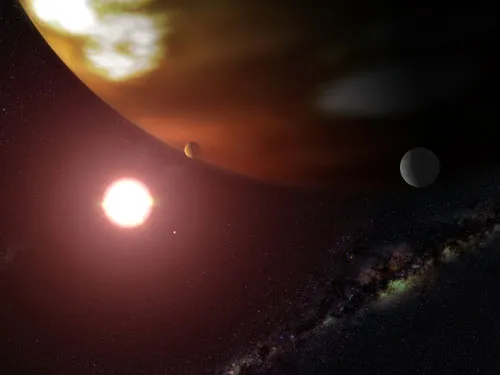
Hundreds of exoplanets have been found during the last decade and a half, most of them as solitary worlds orbiting their stars. With more observation, however, one in three of these systems have more than one planet. Many of these systems contain planets that orbit very far from each other, but in some cases they are found sufficiently close to interact gravitationally.
John A. Johnson, assistant professor of astronomy at Caltech, and his colleagues, found two systems with pairs of giant gaseous planets trapped in an embracing orbit.
In one system, a pair of planets orbit the massive and dying star HD 200964, almost 223 light-years from Earth. There, the intimate dance is much closer than previously known. "This new pair of planets came in an unforeseen package," noted Johnson.
Eric Ford, from the University of Florida, adds that "A planetary system with giant planets so close would be quickly destroyed if the planets weren't in a well-synchronized dance".
The four recently discovered exoplanets are gaseous giants more massive than Jupiter and like most planets around other stars, they were discovered by measuring the "wobble" or Doppler variation in the light emitted by their stars as the planets orbit around them (the radial velocity technique). But it is surprising that the members of each pair are located remarkably close to each other.
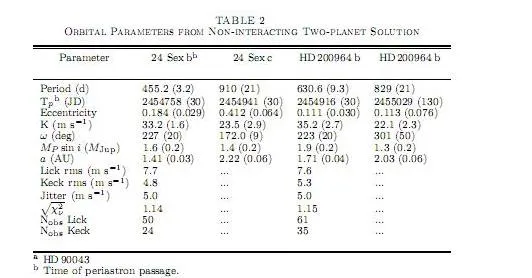
For example, the distance between the planets around HD 200964 is occasionally only 0.35 astronomical units, that is 35% of the distance between Earth and the Sun (about 52,500,000 km), something comparable to the distance between our planet and Mars.
The planets around the other star, 24 Sextanis (244 light-years from home) are at 0.75 Astronomical Units (about 112,654,000 km). For comparison, Jupiter and Saturn are never closer than 531,083,520 km, meaning that the exoplanets in the latter case are approximately one-fifth the distance between the two large gaseous planets of our solar system.
Due to their large masses and proximity, these pairs exert a great gravitational force on each other. This pull, in the case of the exoplanets around HD 200964 is 3 million times greater than the gravitational force between Earth and Mars, 700 times greater than that between our planet and the Moon and 4 times greater than the Sun's gravitational pull on Earth.
Unlike the gaseous giants of our solar system, the new exoplanets are located comparatively close to their stars. Those orbiting around 24 Sextanis have orbital periods of 455 days (1.25 years) and 910 days (2.5 years) and those accompanying HD 200964 have periods of 630 days (1.75 years) and 830 days (2.3 years). Jupiter, by contrast, takes only 12 Earth years to go around the Sun.
Planets move around after being born, in a process known as migration. This is believed to be common, even in the solar system. Planets located in the far reaches of the protoplanetary disk can migrate faster than those closer in. "And they can become stable if they enter a resonant orbit," explains Johnson.
When planets are "trapped" in a resonant orbit, their orbital periods are related by a fraction of two integers. In a 2:1 resonance, for example, an outer planet will orbit its star once for every two orbits of the inner planet; in a 3:2 resonance, the farther planet will orbit twice for every three passages of the closer one. These resonances are created by the gravitational influence of the planets on each other.
"There are many locations in a protoplanetary disk where planets can form. It is very unlikely, however, for two planets to form right in locations where they have periods so proportional," commented the Caltech researcher.
A 2:1 resonance -which is the case for the planets around 24 Sextanis- is the most stable and most common pattern. "Planets tend to get stuck in the 2:1. It's like a big pothole. But if a planet is moving very fast -from the outermost part of the protoplanetary disk, where it formed, towards its parent star- it may not settle in 2:1. As it moves closer, the next step is a 5:3 resonance, then a 3:2 and then a 4:3," detailed Johnson.
The researchers found that the pair of planets around HD 200964 are stuck in a 4:3 resonance. "The closest analogy in our solar system is Titan and Hyperion, two moons of Saturn that also follow that pattern," added Ford. "But the planets in HD 200964 interact much more strongly, since each is 20 thousand times more massive than Titan and Hyperion combined".
Johnson highlights that "This is the tightest system ever discovered," which generates uncertainty about why it happened. "This is the latest in a long series of rare discoveries about extrasolar planets and shows that exoplanets continually have this ability to surprise us. Every time we think we can explain them, something else comes to light".
The astronomers found the two systems using data from a survey or search for planets around stars from 40% to 100% larger than our Sun. Subgiant stars represent a class of stars that evolved off the "main sequence", and ran out of hydrogen for nuclear fusion, causing their cores to collapse and their outer layers to swell. Subgiants eventually become voluminous red giants with large pulsating atmospheres, making it difficult to detect the subtle spectral variations caused by planets orbiting them.
"Subgiants are rotating very slowly and are cool, but they haven't expanded enough to be very fluffy and restless," added Johnson. And he compared these stars to "Goldilocks" that girl who arrives at the house of three bears and tries their soup, preferring the one that is neither too hot nor too cold and the same with the chairs, preferring the one neither too hard nor too soft: These stars are like that girl: not too fast, not too hot, not too fluffy nor too restless, ideal for hunting planets.
"We are currently monitoring 450 of these massive stars and we are finding swarms of stars. Around them we are seeing three or four times more planets at a distance of 3 Astronomical Units -the distance of our asteroid belt- than we see around main sequence stars. Stellar mass has a huge influence on the occurrence of planets because the amount of raw material available to create planets is proportional to the mass of the star," explained the researcher.
Within perhaps 10 or 100 million years, the subgiant stars HD 200964 and 24 Sextanis will become red giants. They will expel their outer atmospheres, swelling enough to engulf the inner planet of their dancing pair and will eject mass, changing the gravitational dynamics of the entire system. "The planets will move apart and their orbits will become unstable. Most likely one of the planets will be ejected from the system completely," and the dance will end.
Sources and related links
- Caltech Astronomer Finds Planets in Unusually Intimate Dance around Dying Star
- Retired A Stars and Their Companions VI. A Pair of Interacting Exoplanet Pairs Around the Subgiants 24 Sextanis and HD200964
Johnson, John Asher; Payne, Matthew et al.
arXiv:1007.4552v1
About the images
- Exoplanet illustration. Credit: NASA.