We are about to check how generous Nature is in endowing the universe with planets, perhaps one like ours: 750 new exoplanet candidates in the Kepler data. Data for 350 were published today and the other 400, for now, are secret.
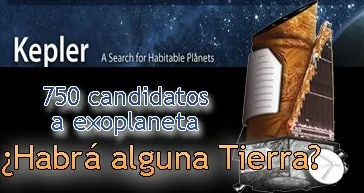
The Kepler team released data today on about 350 exoplanet candidates, including five systems with multiple candidates. This is thanks to data collected by NASA's Kepler mission. The information could add several worlds alien to the Solar System to the current list of more than 450. But, in reality, there are 750 candidates. The 400 difference, for now, are a well-kept secret for the study of the Kepler team.
With this new data, which has been expected since the spacecraft's launch in March of last year, astronomers will be able to examine the stars in detail to find, fundamentally, an exoplanet with characteristics similar to Earth, a place where life could also arise.
But the attention, in astronomical circles during the past months, has focused on what the Kepler team is not going to say, as Dennis Overbye reports in the NYT. By agreement with NASA, the team will withhold data on the 400 best candidates for hosting planets, which the team's astronomers intend to reserve for themselves to study during the Northern Hemisphere summer.
The policy of the U.S. Agency requires that astronomers release their data from instruments like Hubble within a year, but the Kepler astronomers say the launch was delayed and that other problems stole observation time from them. They say, therefore, that they need an extension of the data release time and thus protect themselves from false positives that could exist if other astronomers did not know how to interpret the data correctly.
"If I send you zeros and ones, it would be useless," noted William Borucki, leader of the Kepler team. According to the researcher, the public wants answers to the old question of whether Earth is unique.
The decision to withhold the data, reported in Nature, divided astronomers. Some say it's okay for them to do it for a few more weeks, considering that several of the team's scientists have dedicated their careers to the project.
Paul Kalas, from the University of California, Berkeley, who used Hubble images to find an exoplanet in 2008, commented that on this topic the issue is very different from human experiments, in which a six-week delay could have real consequences when it comes to therapies that could cure diseases.
However, not everyone thinks the same. For others, "hijacking" the data, even temporarily, clashes with the ethical ideal of openness of scientific data.
B. Scott Gaudi, an astronomer at Ohio University, commented that there are more planet candidates than the members of the Kepler team can verify by themselves. "They need help," he said, although he also wondered: "Who am I to say that? I haven't put ten years of my life into this."
John Huchra, from the Harvard-Smithsonian Center, points out the importance of an eventual discovery: "The first astronomer who can prove they found a planet like Earth around a star similar to the Sun will win many prizes" and "NASA will want to have one of its instruments" with this achievement.
The fate of data has been a topic of discussion in science: to whom it belongs, who should have access, and when.
In the past, data was more manageable. Careful annotations in notebooks, with numbered pages, accumulating in an office. Today, the deluge of data from instruments turns it into billions of ones and zeros in vast digital archives with capacities exceeding terabytes.
In the web era, this information can be sent around the world with a click, received and manipulated by anyone who wants to use it to better understand the nature of the topic in question.
"Science is increasingly living in a glass house," pointed out Robbert Dijkgraaf, a physicist at the University of Amsterdam. Phillip Sharp, a biologist at MIT, also referred to this transparency of scientific data: "It's in the past that a group of experts gathers in the other room to draw conclusions. They must be transparent. That is a change in culture."
Secrets, hermeticism, have been part of science since ancient times, through the use of codes and anagrams. Currently, members of a research team agree not to disclose their conclusions before they have been officially communicated.
A few months ago, the Kepler team realized they were going to need an extension and presented four possibilities. The most radical and favorite was to withhold data on 500 candidates until the end of the mission or until the planets have been verified. Or to present all the data (156 thousand stars) on June 15, as had been previously planned.
The final agreement establishes a compromise to protect 400 candidate planets from public knowledge until February 1st - eight months more - and another set of 100 later. With this time, the team will be able to sit down to observe the candidate planets and, perhaps, shout Eureka!.
The benefit of releasing all the data would be to analyze it more quickly among many more astronomers, around the planet. The drawbacks of this policy are two:
That a group claims to have discovered an exoplanet like Earth and it not be true, having misinterpreted the data, or that it is true and astronomers who did not dedicate several years of their lives to this mission take the laurels of the discovery.
To avoid this, the team members committed to releasing a large part of the information now and withholding for themselves about 400 "objects of interest," among which could be the grand prize.
In January, Kepler announced the discovery of five new exoplanets. By April, the number of candidates was already over 300, but at least 50% could be false positives.
The latest communication from Roger Hunter, Kepler Mission Director at Ames Center, was on June 4. There he recalled that on May 12 of this year, one year of orbital operations was completed and they were preparing to release the scientific data from the first 43 days on June 15 (today). The data would include observations of more than 150,000 stars. Meanwhile, the project completed another data volume on May 20 of about 95 gigabytes.
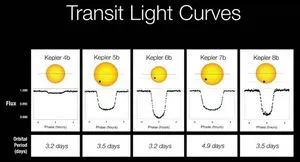
There he also pointed out the difficulty of finding transit events in the data, as they are mixed with eclipsing binary stars (many thousands!).
He also announced that they were preparing four articles on the characteristics of the candidate planets in the data and the location and magnitude of the stars they orbit. The second one is about the false positives found. The third is about the binaries (more than two thousand) and their characteristics. And the last one is about the discovery of several stars that show the presence of two or more candidates transiting the same star!
The data from Kepler's first 43 days can be downloaded from the Multi-Mission Archive at STScI (MAST: http://archive.stsci.edu)
Meanwhile, CoRot detected six new exoplanets. And so the search for "other pairs" in the cosmos continues, a hypothesis that naturally arises from the vastness of the Universe. It is logical to think that we should not be the only ones here. But it must be proven. And that's what they are doing.
Sources and related links
About the images
- Images from Kepler/NASA