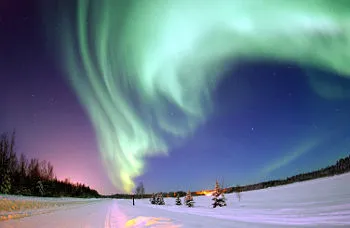
Planeterrella is an experiment that attempts to reproduce the phenomenon of auroras, in the laboratory.
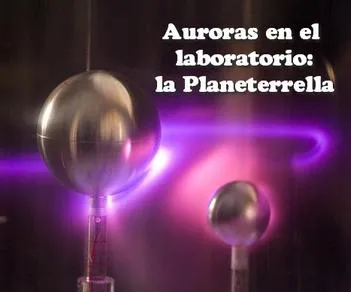
Between 1896 and 1917 the Norwegian physicist Kristian Birkeland designed an experiment called Terrella, which helped him understand the formation mechanism of the polar lights. It consisted of electrons bombarding a magnetized sphere in a vacuum. In his mind, the electron gun represented the Sun, and the magnetized sphere was our planet.
A century later, the experience has been completely redefined by Jean Lilensten, Research Director of CNRS at the Laboratoire de Planétologie de Grenoble. Together with his collaborators and students he recreated that device, but in a more flexible way since it allows simulating many interactions between stars and planets. It is Planeterrella.
Presentation
A star is an object that emits energy in the form of radiation and electrical particles (electrons and ions). The particle wind is called "stellar wind" and, in the case of the Sun, the "solar wind". In the experiment, an electrical duct (a metal tube) and/or one or two spheres can be connected to a negative pole of a generator (which is nothing more than a large battery that produces continuous energy). There are several configurations of Planeterrella.
In the center of a small sphere there is a magnetic dipole with an intensity of 800 mT (milliteslas).
The magnetic north pole is located at the "north" of the "planet" and the magnetic South Pole at the "south", meaning the axis is vertical. In the larger sphere, there are two magnets, each with 400 mT, but they are attached to the sphere inside it. Their axis is tilted 20º with respect to the vertical. These configurations can be changed.
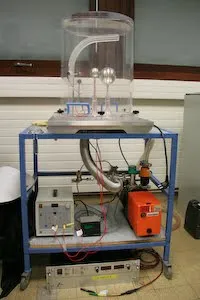
Technical details:
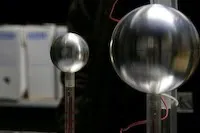
For the Planeterrella, a 50-liter volume vacuum chamber made of Plexiglas with an aluminum base was used. Inside there is an electrical duct mounted on a wheel. The spheres are mounted on bases that move up and down.
The spheres are hollow, five and ten centimeters in diameter. They are made of two threaded halves.
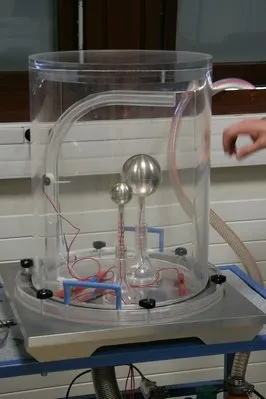
It uses a 10 kV high voltage power supply from the firm Leybold Didactic and a vacuum pump from Alcatel. It also uses rare earth magnets, a voltage sensor and other items whose total value reaches 12 thousand euros.
The precise construction data are not listed on the site, but it is indicated that for education and research, assistance in construction is free and can be requested.
Video: Planeterrella
http://www.youtube.com/watch?v=ucnQFe5Hpow
Predictive Planeterrella?
The different configurations allow it to be used to simulate different situations. But, can it be used to make predictions?
The plane in which the planets orbit around the Sun is called the plane of the ecliptic. The planets also have their own rotation, around their geographic axis. The Earth rotates on itself in 24 hours. It often happens that the axis of rotation is tilted from the vertical, which makes the phenomenon of seasons possible. Earth has an inclination of 23.3 degrees. Mercury is not tilted, Venus has an inclination of -2º (negative because it does so in the opposite direction to ours). Saturn and Neptune have a large inclination, of 27º, but Uranus beats them all with 97º.
It was thought that the magnetic north-south axis should be more or less similar to the rotation axis. But it is not so. Earth's magnetic field is inclined 11.3º with respect to the geographic axis, Neptune's 47º, and Uranus's 59º.
What are the auroras like on Uranus?
The Hubble Space Telescope identified, on the dayside of the planet, the presence of auroras and the Keck telescope photographed an auroral oval on the same side of the planet.
(see for example:
http://www.berkeley.edu/news/media/releases/2004/11/10_uranus.shtml http://thunderbolts.info/forum/phpBB3/viewtopic.php?p=6106 http://hubblesite.org/newscenter/archive/releases/1999/11/).
With Planeterrella, a simulation of the Sun-Uranus system can be made, according to the authors. It is not a truly scientific simulation, in the sense of not having a numerical model.
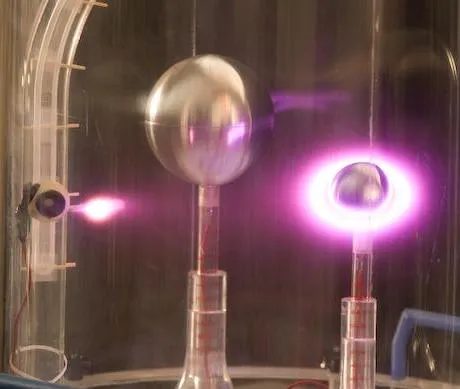
With the device, electrons were fired directly at the North Pole of the sphere. On the dayside, an aurora and an oval around it were seen, just like in space observations.
But on the nightside, which is not possible to see from ground-based observatories because Earth is between the Sun and Uranus, a bright oval aurora connected to the dayside one was seen. Perhaps some future space mission can match this small simulation with reality.
Video: Aurora simulations with Planeterrella
http://www.youtube.com/watch?v=H3vweNL-Kgk
The Planeterrella team is composed of Jean LILENSTEN, from CNRS; Mathieu BARTHÉLÉMY; Cyril SIMON; Guillaume Gronoff; Philippe JEANJACQUOT; Olivier Brissaud; Baptiste Cecconi; Laurent Lamy; Carine Briand; JF Donati.
What are auroras?
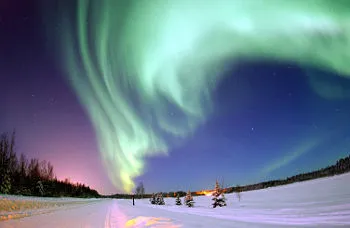
Auroras are a natural phenomenon visible to the naked eye. In the northern hemisphere they are called Auroras borealis or northern lights. In the southern hemisphere they are called auroras australis. It is the most visible effect of the Sun's activity in Earth's atmosphere. Most auroras occur in the regions farthest north or farthest south. The most common color is green and they usually occur between 97 and 1000 kilometers above the surface of our planet.
The phenomenon is associated with the solar wind, a continuous flow of electrically charged particles from the Sun. When these particles reach Earth's magnetic field, some become trapped and travel towards the magnetic poles. When these charged particles collide with atoms and molecules in the atmosphere, energy is released that forms the auroras.
They often occur during the most intense phase of the eleven-year solar cycle. During that time, sunspots increase. Violent eruptions from the solar surface, known as solar flares, are associated with sunspots. Electrons and protons released by the flares add to the particles that interact with Earth's atmosphere.
Where can I see photos of auroras?
The most photographed, the northern auroras, have a page with dozens of links about them.
The recent solar flare in early August generated beautiful auroras. The Spaceweather site usually has updated information on "space weather", which includes Sun activity and the aurora phenomenon.
Sources and related links
- Physicsworld.com: An aurora in the laboratory, by Margaret Harris.
- The Planeterrella, a pedagogic experiment in planetology and plasma physics
Jean Lilensten, Mathieu Barthélemy, Cyril Simon, Philippe Jeanjacquot and Guillaume Gronoff
ACTA GEOPHYSICA
Volume 57, Number 1, 220-235,
DOI: 10.2478/s11600-008-0079-x - Jean Lilensten receives the first Europlanet prize for excellence
About the images
- Images of Planeterrella in action by Mathieu Senet.
- Images of the Planeterrella device.