It takes many years to build a space telescope or a satellite. However, the full-scale model was assembled and disassembled in two days. What is the construction of the next telescope that will replace Hubble like?
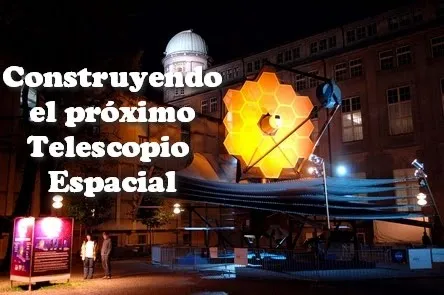
The builder designated by NASA for the James Webb Space Telescope is the company Northrop Grumman. With the goal of helping the public better understand the size, scale, and complexity of the satellite, they built a full-scale model at the recent science festival held in New York.
The model was built mainly from aluminum and steel and weighs about 5,400 kilograms. It measures about 24 meters long, 12 wide, and 12 high.
How are the real space telescopes built?
After a long process of discussion, review, and development by scientific committees, a proposal is made to NASA, which decides which missions will be carried out. If the mission is selected, a timeline is created to develop it.
The science instruments that the satellite will contain are designed to achieve the desired objectives, and a builder is designated. Several designs are tested until the one that best fits the requirements is found. For this, Engineering Test Units, or ETUs, are created before building the real instrument, so engineers and scientists can be sure it will work properly. Those ETUs are a replica of the flight unit that can perform some functions to be tested.
When the tests are satisfactory, the real instruments can be built.
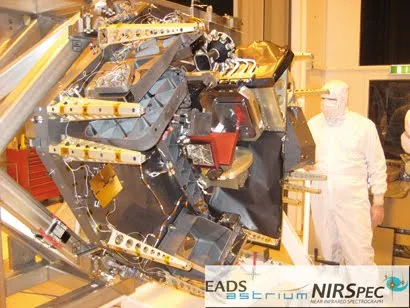
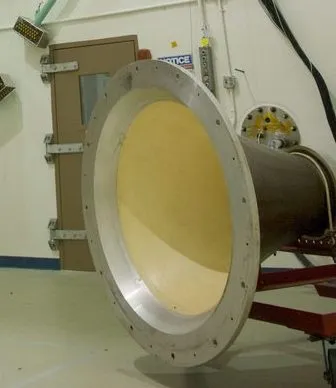
The tests include testing extreme environmental conditions, for which special test chambers are used, like those at NASA's Goddard Space Flight Center.
The instrument is tested for things like vibrations, gravitational force, and also sounds. For the latter, an acoustic test chamber 12 meters high is used, where technicians expose the payloads to the noise of a launch. To do this, they use speakers almost two meters high, called horns, which use an alteration of gaseous nitrogen flow to produce a sound level as high as 143 decibels for one-minute tests.
The decibel, dB, is the relative unit used in acoustics to express the relationship between two magnitudes. It is called that because it is one-tenth of a Bel, the logarithm of the ratio between the magnitude of interest and the reference magnitude, named in honor of Alexander Graham Bell.
One bel is ten decibels, that is, a tenfold increase in power over the reference magnitude, of zero. It is a logarithmic scale.
If the tests reach 143 dB, it means they cross the pain threshold.
Video: Construction of the full-scale model of the JWT at Battery Park
http://www.youtube.com/watch?v=EbCBeq2Rz9Q
Full-scale model of the James Webb Telescope to give a sense of the instrument's size. To see how the assembled model looked and how it appeared by day and night, we can watch the video at http://www.youtube.com/watch?v=304WTE2emc0
The equipment is also tested in the vacuum chamber that simulates space conditions thanks to powerful vacuum pumps. Additionally, a helium refrigeration system is added to simulate the cold cosmos.
The test program begins at the lowest level of assembly of the spacecraft or instrument components and is repeated at each assembly level. Once the instrument passes all the tests, all components are joined into a supporting structure and tested again. The structure is connected to the telescope and the entire observatory is tested, again. Since there is no vacuum chamber large enough for the entire James Webb at Goddard, it will have to travel to the Johnson center in Houston to be tested in a chamber originally built to test the Apollo command module to simulate the trip to the Moon.
Currently, ETUs of the components of the telescope that will replace the famous Hubble are being made.
Live and direct
How often can we say we see a space telescope being built?
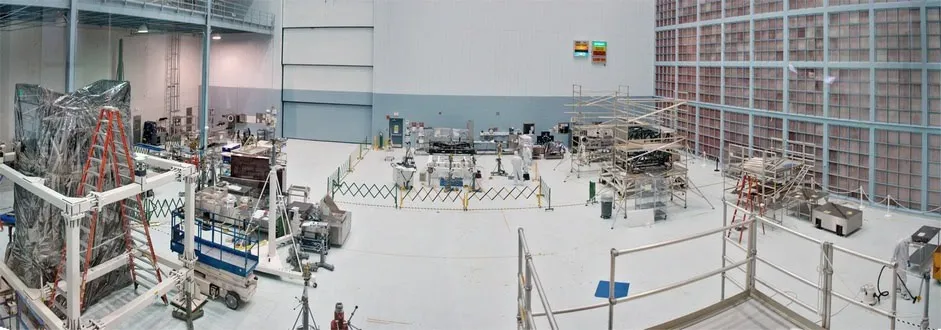
Surely, never. But that changed since the webcams at the Goddard center allow us to see how work is done on the instrument components in its largest clean room. It is a place that looks like a hospital: a pristine area kept as uncontaminated as possible. That is why those who work there wear gloves, boots, masks, and special suits.
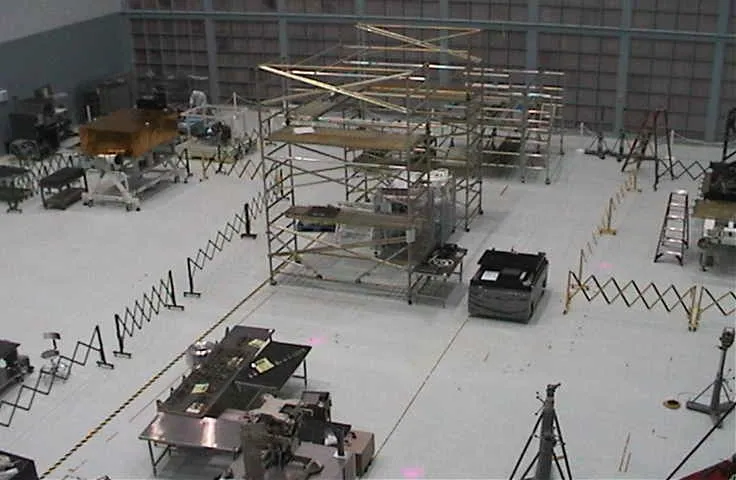
The two webcams installed in Goddard's Building 29 allow viewing the right and left sides from the James Webb Telescope page. We will see there two images, corresponding to each side respectively, which update every minute. But let's not expect constant activity there, as the clean room is generally occupied Monday through Friday from 8 to 16:30, Eastern Time.
Sources and related links
- NASA: How to Build a Life-Sized Model and Real Giant NASA Space Telescope
- James Webb Telescope site
About the images
- Image of the full-scale model of the James Webb Telescope, in Ireland. Credit: Richard Bent, Northrop Grumman Space Technology.
- Image from Goddard webcam. Credit: NASA.
- This panorama shows the interior of the Goddard's High Bay Clean Room. Credit: NASA/Chris Gunn
- Photo of NIRSpec Engineering Test Unit. Credit: ESA.
- Sound horn. Credit: NASA/Chris Gunn