The Large Synoptic Survey Telescope (LSST) will incorporate the world's largest digital camera and will obtain a huge amount of data.

These enormous capabilities will allow astronomers to learn much more about moving objects like near-Earth asteroids, transits, dark energy and the structure of the galaxy.
The LSST will take more than 800 panoramic images, with a 3.2 gigapixel camera, per night. I think if I write the previous sentence again, I get scared. But there are more numbers: it will involve 20 terabytes of data stored every day. I multiply by 30 for the monthly and then by 12 for the annual and...
As narrated in iSGTW, there will be a long journey from Cerro Pachón, in Chile, the future site where the telescope will be installed, and the hundreds of research articles that the data captured by the instrument will inspire in its stipulated ten-year life. The journey will begin with shifts that astronomers will take to monitor the instruments and the data for quality control. They will be able to do it from the top of the control room or remotely from the base in La Serena. The data will be transmitted between both sites with dedicated 10 gigabit per second fiber optic lines.
At the base, around 3,000 computational nodes with 16 cores each wait to perform rapid analysis of the incoming data.
"We have 60 seconds, basically, to do an initial reduction of the data and find some kind of astronomical transit event," commented Jeff Kantor, LSST data management director. "And, of course, we must distinguish those that are true transits of asteroids and other moving objects."
Once the objects are identified, scientists will receive alerts to point their telescopes to the same region of the sky to obtain additional data.
Once a day, the original data and metadata will be transmitted about 8,000 kilometers to the Archive Center at NCSA, the supercomputing center at the University of Illinois, where they will be re-processed and merged into files.
The Archive Center will require 100 teraflops of processing power and the capacity to store 15 petabytes. At least, at the start.
"Once a year we must take that data and reprocess all the images accumulated since the start of the survey. Finally that will require an additional 250 teraflops of computing power," added Kantor.
Scientists and to some extent ordinary citizens will be able to access the data in a variety of ways. LSST team members are investigating technologies that will assist in deploying a link where researchers can access the data and perform basic analyses. Kantor hopes that other organizations will want to establish their own portals that are compatible with Virtual Observatory standards. The software, open source, runs on TeraGrid.
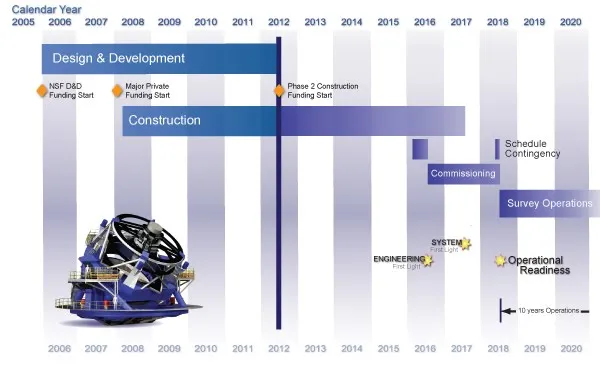
There is still a long way to go to see the LSST in operation, scheduled to complete its design and development phase (started in 2006) next year, to complete its construction around 2017.
The project's name arises from the fact that it will effectively conduct a sky survey that can cover the entire hemisphere twice a week. It was called "Synoptic" from the word Synopsis in the sense that it will conduct a survey to have a "general view" of the universe, a color movie of the Southern sky for ten years.
The high technology required for the construction of this 8.4-meter beast probably explains the participation of Microsoft and Google in the project. Charles Simonyi and Bill Gates donated several million dollars (20 and 10, respectively) in January 2008. Earlier, in 2007, Google had joined the project with which it shares some objectives: handling a massive amount of data and making it useful.
To get a better idea of the technological capabilities involved, let's see that LSST indicates that its database will have: More than 100 tables, image metadata in 700 rows, a source catalog of 3 trillion rows, an object catalog with 20 billion rows, each with more than 200 attributes; a variable object catalog with more than 100 million rows; an alert catalog to meet its objective of alerting the whole world in one minute, etc.
The science archive will consist of 400 thousand 16-megapixel images per night (for ten years), with a total of 60 PB of pixel data.
THE WORLD'S LARGEST DIGITAL CAMERA
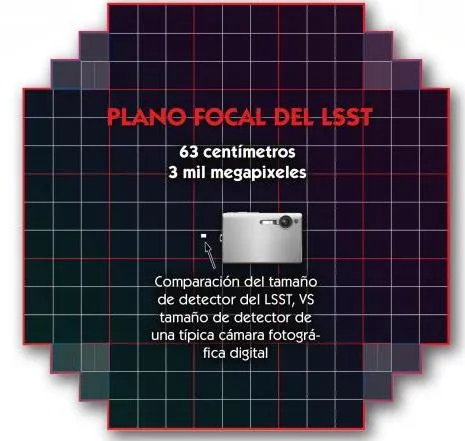
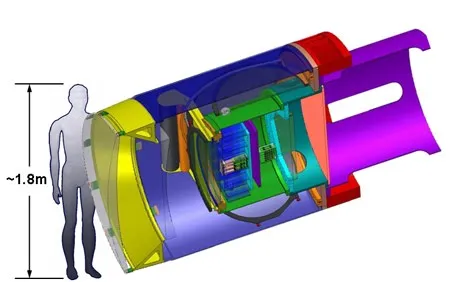
In order to obtain the best possible advantage from its 10 square degree field of view, the LSST telescope will use a three thousand megapixel camera in a circular array of 189 state-of-the-art detector modules, extending 63 centimeters wide. The original combination of a monolithic mirror consisting of an 8.4-meter primary and a 5.0-meter tertiary mirror, will be kept in close alignment with its 3.4-meter secondary mirror.
For the first time the LSST will provide digital images at regular time intervals, of faint astronomical objects across the entire sky. This will allow investigating the physics of dark energy with precision.
A while ago we talked here about a new paradigm in science, linked to the flood of data coming from new technological devices, and then I commented specifically on astronomy facing this new scenario.
Surely the astronomy of the next decade will hold many more surprises for us than we imagine.
Sources and related links
About the images
- Images from LSST.