A team of scientists will spend 22 million computational hours over the next year on one of the world's largest supercomputers, simulating an event that takes less than five seconds.
Robert Fischer and Carl Jordan, from the University of Chicago, are among the scientists on the team. In their work they explore how the laws of nature unfold at extreme temperatures and pressures. The Blue Gene/P supercomputer at Argonne National Laboratory will serve as their primary tool for studying explosive stars.
The supercomputer "is one of the largest and fastest in the world," says Fischer. Desktop computers typically contain only one or two processors; Blue Gene/P has more than 160,000 processors!! What would take a desktop computer thousands of years, this supercomputer can do in three days.
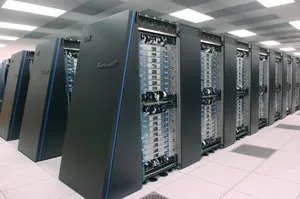
The University's Flash Research Center has computational allocations at Argonne Laboratory thanks to the Department of Energy for its interest in physics that takes place at extreme energy concentrations, including supernovae.
A better understanding of Type Ia supernovae is critical to solving the mystery of dark energy, one of the great challenges for cosmologists today. Dark energy is, in some way, causing the Universe to expand in an accelerated fashion.
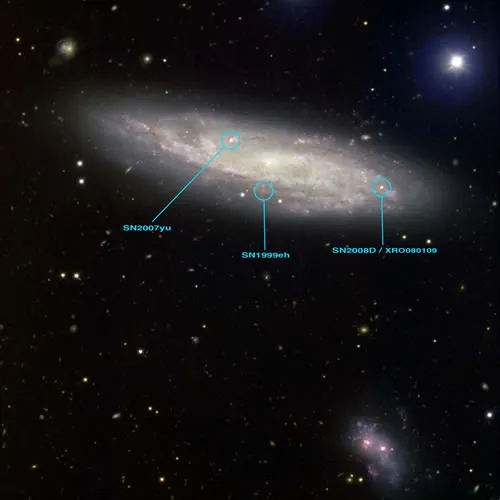
Cosmologists discovered dark energy by using Type Ia supernovae as cosmic measuring devices. This type of stellar explosion exposes approximately the same brightness, so scientists can thus calculate the distance to the galaxies that host the supernovae. However, their brightness varies a bit, about 15%. "To really understand dark energy, you need to reduce this variation to about 1 percent," says Jordan.
The density of white dwarf stars, from which Type Ia supernovae evolve, is extreme. When Sun-sized stars reach the end of their lives, they have expelled most of their mass and leave a core the size of the Moon. A spoonful of material, one cubic centimeter, from a white dwarf would weigh thousands of metric tons. "They are incredibly dense objects."
Type Ia supernovae are believed to occur in binary systems. When a white dwarf has a companion from which it has taken enough material, an explosion occurs.
In the simulations, the team will analyze how explosions occur in four possible scenarios that lead to Type Ia supernovae. This can occur as a deflagration or a detonation.
"Imagine a pool of gasoline and throw a match into it. The type of explosion through the gasoline pool is a deflagration. A detonation is simply if you light a pack of dynamite and let it explode," explains Jordan.
"To determine how the simulations relate to actual supernovae, we need to perform more than a thousand different simulations this year to vary the parameters in the models to see how those parameters affect the supernova," notes Jordan.
It is not the first time that simulations of this type have been performed. We had previously commented on other white dwarf explosion simulations, as well as the computational simulations performed to know how a black hole would affect white dwarfs.
Sources and related links
University of Chicago: Argonne supercomputer to simulate extreme physics of exploding stars
About the images
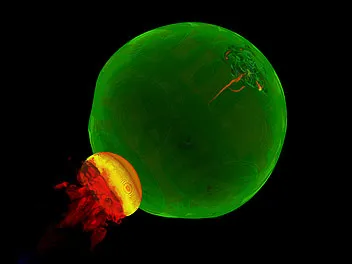
Photo of a Type Ia supernova simulation taken shortly after the moment of detonation. The energy released is equivalent to more than 1000 hydrogen bombs of 100 megatons of TNT each.
Credit: DOE NNSA ASC/Alliance Flash Center