Astronomers, archaeologists, and the "mothers of Calama" search for the calcium of objects distant in time: stars, ancestors, and the disappeared. Notes on the documentary "Nostalgia for the Light" and audio of the talk its director gave today at BAFICI.
Recently, in the multimedia selection 2011-10 I recommended a film about which you can see some previews on YouTube: "Nostalgia for the Light". Yesterday I found out they were screening the documentary as part of the BAFICI 2011 Film Festival and that today, Saturday, was the last chance to see it. I got my ticket and today at 15:00 I was sitting in the huge room 1 (does it fit like 800 people there?) of the Atlas Santa Fe. Before the start, the Chilean Patricio Guzmán, director of this and other documentaries, some of which were being shown at the festival, made an appearance and indicated that, after the screening, he would answer any questions from the audience. The lights faded like when the Sun sets, and the screen illuminated our faces like a full Moon to dazzle us with an unsuspected sensitivity. It is striking to see a large telescope in motion with its clockwork mechanism, and that's how the documentary begins, which travels through several analogies that cut to the deepest core of human feeling. Astronomers, we learn here, look at the past. The light from stars takes time to reach us, despite its speed, because space is immense. The light from the Sun takes eight minutes to arrive on Earth and that from the Moon, one second. But everything takes time to arrive. Everything. In daily life we don't notice that because the separation between us is small compared to the speed of light. But it exists. We literally live in the past. Archaeologists, for their part, also search in the past, traces of our predecessors. The mothers who lost their children, those who were forcibly disappeared during Pinochet's military dictatorship in Chile, also live searching for their past. In the great Atacama Desert, the fabulous telescopes, the stones carved by humans a thousand years ago, and the mothers who wander in search of traces of their children, unite them all. These "mothers of Calama" barely collect a few bones of their children. It is so painful to know that human beings are capable of such atrocity as disappearing our fellow humans, that thinking about their death and burial, their removal and burial in another place so they won't be found, is already inhuman, unspeakable. Those bones, which are similar to those that allow archaeologists to assemble whale skeletons in museums, are made of calcium, like yours and mine. That same calcium that appears in the spectral lines that astronomers capture thanks to the telescopes of Atacama. That past that astronomers and archaeologists scrutinize to know more about Nature is understandable. But the past that the mothers who lost their children dig up is not understood by a part of Chilean society. And what happens in Chile, happens painfully also in many other parts of the world. Here we know it well. Although the scientific past of the seekers of stars and ancestors is very distant on the human scale, the mothers of Calama probe a much closer past, of just decades. And yet it seems that the former searches are more accepted by society and not so much the latter. The nostalgia for the light is that memory that peoples must not forget. And memory has the force of gravity, as is pointed out at the end of the documentary. Without cheap shots, with a human sensitivity on the surface of the lens, Guzmán moves with his interviews with an astronomer, an archaeologist, mothers of the desert, and an astronomer daughter of the disappeared, raised by her grandparents. And also two survivors of a concentration camp: one who gave astronomy courses until they no longer allowed him for fear they would escape thanks to the constellations. And an architect who measured the place with steps and then, upon leaving there, made precise drawings of the site. In the darkness of the cinema one cannot know how others are reacting. But among the autumn coughs, murmurs of emotion, sadness, and pain could be heard. It's that these stories, no matter how much they are told to us, will always hurt us to the bone. Guzmán's Talk Patricio Guzmán thanked the long minutes of applause after the film, somewhat moved. And, microphone in hand, he commented on several interesting things. To mention a few: that it is possible the documentary will premiere in Buenos Aires, that he was promised his films would be shown on Canal Encuentro, that it would premiere in Chile this year with ten copies. But he also shared some details of the making of the interviews and the script with great humility and simplicity. With my recorder I was able to collect a large part of the talk (just a few seconds after it had started) and the audio is already available on the web: From archive.org you can also listen and download. Sources and related links
- Nostalgia for the Light on Patricio Guzmán's website.
- Nostalgia for the Light at BAFICI 2011
- BAFICI: Nostalgia for the Light, by Florencia González
About the images
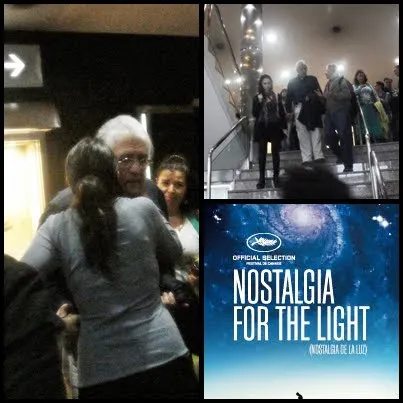
- Composition containing an image of the movie poster along with two photographs taken by me today at the Atlas Santa Fe cinema as director Patricio Guzmán left, still besieged by the audience.