Is global warming a scientific hoax, perhaps the greatest in the history of science? Should we be skeptical? A skeptical look at climate skepticism.
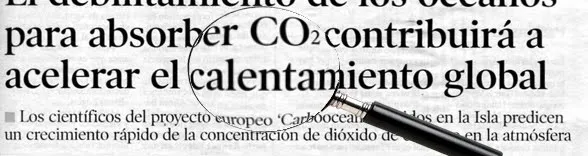
At the end of last year, email accounts of scientists linked to the United Nations Intergovernmental Panel on Climate Change, the IPCC, were hacked. The content of that documentation (obtained in a spurious way, by the way) has fed the conspiracy theorists, those who see conspiracies everywhere.
I certainly despise conspiracy theorists. But that does not mean I should not review the claims about climate change and global warming. It would not be a correct critical attitude to suspect only those who think differently. First we must start at home.
Recently two independent panels reaffirmed the integrity of the IPCC's work. The Netherlands Environmental Assessment Agency conducted a review of the IPCC 2007 report on the impacts of climate change, finding no errors that would have undermined the main conclusions: anthropogenic global warming puts human society at risk.
And also recently, independent researchers from the United Kingdom released their analysis (The Independent Climate Change Email Review, CCE) of the nearly 1000 emails from the Climatic Research Unit (CRU) of the University of East Anglia (UEA).
These reports did find some errors in the research of the scientists in question, related to Himalayan glaciers or the area of the Netherlands below sea level, but not errors regarding the main conclusions of the IPCC.
This will not change the public's skeptical perception of the issue. It will surely receive very little publicity compared to what the case later called Climategate or Climagate received in its time.
What those emails do show is that scientists are also human beings and, like many of us, can say nonsense in private conversations.
But then, who should we believe?
One of the issues that arises in this regard is about the level of knowledge on the subject. Undoubtedly, with greater knowledge we will have better tools for discernment. But does this mean that in order to have an opinion on the matter we must be experts in the field? If only experts could have an opinion and, among them, there are disagreements, who should we believe?
One possibility for analysis lies in the construction of the discourse. Informing oneself (which is a way of gaining knowledge) about what the claims are and how they relate to each other.
Then demand evidence for each of those claims and relationships.
Confront the skeptical arguments with the scientific responses.
Finally, we can see what the models created by the different independent groups of scientists say.
Computer models
These models are usually considered reliable when they manage to replicate known situations. If that happens, then they are trusted to project data.
Although there are divergent models, in general they point to the increase in temperature recently and in the future.
I recommend visiting the EdGCM page. It is an Educational Global Climate Model, that is, software, which can be downloaded for free, on a trial basis, for 30 days. At the core of the program is the GCM (Global Climate Model) developed by NASA's Goddard Institute and has been used by researchers to study past, present, and future climate.
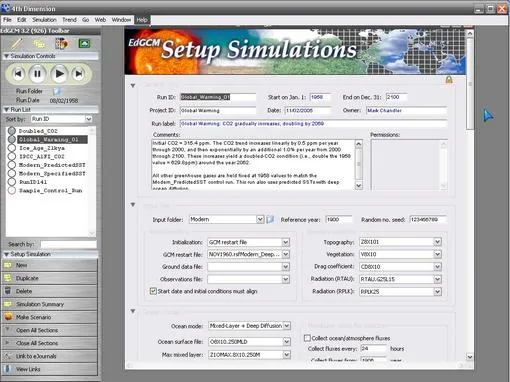
When selecting a pre-created simulation, or creating our own simulation with the parameters we want, we will have to run the program, which will take its good time. In the image below we see a simulation that starts on 12/1/1957 and calculates values day by day until 12/31/2100. It can take a whole day of PC use to finish the simulation, depending on the hardware architecture of our computer.
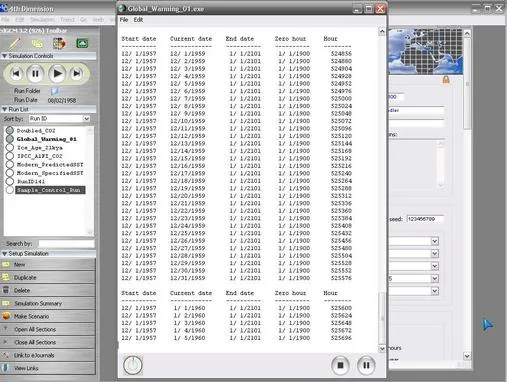
On the EdGCM page there are manuals and video tutorials on using the software.
The "auditors"
Since the public knowledge of this scandal, the intervention of independent "auditors" has also been discussed.
Judith Curry, from the Georgia Institute of Technology, wrote an essay in which she points out, among other things, that "the climate research establishment appealed to its own authority and failed to understand that climategate is primarily a crisis of trust".
That is why "independent auditors" have become popular on the web, through respective blogs and pages like climateaudit.org. Who are they? They claim to be technically educated people. Supposed climate experts who do not produce research, but audit it. For that, they demand public access to data and analyses, things that do not always happen, which regenerates skeptical suspicions.
An open data bank
Yesterday Nature published that at a workshop, to be held between the 7th and 9th of this month, of meteorologists who will meet in Great Britain, they will debate the possibility of gathering the available climate data in a large repository. This is the workshop "Surface Temperature Datasets For The 21st Century".
There is even talk of the possibility that, with that data, citizen science could be done, like with SETI@Home or GalaxyZoo, so that users can help analyze that data.
What data is discussed and which are not?
There are always those who warn of the possible manipulation of any of the scientific claims, or who alert about errors in obtaining or analyzing the data.
However, there does not seem to be much doubt regarding the increase in temperature over the past century. Reservations are placed on how much it has increased or since when the greatest increase has been occurring, but even the most skeptical validate that the temperature has been rising.
Nor is it very debatable that the burning of fossil fuels generates carbon dioxide emissions.
I invite the reader to investigate what data is being discussed. Is the temperature increase or the level of increase being discussed? Is it discussed whether carbon dioxide emissions generate a greenhouse effect or is it doubted whether that is currently happening?
What is the alternative?
We know that the climate changes. And that it does so naturally, due to emissions from volcanoes, livestock, and solar activity.
But it is also clear that human activities affect the environment. Skeptics point out that the effects would not be enough to generate a global change. But then, what do we do?
If today CO2 emissions were not enough to produce a greenhouse effect, their future incremental accumulation, won't it finally be so in the future?
If man's contribution, mainly in industrial processes, were very small in influencing the environment, does it mean that if we do nothing, in the future that contribution will remain small? Or will it increase?
Let's investigate what the alternative is to the scientific stance on what we should do. If what the researchers indicate were false, what is the alternative? Do nothing?
As if that weren't enough, it goes without saying that fossil fuels are not renewable. And this is independent of whether global warming is occurring or not, although much more important if it really is happening.
Who benefits from doing nothing?
The regulation of emissions, which arises from believing that anthropogenic climate change indeed exists, has been called into question. There is talk of lobbying by some alternative energy companies, for example.
And some of this must be true. Where there is money there are always non sanctos interests.
To say this and overlook the great oil lobby, however, would be to see reality with only one eye.
Because the reduction of CO2 emissions mainly affects the oil industry. If we are truly skeptical let's not let this aspect of a complex reality escape. Who benefits from "doing nothing"?
Conclusion
Being skeptical is always welcome. It implies questioning statements, with the aim of validating them. Believing what we are told, just because supposedly they are "reliable sources" or a "general consensus" does not mean they are right.
And it is logical to suspect, because we know some history, that many times there are hidden interests in generating an agenda of topics and beliefs.
But being skeptical is not the same as being conspiratorial.
(By the way, Nora Bär published an interesting article on the subject in La Nación: "La industria de la duda")
Furthermore, I think there are reasons to also be skeptical about the skeptical arguments related to global warming.
I want to invite the reader to be incredulous. Both of those who talk about climate change, and of those who say nothing is happening. Seek information, pay attention to the arguments used, to the alternatives proposed.
Don't be mistaken. My arguments are not scientific. I take those data into account, but I am not doing a deep, methodological, controlled analysis. I understand the claims, some of which come from the scientists themselves. There are different analyses with diverse conclusions. In general, I understand, it is not said that the temperature is not rising at all, but, at most, less than what is said in certain circles. Ultimately, they speak of "exaggerated alarm." And so, what do we do? Nothing?
I think like the average citizen: if the claims about anthropogenic global warming are true, as I think, and we do nothing about it, the negative consequences will end up being paid by future generations. And they will look to the past (that is, to this present) as responsible for their ills due to our inaction.
And that would indeed be the true climate scandal.
Sources and related links
- Wanted: Climate Front-Pager
- Ways To Be Wrong: Climategate, Climate Science And Who Gets A Say
- When Not To Believe The Science Of Scientists
- What is Climategate?
- climate-gate.org/
- Mike’s Nature Trick
- 2009 is the second consecutive year of CO2 reduction from oil
- Cambio climático: Greenpeace
- Skepticalscience.com
About the images
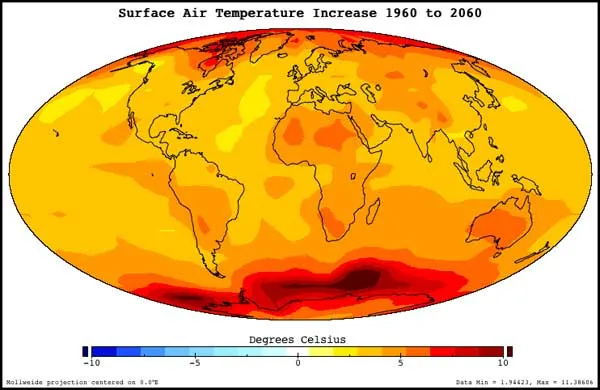
- Annual average global warming per year to 2060 simulated and graphed using EdGCM. Credit: NASA
- EdGCM screenshots. Credit: Chandler, M.A., S.J. Richards, and M.J. Shopsin, 2005: EdGCM: Enhancing climate science education through climate modeling research projects. In Proceedings of the 85th Annual Meeting of the American Meteorological Society, 14th Symposium on Education, Jan 8-14, 2005, San Diego, CA, pp. P1.5. http://edgcm.columbia.edu