To better understand climate change, a new citizen science project proposes using the logs of old ships. Made by the same people behind Galaxy Zoo.
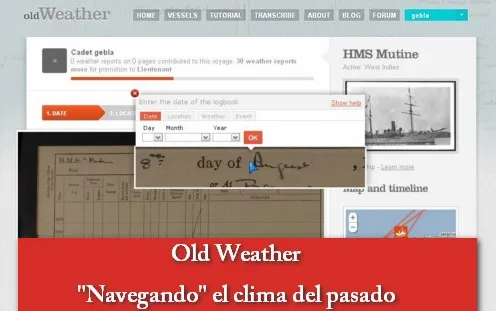
Not all past weather was better. Some scientists think climate change will bring us major headaches in the future.
The Old Weather project does not aim to approve or disapprove statements about global warming. What it presents is the need to collect data because if we want to understand what the weather will be like in the future, we must first understand what it was like in the past.
For this, they have devised a way to collect historical data on climate variability. With more data, the models scientists build to identify patterns will improve their ability to forecast future weather.
The English East India Company, between 1780 and 1830, had ships with instruments used to take measurements that were recorded in their logbooks.
Charles Darwin's voyage on the Beagle is famous, but the ship's captain, Robert Fitzroy and his crew, recorded the weather in their log at each visited point.
The numbers in those records indicate the temperature and pressure at specific locations. To rescue this data, they have obtained these logbooks and scanned them. The writer of these lines works for a company where we do something similar with printed media, to then perform optical character recognition, which allows identifying the content of a digital image.
However, that procedure is only efficient when the typography of a scanned page is regular and very legible. In contrast, when we must read a handwritten page, whose content is also scattered, what we get is an almost illegible set of characters.
That's why the scanned logbooks must have their data "extracted" manually. This is where citizen science and the power of the masses can help.
Each logbook, of course, will be looked at by many people, so if what we think we saw wasn't exactly what was written, it will be noticed in the quantity of records.
How many logbooks are there? It is estimated that in England alone there are 250,000, but many more if we add those that may exist in America, in Asia.
How do I participate?
If we already have an account on ZooUniverse (that is, on Galaxy Zoo or any of the other projects) we use the same account to enter this project. If we don't have an account, we create one.
We can immediately start transcribing/classifying data from logbooks. We might get any ship, not necessarily the same one. There is a tutorial, in English, but it basically works like this:
The idea is to identify 4 types of data in each logbook:
-Date
-Location
-Weather records
-Other data
When we start transcribing we will find a page where we see a photograph of a logbook. On the right we will see the ship's name.
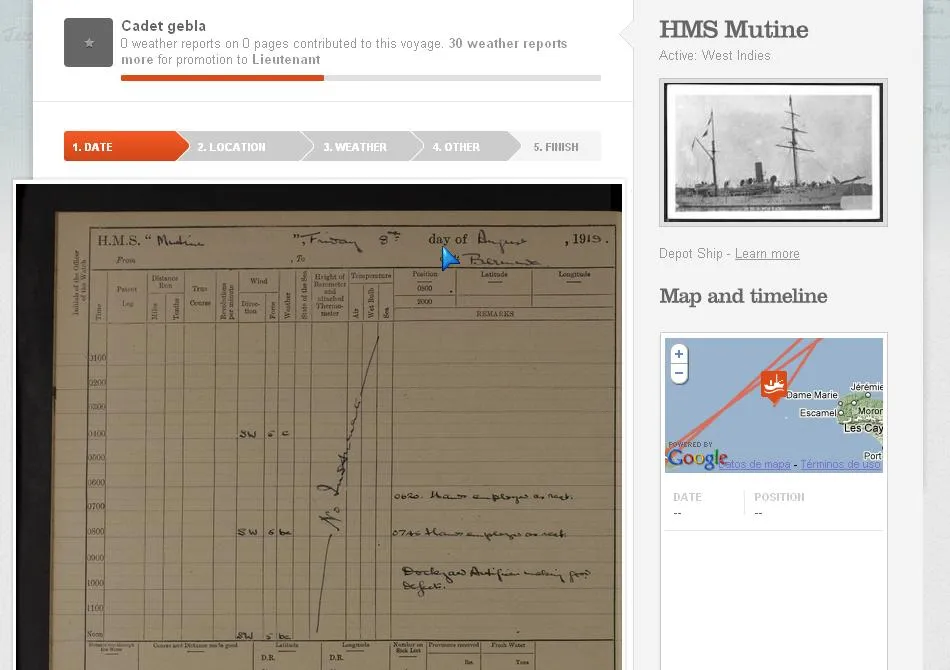
When we click with the mouse on the image, a small rectangular window with two parts will appear. The top part has a series of tabs, corresponding to each of the data types to transcribe.
Below we will see a close-up (zoom) of the part of the logbook we clicked on.
The idea is to position ourselves on the place where we think the data to transcribe is, view it with zoom, like a magnifying glass, and transcribe it.
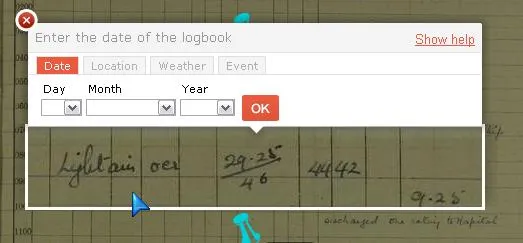
Let's start with the date
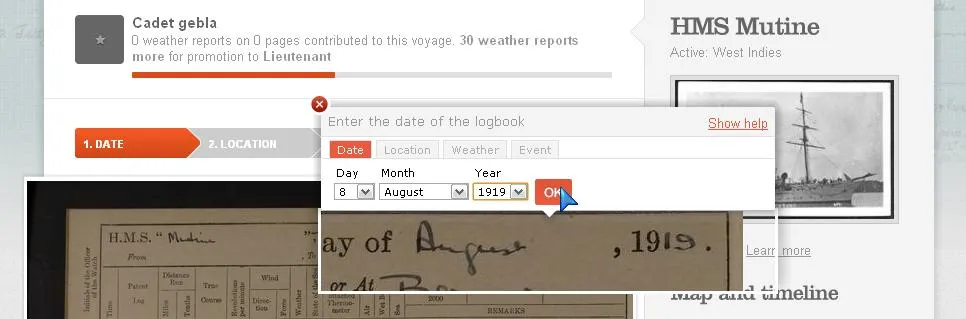
I am on a logbook of the HMS Mutine. As in the vast majority of logbooks, both the date and the position are at the top right.
With a quick glance I already find the word "day", so I position the mouse there. The little window opens, which by default is in the position to take the date (on the appropriate tab).
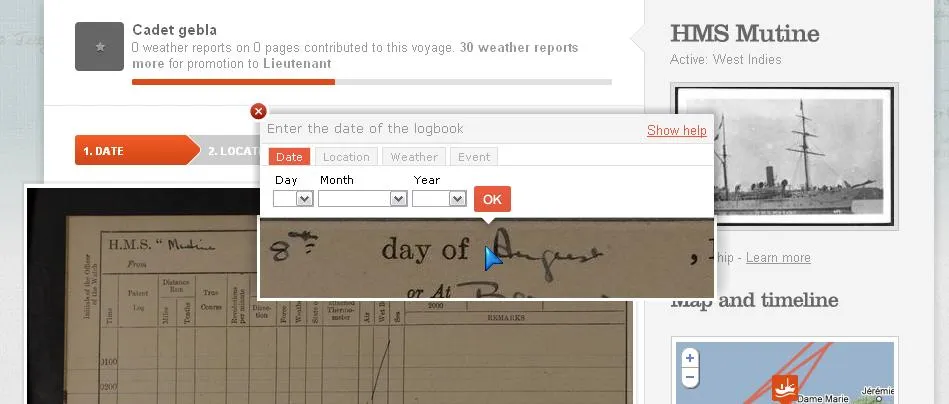
Once the data is entered, I click Ok. If I'm not sure about some data, I put what seems most similar. Later it's possible to edit. If some data is missing, I don't put it.
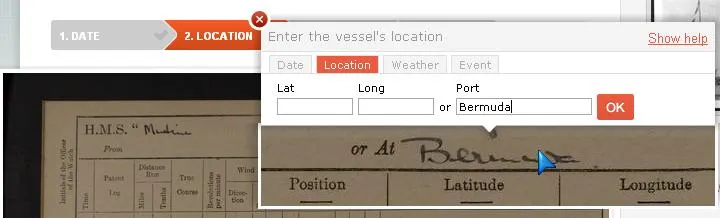
Place
The location is usually right below the date. It may appear as Latitude and Longitude, although in the not many transcriptions I've done so far I never had these coordinates, but the name of a port. If we are not sure, we can do an internet search with the name we think it is.
Weather records
Below the date and place a table begins. The columns from the middle to the right contain weather data. Not all rows, only some. The rows indicate the time.
It's possible that not all the necessary data is there, in which case it doesn't matter, we will indicate the ones that are.
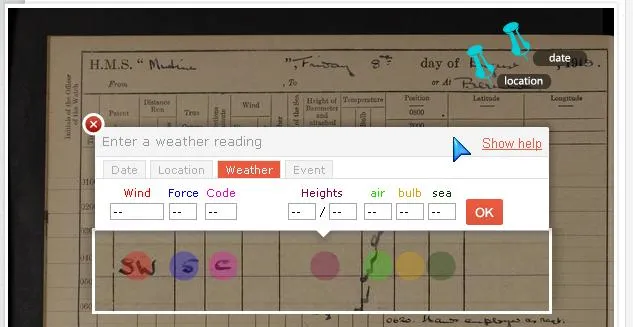
The colored dots and the columns
Immediately after completing the place, when we click the mouse button again, the little window changes somewhat. In the zoom part, colored circles are shown and above there are fields for: wind, force, code, heights, air, bulb, sea. Each word also has its own color.
The idea is that we match the little circles with the columns of the record.
For example, in this case I have no more data than the wind data:
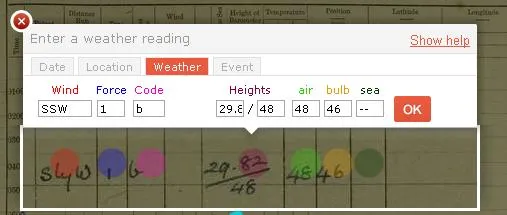
Here with more data. The colored circles help us not to make mistakes.
Other data
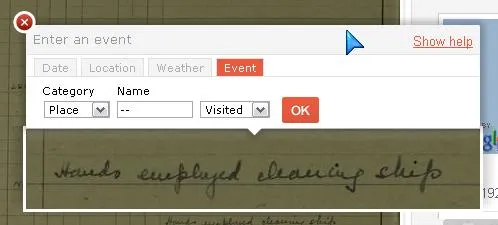
Then we can see the last column where things were noted that might not matter for this purpose, but some perhaps do.
It is very common to note "Hands employed cleaning ship", that is "Hands employed cleaning the ship", or things like that.
What things do matter?
Everything related to the weather. According to the site administrators, mention of volcanoes, icebergs, etc. is especially important. Also mention of crew members, as they also aim to make a roster of each ship's crew.
And that's it, we click the red button on the right ("I've finished with this page") and we will have finished with that page.
If we want to edit a piece of data we can position the mouse over one of the data points and the "edit" option will appear. It is also possible to return to already finished transcriptions through our profile.
What do all these data mean?
Let's start by saying that the site has a forum where many of the questions we might ask have already been asked. For example, what do the codes mean?
It's clear that the letters that go in "Wind" refer to its direction, the cardinal points (North, North-Northeast, South, etc.).
On English Wikipedia there is a list of the codes used. In some cases it seems to be written "N by N". Perhaps the "by" would not be decipherable if someone doesn't tell us, but now that we know, it will seem obvious to us.
Weather codes
In the first weather data we have the direction, then the wind force (which seem to be real numbers from 0 to 10 (if we see something like 45, it's probably 4.5) and then a code of one to three letters.
The code denotes the general state as "cloudy", "snow", "fog", "rain".
Each word is associated with a letter and it's possible to use combinations. In the forum there is a list of codes and their meaning.
The combination "ocr" would mean "overcast, clouds, rain", that is, "overcast, clouds, rain".
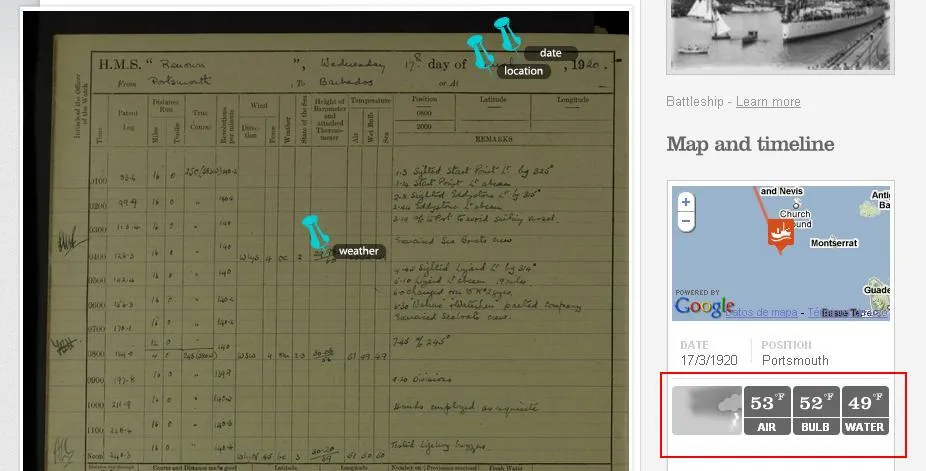
On the right side, as we record data, they appear with some icon that seems to match the code indicated by us. To show this I made a record with the code "l" (el), although in the log it appeared "oc". I did it on purpose to show the result.
First I put the code as you see here:
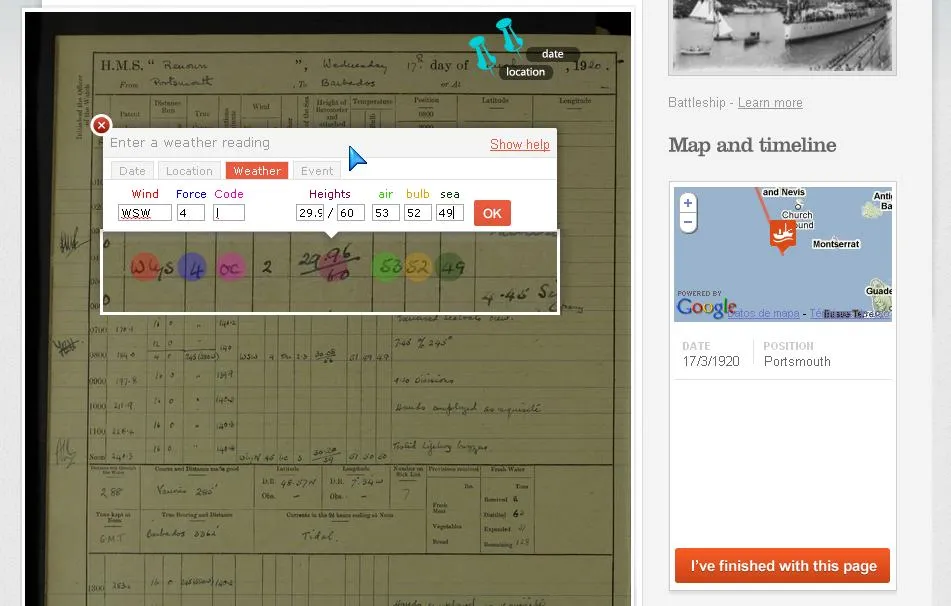
And once I finish it, on the right side, look at the part I marked in red: l (el), according to the previous code list, would mean "Lightning", that is, "lightning or flashes". And that's how the icon on the side seems to show:
It's not that it's necessary to know what the codes mean to transcribe them, but I think it's better to know what we are doing. On the other hand, by having an idea of the most used possible codes, we can save time trying to decipher what characters they are. For example, it seems very strange to use "x" as a code.
The reward
There are no prizes for doing citizen science. It's an activity we will do if we think it's worth it, without expecting any reward. In this case, there is a small "incentive". On each ship on which we transcribe logs we will start as "cadets" and as we progress we can rise in rank to Lieutenant and then to Captain. For those who are competitive it can be a motivation...

Sources and related links
About the images
- Old Weather screenshots.