And finally I went to see Inception. Is it worth going to see? Here I give my opinion.
We are faced with a Hollywood blockbuster, but one of those few that dare to present a complex issue. Like The Matrix and such. I agree with Inti Acevedo that, unlike what may have happened to us with the Wachowski brothers' film, with this Christopher Nolan production we go to the movies being less naive.
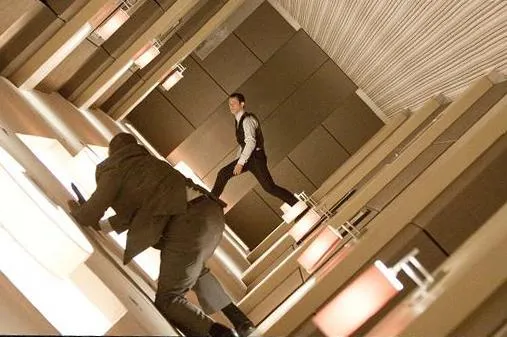
The film, aside from the comments I will make below, is stunning. There are several scenes related to physics in the film, such as those related to gravity, which influenced the work of costume designer Jeffrey Kurland and his department. Kurland notes: "For those scenes we couldn't design garments with a natural fall because, without gravity, they would be floating. We had to do things like put wire in the shoelaces so they would stay straight, or staple the men's ties so they wouldn't fall randomly."
I'm not going to reveal the plot here by telling it in great detail, but anyone who wants to see the film should refrain from continuing to read. I can say that, as Daniel Marín has said, the film will not leave you indifferent.
The film narrates how a team of people "makes a living" through what is called "shared dreams." In this way, with certain futuristic technology, they can "enter" other people's dreams. The intention is to discover some privileged piece of information in those dreams. That kind of information we try to hide from others, but which we might reveal in a dream.
However, the crux of the matter is not about "extracting" information, but about "planting" it. Sowing an idea very deep in a person's unconscious, with the goal that it grows and develops to achieve a specific end.
In this case, one businessman has serious competition from another. The second is ill and will leave his empire to his son, with whom he has a conflictive relationship. "Planting" the idea that he should not continue his father's empire could result in the son dissolving that corporation, to the satisfaction of the "client."
This makes one think of two things, at least.
How do ideas originate in our brain? Why do we think the way we do?
The second issue I want to focus on is the objective. In the cited case, the film's plot, the benefit is as clear as it is material.
We, that is, you the reader, others, me, have ideas. Some believe in God, others (like me) do not. Some believe that human beings can manipulate a certain kind of energy, with consequences in the real world, but of a non-physical character, very different from electricity for example.
There are those who believe in action at a distance, in spiritual worlds, fairies, elves, demons, or in great world conspiracies for a few to dominate the rest.
Why do we have those ideas? Is it possible that someone "planted" them in us?
The way the film in question uses to sow these ideas, through dreams within dreams within dreams, leading the subject to what is called the "subconscious," does it have any correlation in reality? What about subliminal messages, for example?
How to recognize a "planted idea" from reality?
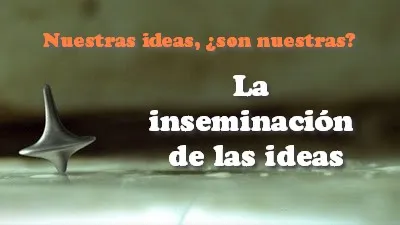
In the film, being able to recognize reality is vital. To establish whether what is being experienced is real or dreamed, they use what they call a "totem", a very personal object whose physical properties only each one knows, so that if the object respects those properties, they know they are experiencing reality. DiCaprio's totem (Cobb, the central character) is a spinning top.
That is, if we observe that objects behave as we know they do, it is reality. In the film's dreams, reality is simulated, although there are "clues" that it is not real, for example in the physical behavior of things. Which can certainly be understood as a metaphor for the scientific method.
It's true, and symbolic interpretations (see ccv's comment on cine5x) of the film's "signs" are already swarming around. Let's say it is just that, a film, and not a documentary about how things are. Thus, we can interpret almost anything from the plot, whether it is a symbolism of the decadence of our society, or that it is relatively "easy" to implant ideas in the subconscious of the unsuspecting.
Moreover, we can find another simile with critical thinking, through the "defenses." Since this knowledge exists about how to extract ideas, it is possible to teach it to those who have great and powerful secrets to keep. So they are forewarned in case someone wants to "extract" that information from them.
In some way, something similar happens with those of us who try to warn others not to have ideas that some of us consider absurd "implanted" in them, like those mentioned before.
Video: Third trailer for Inception (Spanish)
http://www.youtube.com/watch?v=bkJaWzaivqM
The objective
As I said before, the second issue I think about is the objective of wanting to "implant" an idea in another person.
And, as a consequence, the possibility that we human beings have of letting ourselves be influenced by certain ideas.
It is clear that the first can arise, if honest, from that old Platonic idea of the Myth of the Cave and the need to teach others what we have learned.
It is also true that, if not with an honest intention, it can be for some kind of personal or group convenience.
But why do we let certain ideas be planted in us? Perhaps to be happy. It is better, some will say, to believe that this material life is only transitory. That we are something more than flesh to rot. That there are other, spiritual worlds waiting for us, life after life.
Is it necessary to suppose the existence of spiritual dimensions, beings from other worlds, etc., to find meaning in our lives?
Isn't this that we can certainly see, touch and experience enough to give meaning to our life?
If the meaning is in "learning" life after life, why not start in this one we live and learn something, instead of blinding ourselves to seeing reality?
If the meaning of those other spiritual lives is also to help other "spirits" less evolved, why not start now by helping the one next to us who is dying of hunger or ignorance?
That is, if helping, collaborating, teaching, learning, forming part of those "spiritual" objectives, is it necessary to appeal to an unverifiable reality?
I believe not, that this life, imperfect, mortal, factual, sensible, can give us all the meanings necessary for our life, without believing in that which cannot be verified.
I don't know, nobody knows, what this life, this universe, holds in store for us. But I think it is much better to cling to what we know and to what we will be able to know in the future, to find meaning in life, rather than believing in what in other contexts we wouldn't buy. Do you believe that pink elephants fly?
And, furthermore, we could change something. In ourselves and in others. But for that we must do it now. Perhaps there are other lives, another type of existence. But, if there aren't any, at least we will have left something here.
These are some ideas that have been inseminated in my brain. But I don't want to inseminate them in yours, dear reader. Be critical of these thoughts, tear them down, change them, modify them. Do that with these ideas. With all of them. Always (when you can).
Sources and related links
- The origin of ideas
- Official Spanish site for Inception
- Reven's critique of Inception
About the images
- The images belong to Warner Bros.